President Murmu Commends Reserve Bank Role in National Economy
Source:Indian Express ↗
Why It Matters
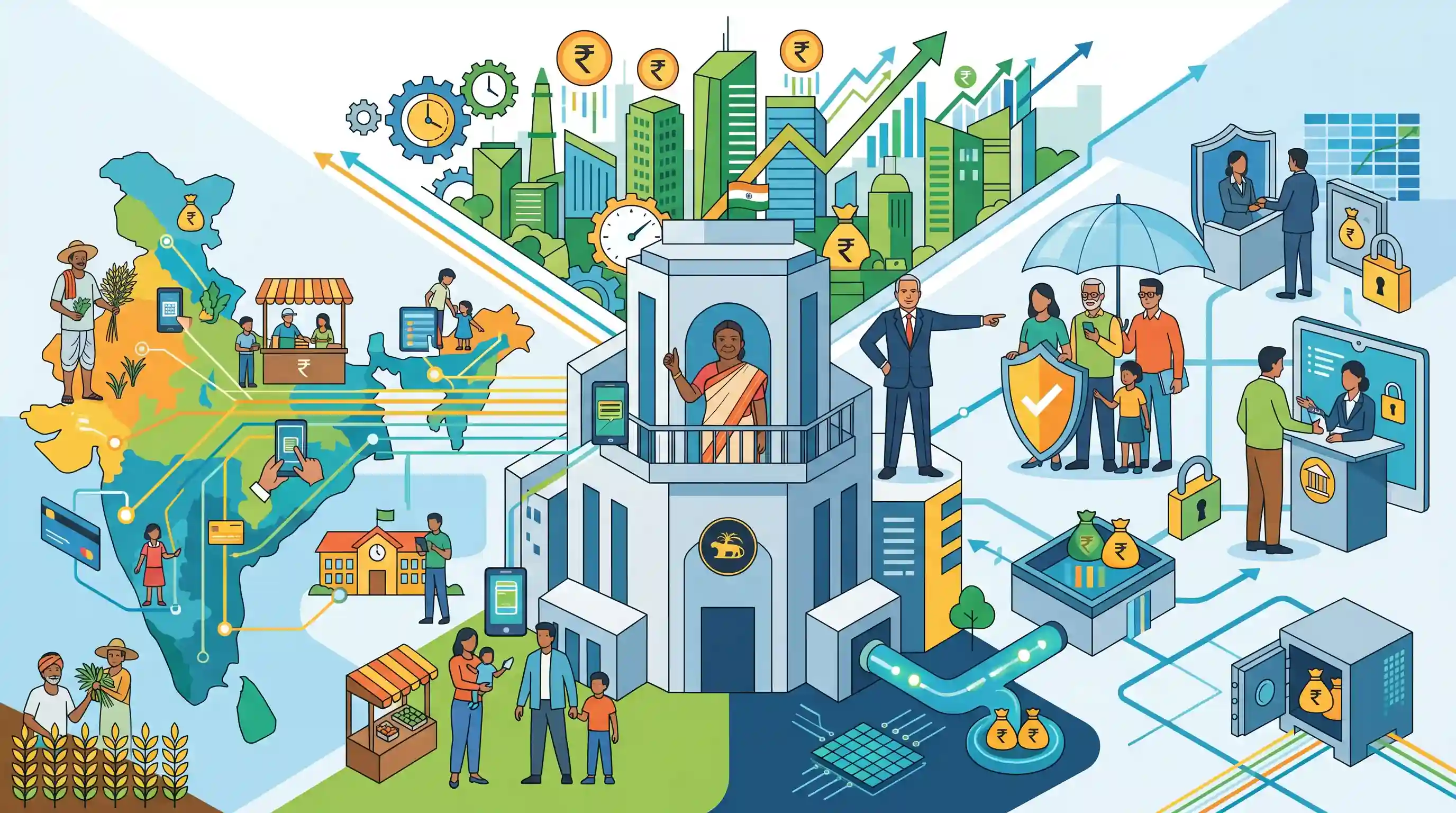
The role of the RBI extends beyond macroeconomic management to ensuring consumer trust and financial inclusion. Enhancing customer protection is crucial for evaluating banking sector reforms and addressing challenges in the contemporary digital banking environment.
Summary
President Droupadi Murmu commended the Reserve Bank of India (RBI) for being at the heart of the country's impressive economic growth story. Emphasizing the central bank's evolving role, RBI Governor Sanjay Malhotra stated that the institution will continuously strive to enhance customer services and ensure robust protection for consumers in the banking sector.
Key Points
- President Droupadi Murmu highlighted the central role played by the Reserve Bank of India in India's rapid economic growth and stability.
- RBI Governor Sanjay Malhotra emphasized the central bank's commitment to significantly improving customer service standards across the financial sector.
- Strengthening consumer protection mechanisms in banking remains a strategic priority to ensure trust and foster financial inclusion.
- The statements reinforce the RBI's dual focus on driving macroeconomic growth while safeguarding the interests of individual banking customers.
Important Terms
Reserve Bank of India (RBI)

India's central bank and regulatory body for the banking system, established in 1935. It manages monetary policy, currency issuance, and maintains financial stability to support economic growth.
UPSC context
GS Paper III: Indian Economy. Key institution for monetary policy, inflation control, and financial sector regulation.
Consumer Protection (in Financial Services)
A framework to safeguard bank customers from unfair practices and fraud. It centers on the 'Charter of Customer Rights,' ensuring fair treatment, transparency, and effective grievance redressal.
UPSC context
GS Paper III: Banking Sector Reforms. Tests understanding of regulatory measures to ensure financial integrity and consumer trust.
Integrated Ombudsman Scheme (RB-IOS)
The 'One Nation One Ombudsman' initiative launched in 2021 to provide a cost-free, simplified grievance redressal mechanism for customers of banks, NBFCs, and digital transaction entities.
UPSC context
GS Paper II: Governance/Grievance Redressal. Essential for understanding institutional mechanisms that improve service delivery and accountability.
Financial Inclusion
The process of ensuring access to appropriate financial products and services—such as credit, insurance, and payments—at an affordable cost to all sections of society.
UPSC context
GS Paper III: Inclusive Growth. A core theme involving schemes like PMJDY and last-mile banking connectivity.
Digital Payments (UPI)
Electronic transaction systems like the Unified Payments Interface (UPI) that facilitate instant, secure, and low-cost fund transfers, positioning India as a global leader in fintech.
UPSC context
GS Paper III: Science & Technology/Economy. Tests the impact of technology on financial accessibility and modernization.
Viksit Bharat 2047
The vision of the Government of India to transform the country into a fully developed nation by the 100th anniversary of its independence in 2047.
UPSC context
GS Paper III: Indian Economy and Development. Represents the long-term strategic roadmap for India’s socio-economic transformation.
Prelims Trap
The RBI Integrated Ombudsman Scheme is a statutory mechanism governed by the Consumer Protection Act, 2019.
The RB-IOS operates under the Banking Regulation Act 1949, RBI Act 1934, and Payment & Settlement Systems Act 2007, not the Consumer Protection Act.
Static Concepts Connected
What is the RBI Integrated Ombudsman Scheme (RB-IOS), 2021?
- One Nation-One Ombudsman: Amalgamated three separate ombudsman schemes for Banks, NBFCs, and Digital Transactions into a single, unified framework.
- Statutory backing: Formulated using RBI's powers under Section 35-A of the Banking Regulation Act, 1949 and the Payment & Settlement Systems Act, 2007.
- Appellate authority: The Executive Director in charge of RBI’s Consumer Education and Protection Department acts as the final Appellate Authority.
What is the "Right to Suitability" in RBI's Charter of Customer Rights?
- Needs analysis: Requires banks to conduct a needs analysis to ensure financial products align with a customer's specific risk appetite and financial capacity.
- Preventing mis-selling: Specifically designed to prevent banks and financial institutions from mis-selling complex investment and insurance products to uninformed retail customers.
Cross-Topic Patterns
Consumer Protection & Financial Inclusion
Enhancing customer protection prevents mis-selling of complex products to vulnerable populations, directly sustaining the trust required for the success of PMJDY and broader digital financial inclusion efforts.
Digital payments, cybersecurity & data laws
With the exponential rise in UPI and digital credit, RBI’s consumer protection mandate increasingly overlaps with national cybersecurity regulations (CERT-In) and the Digital Personal Data Protection (DPDP) Act.

Expect a Prelims multi-statement question on the RBI Integrated Ombudsman Scheme's expanded jurisdiction over NBFCs and digital platforms.
Linked PYQs · 4
Linked PYQs · 4
- 2022MainsGS3
Is inclusive growth possible under market economy ? State the significance of financial inclusion in achieving economic growth in India.
- 2025PrelimsGS1
Which of the following are the sources of income for the Reserve Bank of India? I. Buying and selling Government bonds II. Buying and selling foreign currency III. Pension fund management IV. Lending to private companies V. Printing and distributing currency notes Select the correct answer using the code given below.
- 2022PrelimsGS1
With reference to the Indian economy, consider the following statements: 1. If the inflation is too high, Reserve Bank of India (RBI) is likely to buy government securities. 2. If the rupee is rapidly depreciating, RBI is likely to sell dollars in the market. 3. If interest rates in the USA or European Union were to fall, that is likely to induce RBI to buy dollars. Which of the statements given above are correct?
- 2022PrelimsGS1
In India, which one of the following is responsible for maintaining price stability by controlling inflation?
