Macroeconomic Resilience of Indian Economy Amid Headwinds
Source:Indian Express ↗
Why It Matters
Understanding the factors driving India's economic resilience amidst global headwinds is a core component of the GS3 syllabus (Indian Economy). Aspirants must understand the role of domestic macroeconomic fundamentals and the RBI's monetary policy in balancing inflation and growth.
Summary
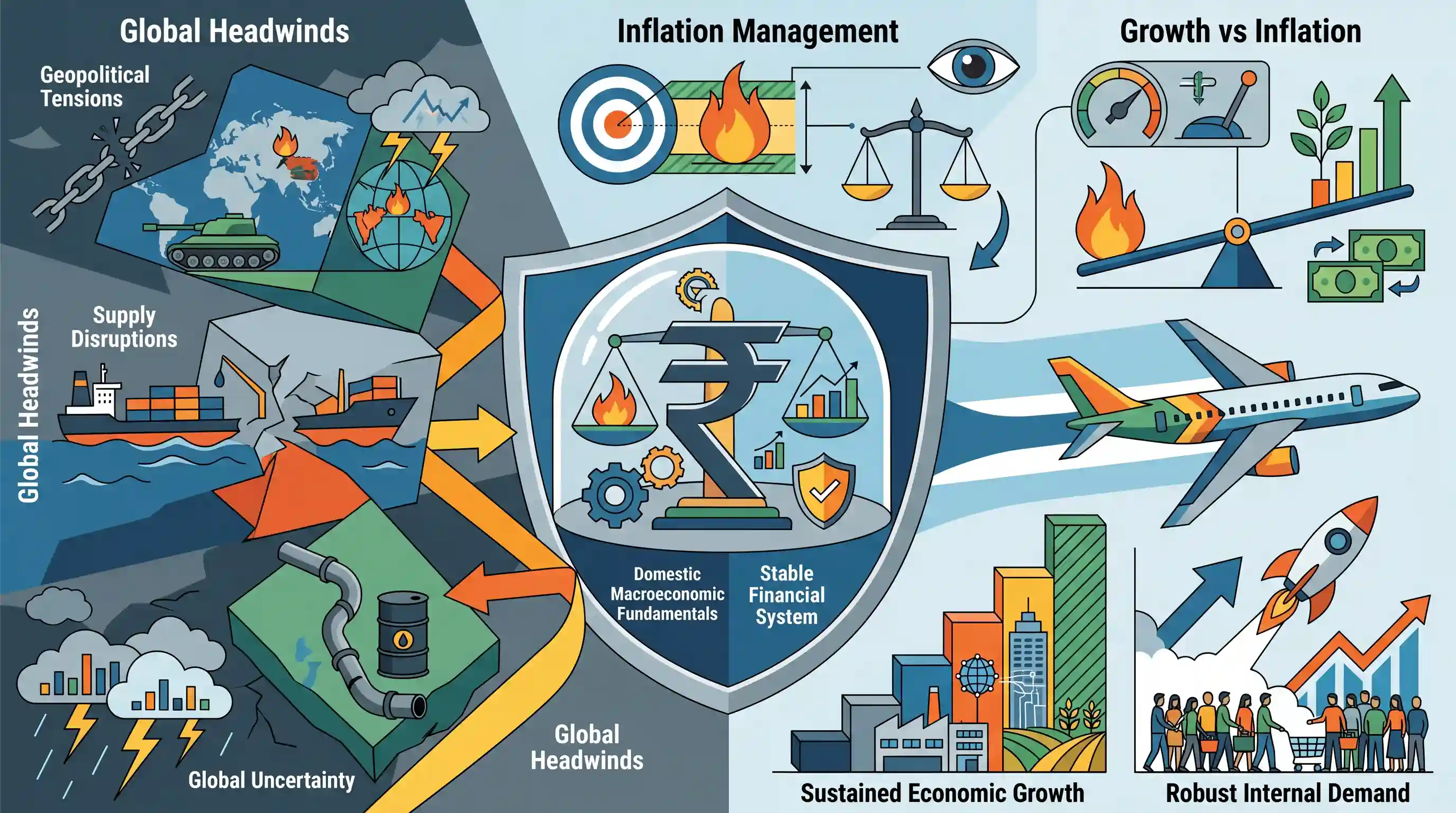
An article published in the RBI bulletin underscores the resilience of the Indian economy amidst elevated global uncertainty. Driven by strong domestic macroeconomic fundamentals, robust internal demand, and a stable financial system, India has managed to navigate global headwinds including geopolitical tensions and supply disruptions. The central bank emphasizes that its monetary policy remains vigilant to manage inflation expectations while simultaneously fostering sustained economic growth, enabling the economy to weather external shocks effectively.
Key Points
- The RBI bulletin highlights that the Indian economy continues to remain resilient despite a highly uncertain global economic environment characterized by geopolitical conflicts and supply chain constraints.
- Domestic macroeconomic fundamentals, robust domestic demand, and a sound financial sector are anchoring this resilience and sustaining economic growth.
- The Reserve Bank of India's monetary policy remains focused on managing inflation to align with its target while ensuring that growth is supported.
- While global headwinds pose potential downside risks to the growth outlook, India's proactive policy interventions and structural strengths provide an effective buffer.
Important Terms
Reserve Bank of India (RBI)

India's central bank and regulatory body responsible for maintaining monetary stability, regulating the banking system, and managing the country’s foreign exchange reserves and currency issuance.
UPSC context
GS Paper III (Economy). Essential for understanding monetary policy, banking regulation, and the 'Lender of Last Resort' function.
Monetary Policy Committee (MPC)
A six-member statutory body empowered by the RBI Act, 1934, to determine the policy repo rate required to achieve the inflation target.
UPSC context
GS Paper III. Tests knowledge of institutional frameworks for price stability and growth balancing.
Repo Rate
The fixed interest rate at which the RBI lends overnight liquidity to banks against the collateral of government and other approved securities.
UPSC context
Prelims & GS Paper III. Primary tool for liquidity management and inflation control.
Consumer Price Index (CPI)
A measure that examines the weighted average of prices of a basket of consumer goods and services, serving as India's primary inflation anchor.
UPSC context
GS Paper III. Critical for understanding the distinction between headline and core inflation in policy targeting.
Macroeconomic Stability
A situation where an economy's key indicators—inflation, fiscal deficit, and exchange rates—remain stable and predictable, allowing for sustainable growth and shock absorption.
UPSC context
Mains GS Paper III. Tests ability to analyze India’s resilience against global headwinds and geopolitical shocks.
Foreign Exchange (Forex) Reserves
External assets held by the central bank, including foreign currencies, gold, and SDRs, used to back liabilities and influence monetary policy.
UPSC context
Prelims & GS Paper III. Vital indicator of external sector strength and import cover.
Headline Inflation
The total inflation within an economy, including volatile commodities like food and energy, which the RBI targets at 4% (±2%).
UPSC context
GS Paper III. Key to understanding the RBI's Flexible Inflation Targeting framework.
Prelims Trap
"The RBI effectively controls supply-driven inflation through monetary policy tightening."
Monetary policy primarily addresses demand-pull inflation. Rate hikes are largely ineffective against supply-side (cost-push) inflation like sudden food or fuel shocks, which require fiscal/administrative interventions.
Static Concepts Connected
What is the statutory framework for Flexible Inflation Targeting (FIT) in India?
- Target Band: Set at 4% with a tolerance band of +/- 2% (2% to 6%) for a period of five years.
- Setting Authority: The inflation target is determined by the Government of India, in consultation with the Reserve Bank of India, under the RBI Act.
- Failure Criteria: The RBI is deemed to have failed if average inflation breaches the upper or lower tolerance limits for three consecutive quarters.
What indicators constitute India's strong "macroeconomic fundamentals"?
- External Buffers: Robust foreign exchange reserves that shield the rupee against capital flight and global financial spillovers.
- Sustainable CAD: A narrow Current Account Deficit (CAD), stabilized by strong software services exports and steady remittance inflows.
- Fiscal Consolidation: A committed glide path toward reducing the fiscal deficit, anchoring market confidence in sovereign debt.
Cross-Topic Patterns
Imported Inflation & Global Geopolitics
Supply chain disruptions from geopolitical conflicts cause imported cost-push inflation, complicating the RBI's ability to maintain the delicate growth-inflation trade-off using traditional rate hikes.
Twin Balance Sheet Advantage
India's current resilience relies heavily on the shift to a 'Twin Balance Sheet advantage'—record-low bank NPAs and deleveraged corporate balance sheets acting as a shock absorber against external financial spillovers.

Expect a 2026 prelims question linking imported inflation, forex buffers, and the limitations of the MPC in addressing supply-side shocks.
Linked PYQs · 5
Linked PYQs · 5
- 2024MainsGS3
What are the causes of persistent high food inflation in India? Comment on the effectiveness of the monetary policy of the RBI to control this type of inflation.
- 2022PrelimsGS1
With reference to the Indian economy, consider the following statements: 1. If the inflation is too high, Reserve Bank of India (RBI) is likely to buy government securities. 2. If the rupee is rapidly depreciating, RBI is likely to sell dollars in the market. 3. If interest rates in the USA or European Union were to fall, that is likely to induce RBI to buy dollars. Which of the statements given above are correct?
- 2018MainsGS3
How would the recent phenomena of protectionism and currency manipulations in world trade affect macroeconomic stability of India?
- 2019MainsGS3
Do you agree with the view that steady GDP growth and low inflation have left the Indian economy in good shape? Give reasons in support of your arguments.
- 2021PrelimsGS1
With reference to Indian economy, demand-pull inflation can be caused/ increased by which of the following? 1. Expansionary policies 2. Fiscal stimulus 3. Inflation-indexing wages 4. Higher purchasing power 5. Rising interest rates Select the correct answer using the code given below.
