Fiscal deficit management and central bank dividend payout mechanisms
Source:Indian Express ↗
Why It Matters
This event is a classic illustration of the intersection between a central bank's balance sheet management and sovereign fiscal policy. It provides practical context to UPSC concepts like the Economic Capital Framework (Bimal Jalan Committee), Contingent Risk Buffer, forex interventions, and how non-tax revenue impacts the fiscal deficit and bond yields.
Summary
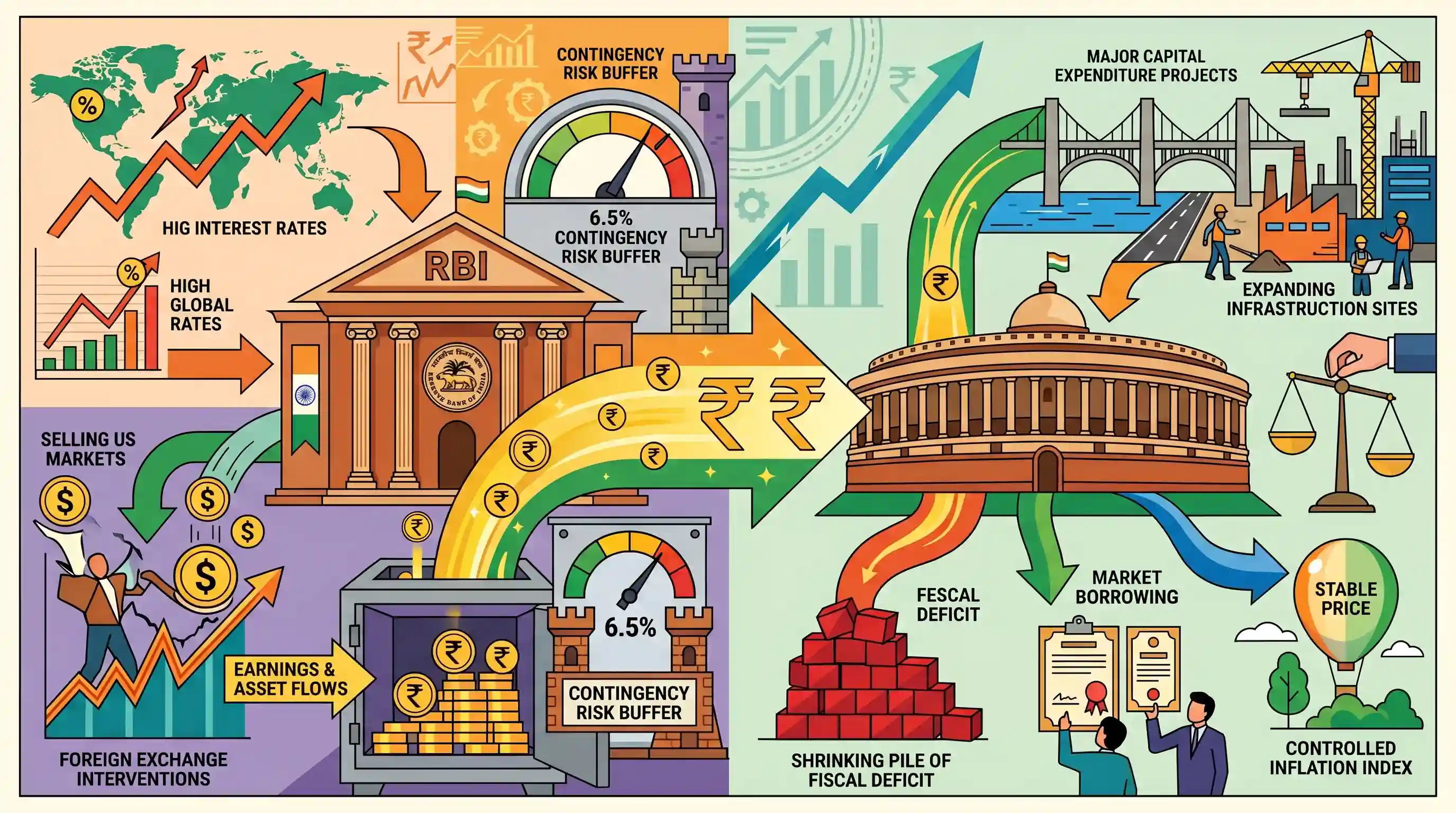
The Reserve Bank of India (RBI) has authorized a record surplus transfer of Rs 2.86 lakh crore to the central government for the fiscal year 2026. This significant payout was primarily driven by the RBI's strategic interventions in the foreign exchange market—selling dollars to stabilize a depreciating rupee—and robust earnings from foreign assets amid high global interest rates. Simultaneously, the RBI fortified its own balance sheet by raising its Contingency Risk Buffer (CRB) to 6.5%, adhering to the Economic Capital Framework. For the government, this fiscal windfall offers crucial macroeconomic leeway to manage the fiscal deficit, reduce market borrowing, and sustain capital expenditure without stoking inflation.
Key Points
- The RBI board approved a historic surplus transfer of Rs 2.86 lakh crore to the central government for FY26, which is over 130% higher than the budgeted estimate.
- The record surplus is largely attributed to RBI's significant dollar sales to manage rupee depreciation and higher interest income from foreign currency assets due to elevated global interest rates.
- The RBI has augmented its Contingency Risk Buffer (CRB) to 6.5% of its balance sheet, the upper limit recommended by the Bimal Jalan Committee's Economic Capital Framework (ECF).
- This windfall transfer will provide the government with substantial fiscal flexibility, aiding in meeting fiscal deficit targets, potentially reducing gross market borrowing, and softening bond yields.
Important Terms
Economic Capital Framework (ECF)

A policy mechanism determining the optimal level of risk provisions and profit distribution from the RBI to the Central Government, balancing central bank resilience with fiscal needs.
UPSC context
GS Paper 3: Indian Economy; tests understanding of institutional finance, resource mobilization, and the RBI-Government fiscal relationship.
Contingency Risk Buffer (CRB)
A specific reserve within the RBI's capital intended to safeguard against unforeseen monetary, financial, credit, and operational risks; typically maintained between 5.5% and 6.5% of its balance sheet.
UPSC context
GS Paper 3: Monetary Policy; relevant for understanding risk management in banking and central bank autonomy.
Surplus Transfer
The annual transfer of residual net income from the RBI to the central government under Section 47 of the RBI Act, 1934, after accounting for expenses and provisioning.
UPSC context
GS Paper 3: Resource Mobilization; tests knowledge of non-tax revenue sources and their impact on the national budget.
Bimal Jalan Committee
An expert committee (2018) that established the current rules for the RBI's capital reserves, specifically recommending the 5.5%–6.5% CRB range and a rule-based surplus distribution policy.
UPSC context
Prelims/Mains: Important committees; tests historical and technical context of Indian economic reforms.
Fiscal Deficit
The shortfall in a government's income compared to its spending. RBI surplus transfers serve as a non-tax revenue windfall that helps the government reduce this gap without extra borrowing.
UPSC context
GS Paper 3: Fiscal Policy; central to discussions on macroeconomic stability and deficit consolidation.
Foreign Exchange Intervention
The central bank's actions in the currency market—such as selling dollars to stabilize the rupee—which can generate significant realized trading gains, contributing to the annual surplus.
UPSC context
GS Paper 3: External Sector; tests knowledge of exchange rate management and its fiscal side-effects.
Prelims Trap
"The surplus transferred by the RBI is classified as a Capital Receipt in the Union Budget."
This is a trap. The RBI surplus transfer is classified as non-tax revenue under Revenue Receipts, not a Capital Receipt, because it neither creates a liability nor reduces government assets.
Static Concepts Connected
What is the RBI's Economic Capital Framework (ECF)?
- Origin: Adopted in 2019 based on the Bimal Jalan Committee recommendations to manage the central bank's risk capital.
- Objective: Provides a transparent methodology to determine how much risk capital the RBI retains and how much surplus profit is transferred to the government.
- CRB limits: Mandates maintaining a Contingency Risk Buffer (CRB) strictly between 5.5% and 6.5% of the RBI's total balance sheet.
How does the RBI generate surplus income from forex operations?
- Dollar sales: The RBI realizes exchange gains when it sells US dollars from its reserves to stabilize the rupee at a higher exchange rate than its historical acquisition cost.
- Interest income: The RBI earns interest income by investing its foreign currency assets in safe, high-yielding foreign sovereign bonds, such as US Treasuries.
- Statutory transfer: Unlike commercial entities, RBI pays no income tax on these earnings. After transferring to the Contingency Risk Buffer, the remaining profit goes to the government.
Cross-Topic Patterns
Surplus transfers and bond yield softening
A massive non-tax revenue windfall reduces the government's market borrowing needs. Lower borrowing supply pushes government bond prices up and yields down, directly lowering economy-wide borrowing costs.
Forex interventions and domestic liquidity absorption
When the RBI sells dollars to arrest rupee depreciation, it simultaneously sucks equivalent rupees out of the domestic market. This inadvertently tightens domestic liquidity, impacting monetary policy transmission.

Expect a 2026 prelims question linking RBI's CRB limits (5.5-6.5%), surplus classification as non-tax revenue, and its bond yield impact.
Linked PYQs · 2
Linked PYQs · 2
- 2022PrelimsGS1
With reference to the Indian economy, consider the following statements: 1. If the inflation is too high, Reserve Bank of India (RBI) is likely to buy government securities. 2. If the rupee is rapidly depreciating, RBI is likely to sell dollars in the market. 3. If interest rates in the USA or European Union were to fall, that is likely to induce RBI to buy dollars. Which of the statements given above are correct?
- 2019PrelimsGS1
Which one of the following is not the most likely measure the Government/RBI takes to stop the slide of Indian rupee?
