Reserve Bank of India Surplus Transfer and Fiscal Deficit
Source:The Hindu ↗
Why It Matters
The RBI's dividend payout is a significant component of the government's non-tax receipts. Understanding the RBI's balance sheet, its sources of income, and the Economic Capital Framework (which governs surplus transfers and the Contingent Risk Buffer) is vital for analyzing India's macroeconomic management, fiscal health, and monetary stability.
Summary
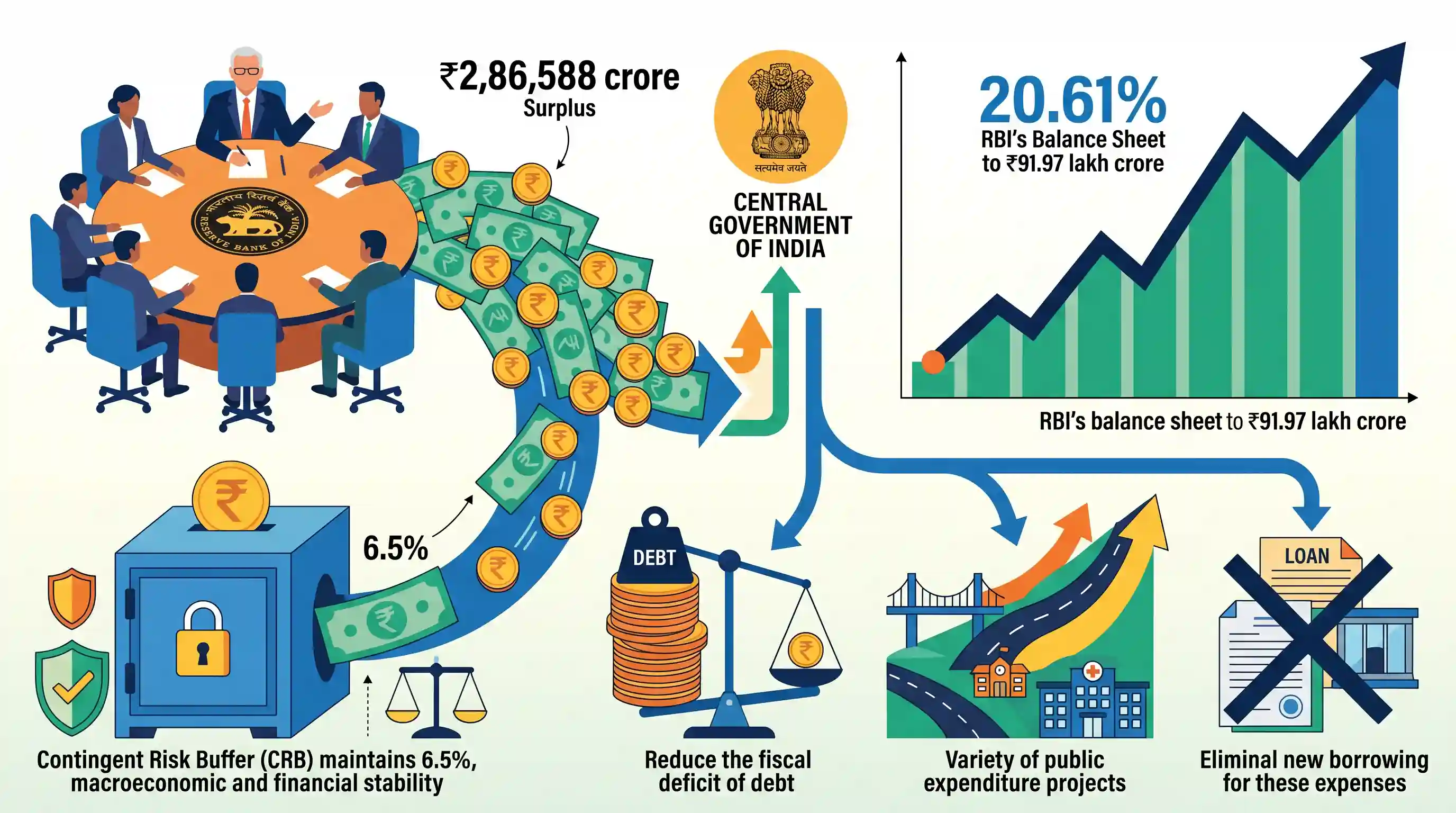
The Reserve Bank of India (RBI) board, headed by Governor Sanjay Malhotra, has approved a massive surplus transfer of ₹2,86,588 crore to the Central Government for the accounting year 2025-26. In line with the Economic Capital Framework (ECF), the board maintained the Contingent Risk Buffer (CRB) at 6.5% of the RBI's balance sheet—transferring ₹1,09,379.64 crore to the buffer to ensure macroeconomic and financial stability. The RBI's balance sheet saw a substantial expansion of 20.61% to ₹91.97 lakh crore. The large dividend acts as a crucial non-tax revenue source for the government, helping manage the fiscal deficit and public expenditure without additional borrowing.
Key Points
- The RBI board approved a massive dividend payment of ₹2,86,588 crore to the Central Government for the 2025-26 accounting year.
- The RBI transferred ₹1,09,379.64 crore to its Contingent Risk Buffer (CRB), maintaining it at 6.5% of the central bank's balance sheet.
- Under the revised Economic Capital Framework (ECF), the RBI is required to maintain the CRB within a range of 4.5% to 7.5% of its balance sheet.
- The RBI's balance sheet expanded by 20.61% during the year, reaching a total of ₹91,97,121.08 crore.
- The central bank generated a net income of ₹3,95,972.10 crore in FY26 before risk provisions and statutory fund transfers.
Important Terms
Economic Capital Framework (ECF)

A governance framework, adopted in 2019 via the Bimal Jalan Committee, determining the appropriate risk provisions and surplus distribution the RBI must maintain before transferring profits to the government.
UPSC context
GS Paper 3 (Indian Economy); critical for understanding RBI-Government relations and institutional autonomy versus resource mobilization.
Contingent Risk Buffer (CRB)
A reserve fund within the ECF (maintained at 5.5%–6.5% of the balance sheet) to safeguard the RBI against unforeseen shocks like currency volatility or financial crises.
UPSC context
GS Paper 3; relevant for questions on financial stability, central bank reserves, and the 'Lender of Last Resort' role.
Surplus Transfer
The annual payment of the RBI's net profit to the Central Government under Section 47 of the RBI Act, technically called 'surplus' rather than a commercial dividend.
UPSC context
GS Paper 3 (Government Budgeting); tests understanding of the legal and technical nature of RBI's financial contributions to the exchequer.
Section 47 of the RBI Act, 1934
The statutory provision in the Reserve Bank of India Act, 1934, that mandates the central bank to transfer its remaining profits to the government after making necessary provisions.
UPSC context
GS Paper 3/Prelims; the specific legal basis for the transfer of reserves, distinguishing it from general corporate dividends.
Non-tax Revenue
Government receipts that do not involve taxation, including interest, dividends/profits from public sector undertakings, and surplus transfers from the RBI.
UPSC context
GS Paper 3 (Mobilization of Resources); essential for analyzing how the government bridges fiscal gaps without raising taxes.
Fiscal Consolidation
Policy efforts to reduce the government's fiscal deficit and public debt, often supported by windfall receipts like record RBI surplus transfers.
UPSC context
GS Paper 3 (Government Budgeting); tests the impact of external revenue injections on the national debt-to-GDP ratio and fiscal targets.
Prelims Trap
"The annual surplus transferred by the RBI is accounted under the Capital Receipts of the Union Budget."
RBI surplus transfers are classified as Non-Tax Revenue, which is a key component of the government's Revenue Receipts, not Capital Receipts.
Static Concepts Connected
What is the RBI's Economic Capital Framework (ECF)?
- Origin: Adopted based on the Bimal Jalan Committee recommendations to formally govern risk provisioning and surplus distribution.
- Statutory Backing: Surplus profit transfer to the Central Government is mandated under Section 47 of the Reserve Bank of India Act, 1934.
- Risk Buffer: Mandates maintaining a Contingent Risk Buffer (CRB) as a specific percentage of the balance sheet to absorb unexpected systemic or monetary shocks.
What are the primary sources of the RBI's income?
- Securities: Interest earned on its vast holdings of domestic government securities (G-Secs) and foreign sovereign bonds.
- LAF Operations: Interest generated from short-term lending to commercial banks via Liquidity Adjustment Facility (LAF) operations.
- Forex Interventions: Gains realized from the central bank's active interventions (buying and selling) in the foreign exchange market.
Cross-Topic Patterns
RBI Surplus & FRBM Consolidation
Windfall non-tax revenues from the RBI provide vital fiscal space, allowing the government to sustain high capital expenditure while still adhering to strict FRBM fiscal consolidation glide paths.
Forex Inflows & Balance Sheet Expansion
Massive RBI balance sheet expansion is frequently driven by the absorption of foreign capital inflows, which in turn inflates the absolute quantum required for the Contingent Risk Buffer (CRB).

Expect a 2026 multi-statement question interlinking the Bimal Jalan Committee ECF, Non-Tax Revenue, and RBI balance sheet drivers.
Linked PYQs · 3
Linked PYQs · 3
- 2025PrelimsGS1
Which of the following are the sources of income for the Reserve Bank of India? I. Buying and selling Government bonds II. Buying and selling foreign currency III. Pension fund management IV. Lending to private companies V. Printing and distributing currency notes Select the correct answer using the code given below.
- 2024PrelimsGS1
Consider the following statements in respect of the digital rupee : 1. It is a sovereign currency issued by the Reserve Bank of India (RBI) in alignment with its monetary policy. 2. It appears as a liability on the RBI's balance sheet. 3. It is insured against inflation by its very design. 4. It is freely convertible against commercial bank money and cash. Which of the statements given above are correct?
- 2019MainsGS3
The public expenditure management is a challenge to the Government of India in the context of budget making during the post-liberalization period. Clarify it.
