RBI and Banks Push New Features to Scale Digital Rupee Usage
Source:Indian Express ↗
Why It Matters
Understanding the evolution and technological scaling of India's Central Bank Digital Currency (CBDC) is critical for Mains GS3 (Banking & Monetary Policy) as it highlights the intersection of digital public infrastructure, monetary sovereignty, and financial inclusion.
Summary
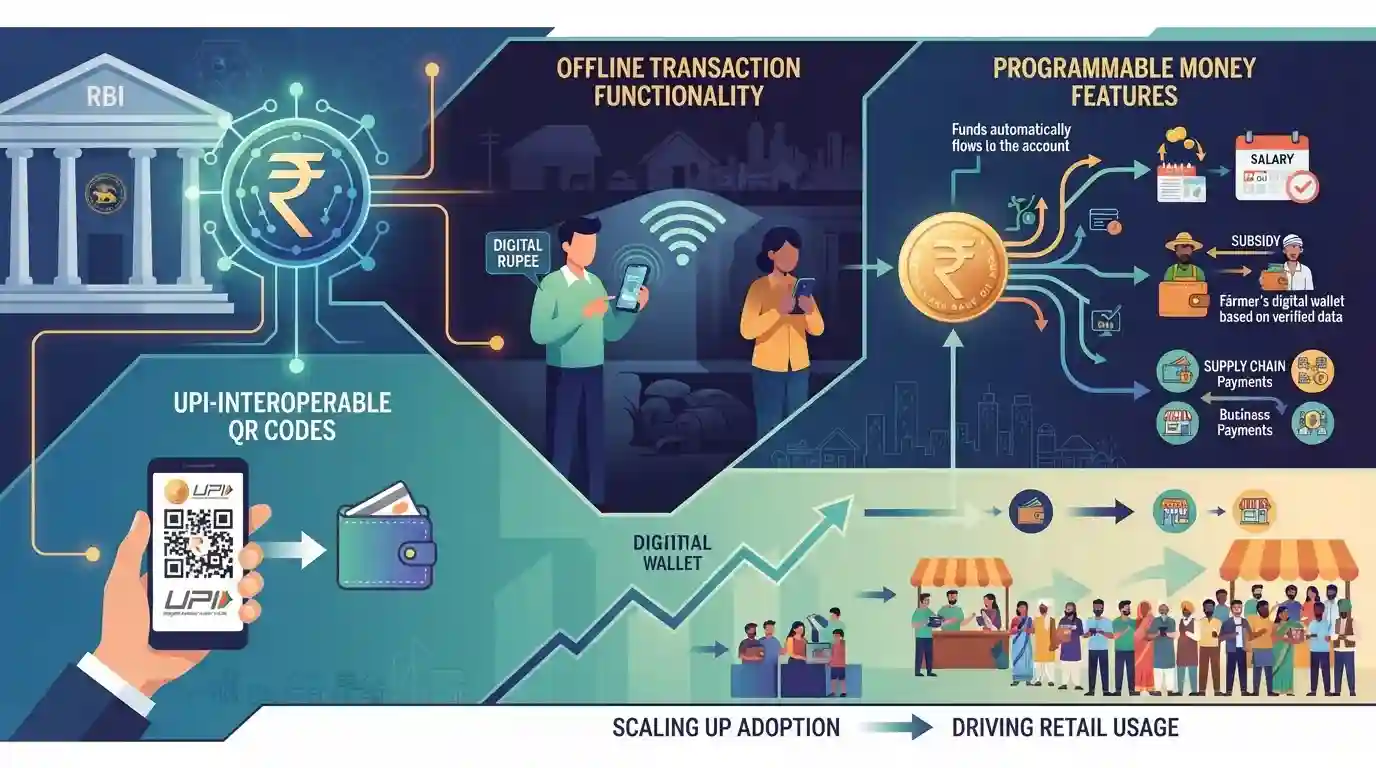
The Reserve Bank of India and participating commercial banks are rolling out new strategic features to scale up the adoption of the Central Bank Digital Currency (CBDC), or Digital Rupee. Efforts include UPI-interoperable QR codes, offline transaction functionality, and programmable money features to overcome initial adoption friction and drive retail usage.
Key Points
- The Reserve Bank of India (RBI) and major commercial banks are planning to introduce new features to boost the adoption and usage of the Central Bank Digital Currency (CBDC), also known as the Digital Rupee or e-Rupee.
- Key integration strategies include linking the Digital Rupee with the Unified Payments Interface (UPI) by allowing interoperable QR codes so users can scan any UPI QR code using a CBDC app.
- Banks are exploring programmability features—such as restricted use for specific purposes like fertilizer subsidies or corporate salaries—and offline transaction capabilities to expand reach in areas with poor internet connectivity.
- The initiative aims to address sluggish retail transaction volumes and move beyond pilot-phase limitations by making CBDC transactions more seamless for everyday users.
Prelims Trap
CBDC operates identically to a commercial bank savings account, offering interest yields alongside digital convenience and sovereign backing.
Aspirants often assume CBDC pays interest like a savings bank account or that it is just another form of UPI payment. CBDC is a direct liability of the RBI and does not inherently earn interest.
Static Concepts Connected
What are the core structural features and legal status of a Central Bank Digital Currency (CBDC)?
- Sovereign Liability: It is a sovereign currency issued by the central bank in digital form, appearing as a liability on the central bank's balance sheet.
- Legal Tender Status: It is a legal tender accepted freely for any transaction by public, government, and commercial entities, unlike cryptocurrencies or private digital tokens.
- Non-Interest Bearing: Unlike commercial bank deposits, it does not typically earn interest unless specifically structured by the central bank, mitigating risks of bank disintermediation.
Cross-Topic Patterns
CBDC and Direct Benefit Transfer Architecture
CBDC programmability for fertilizer subsidies links digital currency implementation directly with fiscal transfer reforms and leakages reduction in direct benefit transfer architecture.
Digital Public Infrastructure and Financial Inclusion
Integration of offline digital currency transactions intersects financial inclusion goals with digital public infrastructure (DPI) expansion in remote rural areas.

Expect a statement-based prelims question on whether CBDC yields interest like bank deposits or if it replaces physical cash entirely as legal tender.
Linked PYQs · 3
Linked PYQs · 3
- 2026PrelimsGS1
Which one of the following statements about Unified Payments Interface (UPI) and Central Bank Digital Currency (Digital Rupee) is not correct ?
- 2024PrelimsGS1
Consider the following statements in respect of the digital rupee : 1. It is a sovereign currency issued by the Reserve Bank of India (RBI) in alignment with its monetary policy. 2. It appears as a liability on the RBI's balance sheet. 3. It is insured against inflation by its very design. 4. It is freely convertible against commercial bank money and cash. Which of the statements given above are correct?
- 2023PrelimsGS1
With reference to Central Bank digital currencies, consider the following statements: 1. It is possible to make payments in a digital currency without using US dollar or SWIFT system. 2. A digital currency can be distributed with a condition programmed into it such as a time-frame for spending it. Which of the statements given above is/are correct?
