Reserve Bank Measures to Shield Exporters from External Tariffs
Source:The Hindu ↗
Why It Matters
Highlights RBI's proactive role in macroeconomic management, specifically in shielding the domestic export sector from external shocks (e.g., US tariff hikes). Emphasizes policy tools like foreign currency accounts, IFSC liberalization, and trade data reconciliation mechanisms (EDPMS/IDPMS) used to provide operational flexibility and liquidity to traders.
Summary
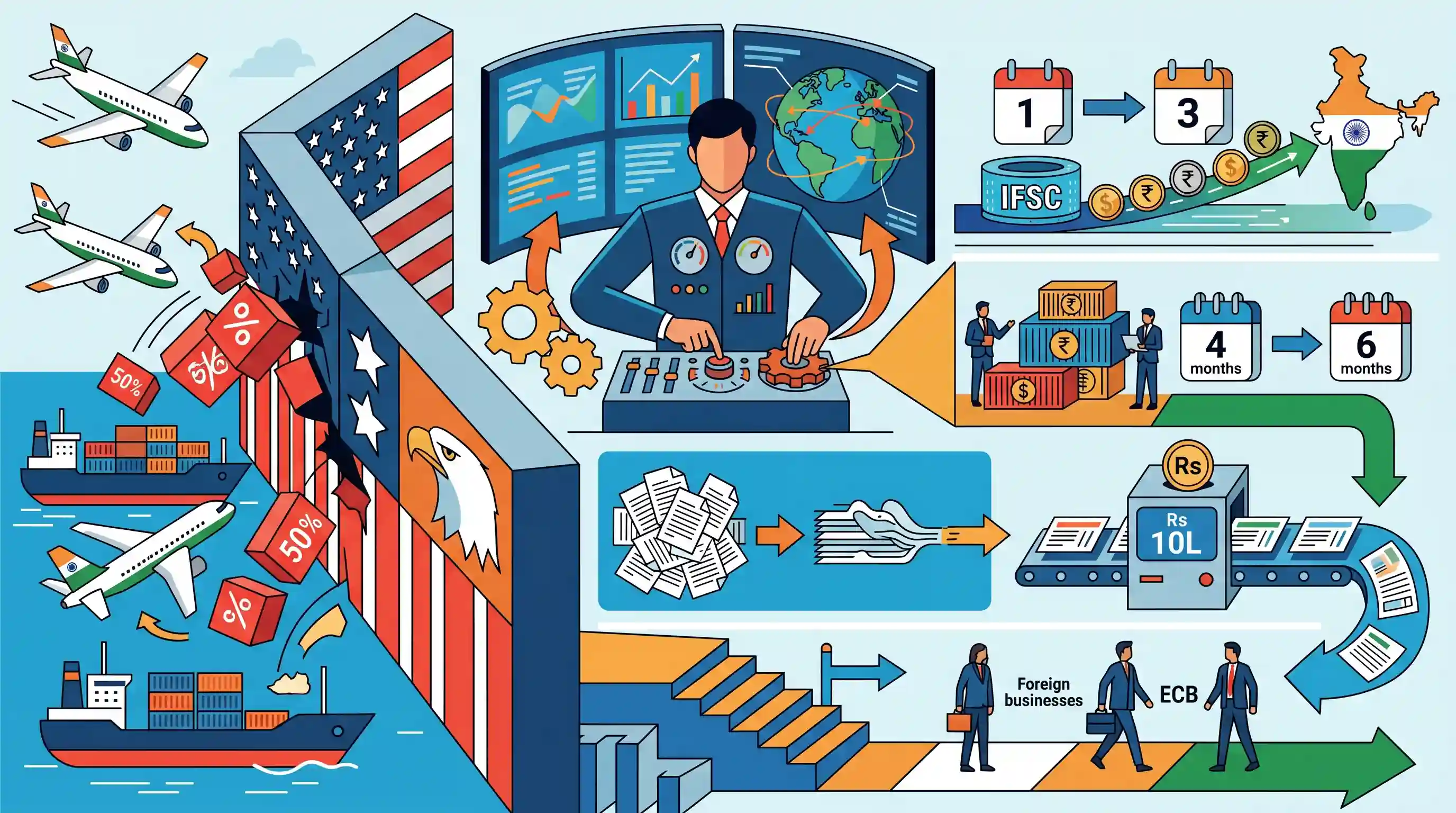
The Reserve Bank of India (RBI) has announced a slew of measures to support Indian exporters dealing with the fallout of a 50% tariff imposed by the US administration on Indian shipments. Key interventions include extending the timeline for repatriating export proceeds from foreign currency accounts in International Financial Services Centres (IFSCs) from one to three months, and increasing the forex outlay period for Merchandise Trade Transactions (MTT) from four to six months. Furthermore, to ease compliance, the RBI simplified the reconciliation process under EDPMS and IDPMS for trade bills up to Rs 10 lakh. RBI Governor Sanjay Malhotra also indicated forthcoming rationalization of FEMA regulations regarding foreign business presence in India and the External Commercial Borrowing (ECB) framework, reflecting a responsive approach to external sector pressures.
Key Points
- The RBI extended the timeline for Indian exporters to repatriate export proceeds from foreign currency accounts in IFSCs from one month to three months.
- The period for foreign exchange outlays for Merchandise Trade Transactions (MTT) was increased from four to six months.
- Compliance burdens for small-value trade transactions (up to Rs 10 lakh) were eased through a simplified declaration-based reconciliation process under EDPMS and IDPMS.
- The RBI announced upcoming rationalization of FEMA regulations concerning foreign entities establishing a business presence in India and the External Commercial Borrowing (ECB) framework.
- These measures are a direct policy response to support exporters facing challenges from the U.S. government's recent imposition of 50% tariffs on Indian shipments.
Important Terms
Foreign Exchange Management Act (FEMA)

A 1999 legislation that regulates foreign exchange transactions in India, facilitating external trade and payments while promoting the orderly development of the foreign exchange market.
UPSC context
GS Paper III: Indian Economy. Key for understanding regulatory frameworks governing international trade and forex management.
External Commercial Borrowings (ECB) framework
Commercial loans raised by eligible Indian entities from non-resident lenders, regulated by the RBI to provide access to cheaper foreign capital for expansion and infrastructure.
UPSC context
GS Paper III: Investment Models/Resource Mobilization. Tests knowledge of external debt and capital inflows.
Export Data Processing and Monitoring System (EDPMS)
An RBI-operated centralized online platform that tracks export shipments and ensures the timely repatriation of proceeds by integrating data from Customs and banks.
UPSC context
GS Paper III: External Sector/IT in Governance. Relevant for trade facilitation and digital monitoring mechanisms.
International Financial Services Centres (IFSC)
An offshore financial hub within India (e.g., GIFT City) that provides financial services across borders, intended to give Indian firms easier access to global markets.
UPSC context
GS Paper III: Economic Development/Infrastructure. Crucial for discussions on global financial integration and Ease of Doing Business.
Merchandise Trade Transactions (MTT)
A triangular trade arrangement where an Indian intermediary buys from a foreign supplier and sells to a foreign buyer without the goods ever entering Indian territory.
UPSC context
GS Paper III: Indian Economy/Trade Policy. Important for understanding "triangular trade" and specialized forex regulations.
Import Data Processing and Monitoring System (IDPMS)
A digital monitoring system that tracks import transactions by matching Customs' Bill of Entry data with bank outward remittance records to prevent forex siphoning.
UPSC context
GS Paper III: External Sector. Tests understanding of digital tools used for regulatory oversight and anti-money laundering.
Prelims Trap
"The Ministry of Commerce determines the timeline for exporters to repatriate their foreign exchange proceeds."
While the Commerce Ministry handles broad trade policy via DGFT, foreign exchange realization rules, repatriation timelines, and tracking portals (EDPMS) are strictly regulated by the RBI under FEMA.
Static Concepts Connected
How does FEMA classify International Financial Services Centres (IFSCs)?
- Foreign Jurisdiction: Under FEMA, an IFSC (like GIFT City) is treated as a non-resident zone. Transactions here are conducted in foreign currencies without typical domestic conversion rules.
- Regulatory Boundary: While IFSCA is the unified regulator for the zone, the RBI still sets the macro-level FEMA rules for domestic Indian entities interacting with IFSCs.
What are External Commercial Borrowings (ECBs) and their key risks?
- Definition: They are commercial loans raised by eligible resident Indian entities from recognized non-resident entities abroad, forming a major part of India's external debt.
- Currency Risk: Firms face exchange rate risk. If the Rupee depreciates against the borrowed foreign currency, the domestic cost of servicing that debt increases significantly.
Cross-Topic Patterns
US Protectionism + Forex management
US tariffs act as exogenous macroeconomic shocks. UPSC frequently tests the linkage between foreign protectionist policies, their impact on India's current account, and the RBI's responsive forex management strategies.
GIFT City + Capital Account Convertibility
Allowing exporters to park funds in IFSC foreign currency accounts for longer durations is a practical stepping stone in India's gradual shift towards fuller capital account convertibility.

Expect a multi-statement Prelims question combining FEMA repatriation rules, IFSC 'non-resident' status, and RBI's forex tools.
Linked PYQs · 3
Linked PYQs · 3
- 2022PrelimsGS1
Consider the following statements: 1. Tight monetary policy of US Federal Reserve could lead to capital flight. 2. Capital flight may increase the interest cost of firms with existing External Commercial Borrowings (ECBs). 3. Devaluation of domestic currency decreases the currency risk associated with ECBs. Which of the statements given above are correct?
- 2020PrelimsGS1
With reference to the international trade of India at present, which of the following statements is/are correct? 1. India's merchandise exports are less than its merchandise imports. 2. India's imports of iron and steel, chemicals, fertilisers and machinery have decreased in recent years. 3. India's exports of services are more than its imports of services. 4. India suffers from an overall trade/current account deficit. Select the correct answer using the code given below:
- 2022PrelimsGS1
With reference to the Indian economy, consider the following statements: 1. An increase in Nominal Effective Exchange Rate (NEER) indicates the appreciation of rupee. 2. An increase in the Real Effective Exchange Rate (REER) indicates an improvement in trade competitiveness. 3. An increasing trend in domestic inflation relative to inflation in other countries is likely to cause an increasing divergence between NEER and REER. Which of the above statements are correct?
