Reserve Bank of India Open Market Operations Liquidity Injection
Source:The Hindu ↗
Why It Matters
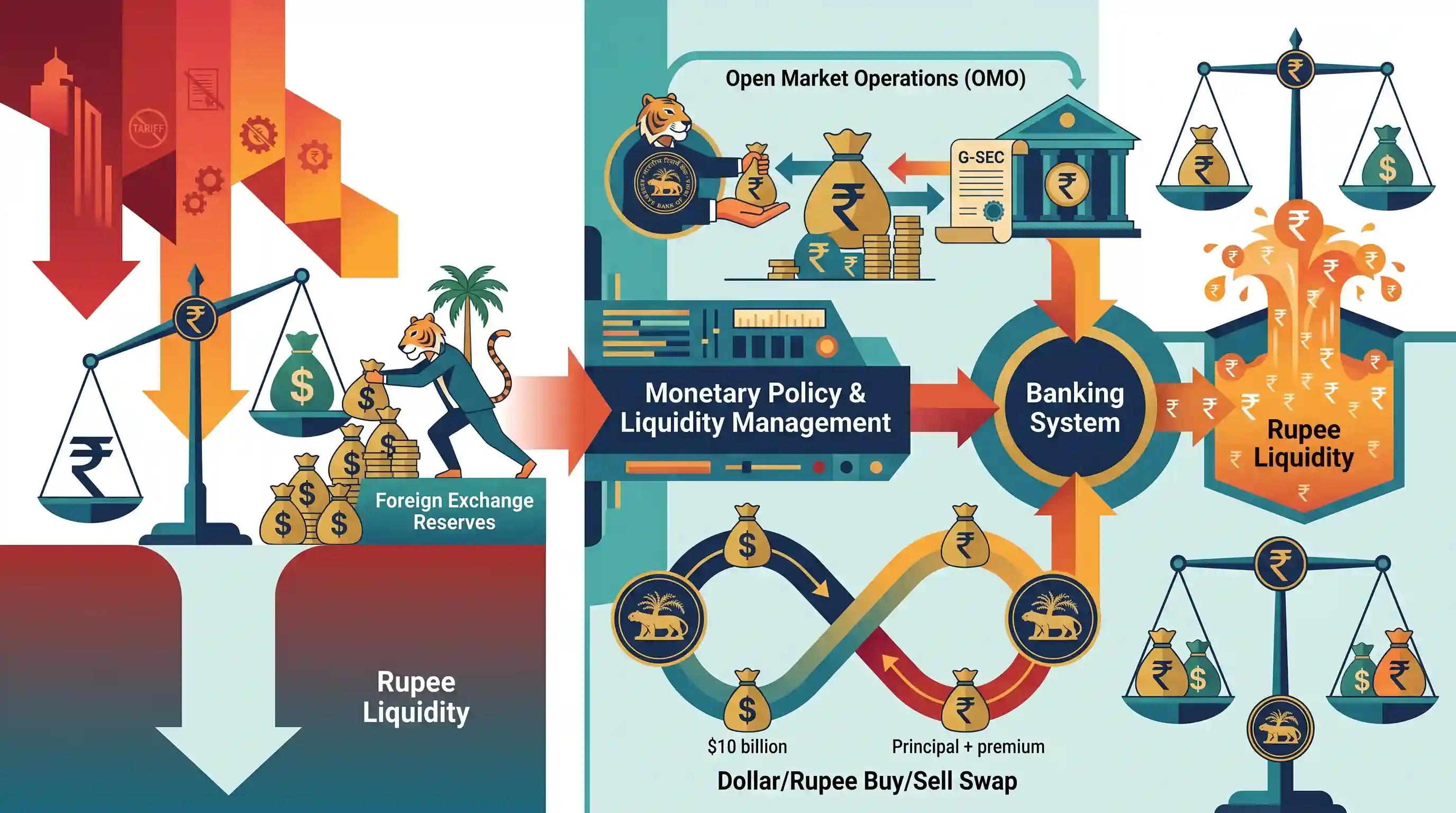
RBI's dual interventions—injecting rupee liquidity through OMOs while managing exchange rate volatility via dollar buy/sell swaps—highlight the central bank's delicate balancing act amid external shocks like U.S. tariffs. These actions directly impact borrowing costs, currency stability, and macroeconomic resilience.
Summary
The Reserve Bank of India (RBI) has unveiled measures to inject roughly ₹2.90 lakh crore of liquidity into the banking system to counterbalance the effects of recent currency market interventions. This infusion involves ₹2,00,000 crore through Open Market Operations (OMO) to purchase government securities, alongside a three-year $10 billion Dollar/Rupee Buy/Sell Swap. The strategy is designed to restore rupee liquidity depleted by the RBI's aggressive sale of dollars—an effort to prevent a steep depreciation of the Indian rupee amid pressures from U.S. tariffs. These maneuvers underscore the RBI's dual role in managing domestic money supply while stabilizing external exchange rates and foreign reserves.
Key Points
- The RBI announced measures to inject approximately ₹2.90 lakh crore of liquidity into the banking system.
- The injection is facilitated through ₹2 lakh crore in Open Market Operation (OMO) purchases of government securities and a $10 billion Dollar/Rupee Buy/Sell Swap.
- The intervention aims to alleviate domestic liquidity deficits caused by the RBI's heavy dollar selling to stem the depreciation of the rupee.
- The dual strategy also provides a breather to India's depleting foreign exchange reserves amid currency pressures exacerbated by U.S. tariffs.
Important Terms
Open Market Operations (OMO)

The purchase or sale of government securities by the RBI in the open market to regulate the money supply and liquidity levels in the economy.
UPSC context
GS-III Economy; frequently tested as a primary quantitative tool of monetary policy for inflation and liquidity control.
Dollar/Rupee Buy/Sell Swap
A foreign exchange tool where the RBI buys US dollars from banks for rupees (injecting liquidity) while agreeing to reverse the transaction at a future date.
UPSC context
GS-III Economy; examines understanding of external sector management and unconventional liquidity tools used during currency volatility.
Liquidity Management
The RBI's framework for ensuring adequate money supply in the banking system to align short-term interest rates with the policy rate and support growth.
UPSC context
GS-III Economy; essential for questions on monetary policy transmission, banking stability, and the RBI's role as 'lender of last resort'.
Government Securities (G-Secs)
Marketable debt instruments issued by the Central or State governments to borrow money, considered 'gilt-edged' due to their negligible risk of default.
UPSC context
GS-III Economy; important for topics regarding fiscal deficit financing, financial markets, and RBI's market-based operations.
Foreign Exchange Reserves (Forex)
Assets held by the central bank in foreign currencies, gold, and SDRs to manage exchange rate volatility and ensure external payment capacity.
UPSC context
GS-III Economy; critical for the External Sector, specifically Balance of Payments and India's economic resilience against global shocks.
Reserve Bank of India (RBI)
India's central bank and statutory body responsible for regulating the banking system, managing foreign exchange, and implementing monetary policy.
UPSC context
GS-III Economy; the core institutional subject for banking, monetary stability, and financial regulation topics.
Prelims Trap
"RBI selling dollars from its forex reserves increases domestic Rupee liquidity."
When RBI sells dollars in the spot market, it takes in Rupees from banks. This absorbs Rupee liquidity, creating a deficit that must be refilled.
Static Concepts Connected
What is 'Sterilization' in the context of RBI's monetary operations?
- Core Definition: The process by which RBI neutralizes the impact of its foreign exchange market interventions on domestic money supply.
- Standard Mechanism: If RBI sells dollars (absorbing Rupees), it concurrently buys government securities via OMOs to re-inject that Rupee liquidity.
- Policy Objective: Ensures that defending the exchange rate does not unintentionally derail the domestic monetary policy stance (e.g., inflation targeting).
How does a Dollar/Rupee Buy/Sell Swap impact domestic liquidity?
- Immediate Injection: The RBI buys dollars from banks, immediately injecting an equivalent amount of Rupee liquidity into the domestic banking system.
- Future Reversal: A simultaneous contract dictates the RBI will sell the dollars back later, ensuring the liquidity injection is temporary.
- Versus Spot Market: Unlike open market spot purchases, a swap provides predictable, term-based liquidity without permanently altering RBI's balance sheet.
Cross-Topic Patterns
Impossible Trinity + RBI interventions
RBI's complex balancing act of managing exchange rates (dollar sales) while maintaining independent control of domestic money supply (OMOs) perfectly illustrates the Mundell-Fleming trilemma.
US Protectionism + Domestic Credit
US tariffs trigger currency depreciation and capital outflows. RBI's defense of the Rupee inadvertently tightens domestic bank liquidity, showing how external trade shocks dictate internal credit cycles.

Expect a multi-statement question interlinking forex spot interventions, RBI's sterilization via OMOs, and their net impact on money supply.
Linked PYQs · 5
Linked PYQs · 5
- 2023PrelimsGS1
Which one of the following activities of the Reserve Bank of India is considered to be part of 'sterilization'?
- 2013PrelimsGS1
In the context of Indian economy, 'Open Market Operations' refers to
- 2022PrelimsGS1
With reference to the Indian economy, consider the following statements: 1. If the inflation is too high, Reserve Bank of India (RBI) is likely to buy government securities. 2. If the rupee is rapidly depreciating, RBI is likely to sell dollars in the market. 3. If interest rates in the USA or European Union were to fall, that is likely to induce RBI to buy dollars. Which of the statements given above are correct?
- 2019PrelimsGS1
Which one of the following is not the most likely measure the Government/RBI takes to stop the slide of Indian rupee?
- 2025PrelimsGS1
Which of the following are the sources of income for the Reserve Bank of India? I. Buying and selling Government bonds II. Buying and selling foreign currency III. Pension fund management IV. Lending to private companies V. Printing and distributing currency notes Select the correct answer using the code given below.
