RBI announces liquidity injection measures through OMO and forex swaps
Source:The Hindu ↗
Why It Matters
UPSC frequently tests candidates on the tools of monetary policy (like OMOs) and the mechanisms used by the RBI to manage currency volatility and forex reserves. This article provides a practical example of how the RBI balances domestic rupee liquidity with external exchange rate stability.
Summary
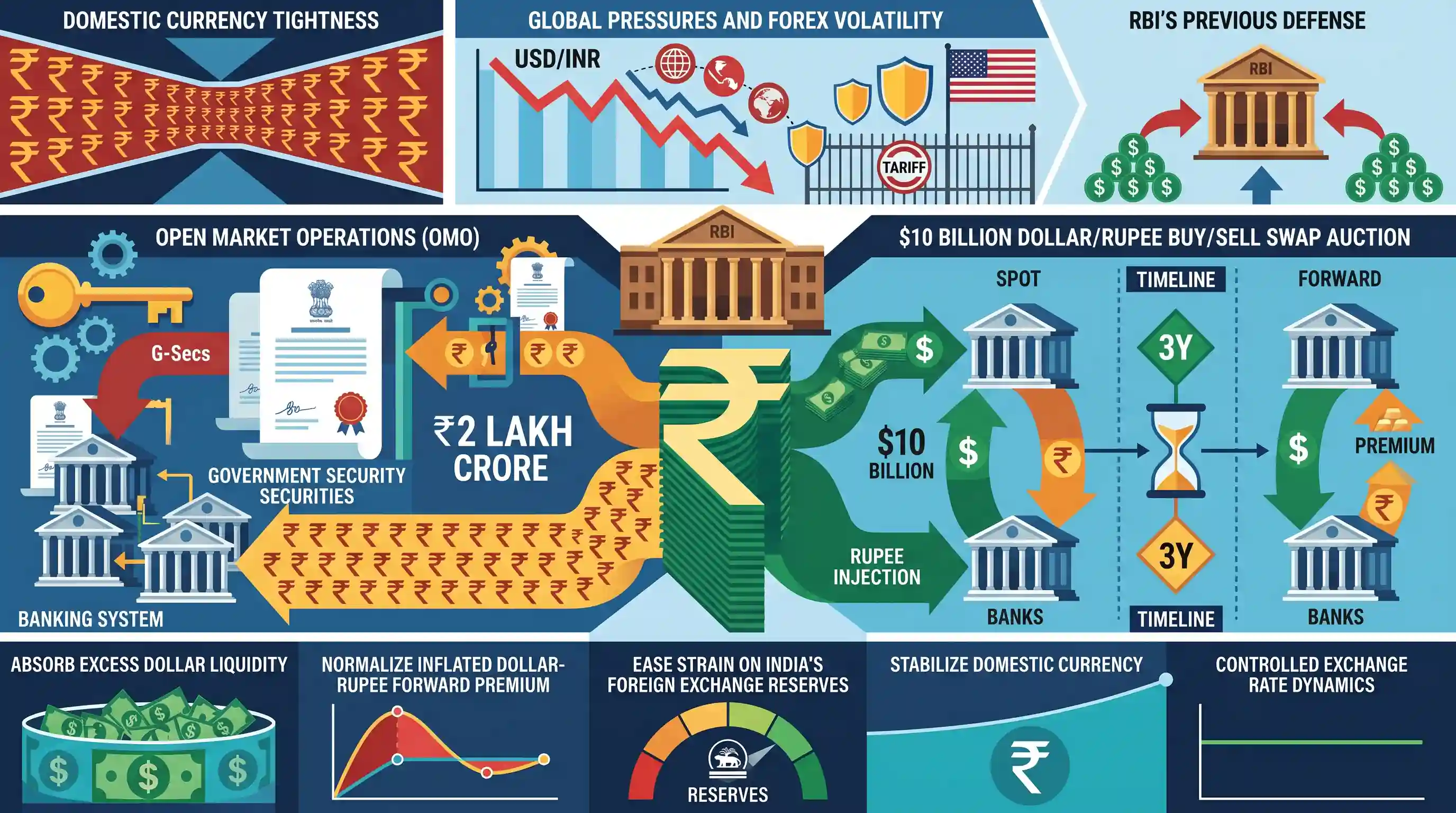
The Reserve Bank of India (RBI) has introduced comprehensive measures to inject ₹2.90 lakh crore in liquidity into the banking system to manage domestic currency tightness and foreign exchange volatility. The central bank will conduct Open Market Operation (OMO) purchases of government securities worth ₹2 lakh crore. In addition, the RBI will execute a $10 billion Dollar/Rupee buy/sell swap auction with a three-year tenor. This swap is designed to absorb excess dollar liquidity, normalize the inflated dollar-rupee forward premium, and ease the strain on India's foreign exchange reserves. The move follows significant RBI interventions—selling billions of dollars—to defend the depreciating rupee amidst global pressures, including US tariffs.
Key Points
- The RBI announced measures to inject ₹2.90 lakh crore in liquidity through Open Market Operations (OMOs) and a forex swap auction.
- The OMO component involves purchasing ₹2 lakh crore of Government of India securities in four tranches.
- A $10 billion, 3-year Dollar/Rupee buy/sell swap auction aims to absorb excess dollar liquidity, reduce the dollar-rupee forward premium, and infuse rupee liquidity.
- The intervention provides a breather to India's foreign exchange reserves, which faced depletion as the RBI sold dollars heavily (e.g., $11.88 billion net in October 2025) to arrest the rupee's depreciation against the US dollar.
Important Terms
Open Market Operations (OMO)

The purchase or sale of government securities by the RBI in the open market to regulate systemic liquidity and money supply on a durable basis.
UPSC context
GS Paper 3: Monetary Policy. Tests understanding of quantitative tools used to control inflation and manage banking liquidity.
Dollar-Rupee Swap
A foreign exchange tool where the RBI buys or sells USD in exchange for INR with a commitment to reverse the transaction at a future date.
UPSC context
GS Paper 3: External Sector. Critical for understanding exchange rate management and liquidity injection/absorption without affecting bond yields.
Foreign Exchange Reserves
Assets held by the central bank in foreign currencies, comprising Foreign Currency Assets (FCA), Gold, Special Drawing Rights (SDRs), and the Reserve Tranche Position with the IMF.
UPSC context
GS Paper 3: External Sector. Key for questions on India's economic resilience, import cover, and balance of payments.
Government Securities (G-Secs)
Tradable debt instruments issued by the Central or State Governments to fund fiscal deficits, considered risk-free 'gilt-edged' securities.
UPSC context
GS Paper 3: Financial Markets. Essential for topics regarding government borrowing, fiscal policy, and RBI’s market operations.
Forward Premium
A condition in the forex market where the forward exchange rate of a currency is higher than its current spot rate.
UPSC context
GS Paper 3: Indian Economy. Tests advanced conceptual clarity on exchange rate expectations and interest rate differentials.
Liquidity Management
The central bank's strategy to maintain optimal cash levels in the banking system using tools like Repo, OMO, and Swaps to balance growth and inflation.
UPSC context
GS Paper 3: Monetary Policy. A recurring theme in Prelims and Mains regarding RBI’s core functions and market stability.
Prelims Trap
"A Dollar/Rupee buy/sell swap by the RBI is designed to absorb excess rupee liquidity from the banking system."
In a Buy/Sell swap, the RBI buys dollars in the spot market and sells in the forward market. This immediately injects, rather than absorbs, domestic rupee liquidity.
Static Concepts Connected
How do RBI's forex interventions impact domestic liquidity and what is sterilization?
- Selling Dollars: When RBI sells dollars to defend a depreciating Rupee, it sucks out domestic rupee liquidity because banks pay the RBI in rupees for those dollars.
- Buying Dollars: Conversely, when the RBI buys dollars, it injects rupee liquidity into the domestic banking system. Unchecked, excess liquidity can cause inflation.
- Sterilization: The RBI uses Open Market Operations (buying/selling government bonds) to neutralize or "sterilize" the rupee liquidity impact of its foreign exchange operations.
How does a Dollar/Rupee Buy/Sell Swap function?
- Spot Leg: The RBI buys dollars from commercial banks at the current spot rate, immediately injecting rupee liquidity into the banking system.
- Forward Leg: Simultaneously, the RBI contracts to sell the dollars back to banks at a specified future date, absorbing the rupee liquidity later.
- Forex Reserves Impact: It temporarily increases India's foreign exchange reserves (specifically Foreign Currency Assets) for the duration of the swap, providing a cosmetic buffer.
Cross-Topic Patterns
Forex interventions & Inflation targeting
The RBI's mandate to control inflation often clashes with exchange rate management. Selling dollars to arrest rupee depreciation tightens domestic liquidity, which can inadvertently slow economic growth.
OMOs and G-Sec Yields
A massive ₹2 lakh crore OMO purchase increases demand for government securities. This pushes up bond prices, which inversely cools down sovereign bond yields and government borrowing costs.

Expect a 2026 multi-statement prelims question testing the exact sequential impact of Forex Swaps on Rupee liquidity and forward premiums.
Linked PYQs · 5
Linked PYQs · 5
- 2013PrelimsGS1
In the context of Indian economy, 'Open Market Operations' refers to
- 2023PrelimsGS1
Which one of the following activities of the Reserve Bank of India is considered to be part of 'sterilization'?
- 2022PrelimsGS1
With reference to the Indian economy, consider the following statements: 1. If the inflation is too high, Reserve Bank of India (RBI) is likely to buy government securities. 2. If the rupee is rapidly depreciating, RBI is likely to sell dollars in the market. 3. If interest rates in the USA or European Union were to fall, that is likely to induce RBI to buy dollars. Which of the statements given above are correct?
- 2019PrelimsGS1
Which one of the following is not the most likely measure the Government/RBI takes to stop the slide of Indian rupee?
- 2013PrelimsGS1
Which one of the following groups of items is included in India's foreign-exchange reserves?
