Business Correspondents and Updated KYC Norms by RBI
Source:The Hindu ↗
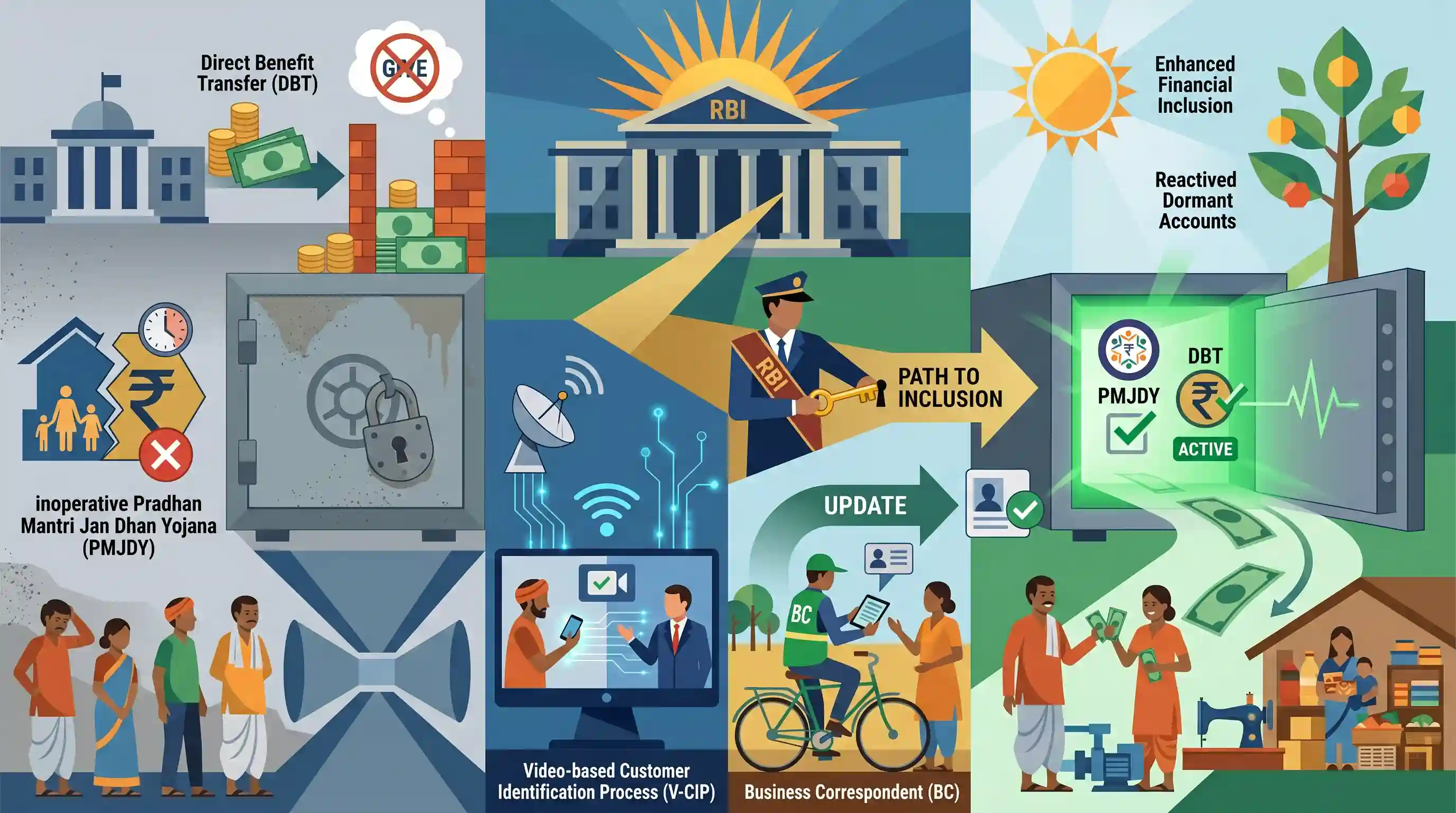
Why It Matters
It highlights systemic challenges in the delivery of welfare schemes (DBT) due to procedural bottlenecks like KYC and dormant accounts. Furthermore, it showcases RBI's proactive regulatory tools (V-CIP and leveraging Business Correspondents) to ensure the last-mile effectiveness of financial inclusion drives like PMJDY.
Summary
The Reserve Bank of India (RBI) has eased KYC norms to enhance financial inclusion and reactivate dormant bank accounts. The central bank introduced a Video-based Customer Identification Process (V-CIP) and allowed Business Correspondents (BCs) to update KYC information. This is particularly significant for reactivating inoperative Pradhan Mantri Jan Dhan Yojana (PMJDY) accounts, addressing bottlenecks that eligible beneficiaries face when withdrawing money from Direct Benefit Transfer (DBT) schemes in rural and semi-urban areas.
Key Points
- The RBI has given banks a deadline of June 2026, or one year (whichever is later), to complete the KYC updation for low-risk customers.
- A Video-based Customer Identification Process (V-CIP) has been introduced for easier remote onboarding and KYC updating.
- Business Correspondents (BCs) are now permitted to perform KYC updates, helping expand reach into semi-urban and rural areas.
- The primary goal is to reactivate dormant PMJDY accounts, which has been a major hurdle for beneficiaries withdrawing funds under Direct Benefit Transfer (DBT) schemes.
Important Terms
Business Correspondents (BCs)

Retail agents engaged by banks to provide services like deposits, withdrawals, and account updates in unbanked areas. They are essential for achieving last-mile financial inclusion in rural regions.
UPSC context
GS-III: Economy. Tests knowledge of last-mile delivery mechanisms and strategies for financial inclusion in underserved areas.
Video-based Customer Identification Process (V-CIP)
An RBI-approved digital method for remote customer identity verification using live video interaction. It leverages technology like facial recognition and geo-tagging to ensure secure and contactless banking.
UPSC context
GS-III: Economy/S&T. Tests understanding of digital governance and technological interventions in banking sector regulations.
Pradhan Mantri Jan Dhan Yojana (PMJDY)
India's flagship financial inclusion mission launched in 2014 to provide universal banking access. It offers zero-balance accounts, RuPay cards, and access to credit, insurance, and pensions.
UPSC context
GS-III: Economy. Core flagship scheme; tests knowledge of social security, financial inclusion, and poverty alleviation strategies.
Direct Benefit Transfer (DBT)
A mechanism to transfer government subsidies and welfare benefits directly into beneficiaries' bank accounts. It uses the JAM trinity (Jan Dhan-Aadhaar-Mobile) to eliminate leakages and intermediaries.
UPSC context
GS-II/III: Governance/Economy. Tests knowledge of administrative reforms, transparency in welfare delivery, and digital governance.
Reserve Bank of India (RBI)
India’s central bank and regulatory authority for the banking system. It manages monetary policy, issues currency, and ensures financial stability while promoting developmental goals like inclusion.
UPSC context
GS-III: Economy. Tests understanding of the central bank's regulatory role and its impact on national economic development.
Payments Council of India (PCI)
An industry body representing digital payment companies in India. It works with regulators to resolve industry-level barriers and promotes a 'less-cash' society through policy advocacy.
UPSC context
GS-III: Economy. Tests knowledge of institutional frameworks and industry bodies involved in digital economy and payment regulations.
Prelims Trap
"Business Correspondents are directly licensed and regulated by the RBI as independent entities."
BCs are retail agents appointed by commercial banks for doorstep banking. The parent bank—not the RBI—directly oversees them and retains full liability for their actions.
Static Concepts Connected
What is the Business Correspondent (BC) model in Indian banking?
- Agent role: Retail agents engaged by banks to provide banking services at locations other than a traditional branch or ATM.
- Services offered: Collection of small deposits, disbursal of microcredit, remittance services, and now periodic KYC updates for customers.
- Bank liability: The parent bank retains full responsibility for all acts of omission and commission by the Business Correspondent.
When does a bank account become 'inoperative' or 'dormant'?
- Two-year rule: An account is classified as inoperative if there are no customer-induced transactions (like withdrawals or deposits) for over two years.
- Interest accrual: Savings accounts continue to earn interest at the regular rate even after being classified as inoperative or dormant.
- DBT impact: High dormancy in zero-balance Jan Dhan accounts blocks beneficiaries from accessing Direct Benefit Transfer (DBT) funds.
Cross-Topic Patterns
PMJDY dormancy stalling DBT payouts
High dormancy rates (20-23%) in Jan Dhan accounts create bottlenecks for welfare delivery, directly linking banking regulations to the success of fiscal policy and DBT governance.
Digital KYC vs. Disability Rights
Mandating V-CIP (video interactions, screen-reading) raises substantive equality concerns under Article 21 for Persons with Disabilities, linking e-governance expansions to fundamental rights jurisprudence.

A composite Prelims question linking BC responsibilities, V-CIP geotagging rules, and PMJDY account dormancy conditions is likely in 2026.
Linked PYQs · 5
Linked PYQs · 5
- 2024PrelimsGS1
With reference to the Pradhan Mantri Jan Dhan Yojana (PMJDY), which of the following statements is/are correct? 1. The scheme aims to open bank accounts for unbanked households. 2. There is a minimum balance requirement for accounts opened under this scheme. 3. Beneficiaries get a Rupay Debit Card with an inbuilt accident insurance cover. Select the correct answer using the code given below.
- 2016PrelimsGS1
The establishment of 'Payment Banks' is being allowed in India to promote financial inclusion. Which of the following statements is/are correct in this context? 1. Mobile telephone companies and supermarket chains that are owned and controlled, by residents are eligible to be promoters of Payment Banks. 2. Payment Banks can issue both credit cards and debit cards. 3. Payment Banks cannot undertake lending activities. Select the correct answer using the code given below.
- 2015MainsGS3
In what way could replacement of price subsidy with Direct Benefit Transfer (DBT) change the scenario of subsidies in India ? Discuss.
- 2016MainsGS3
Pradhan Mantri Jan-Dhan Yojana (PMJDY) is necessary for bringing unbanked to the institutional finance fold. Do you agree with this for financial inclusion of the poorer section of the Indian society? Give arguments to justify your opinion.
- 2022MainsGS3
Is inclusive growth possible under market economy ? State the significance of financial inclusion in achieving economic growth in India.
