RBI Dollar Rupee Swap Auction to Manage Banking Liquidity
Source:Indian Express ↗
Why It Matters
This highlights the practical application of unconventional monetary policy tools by the RBI. Dollar-rupee swaps allow the central bank to manage domestic banking liquidity and mitigate exchange rate volatility simultaneously, demonstrating the nuanced mechanics of macroeconomic management without permanently impacting forex reserves.
Summary
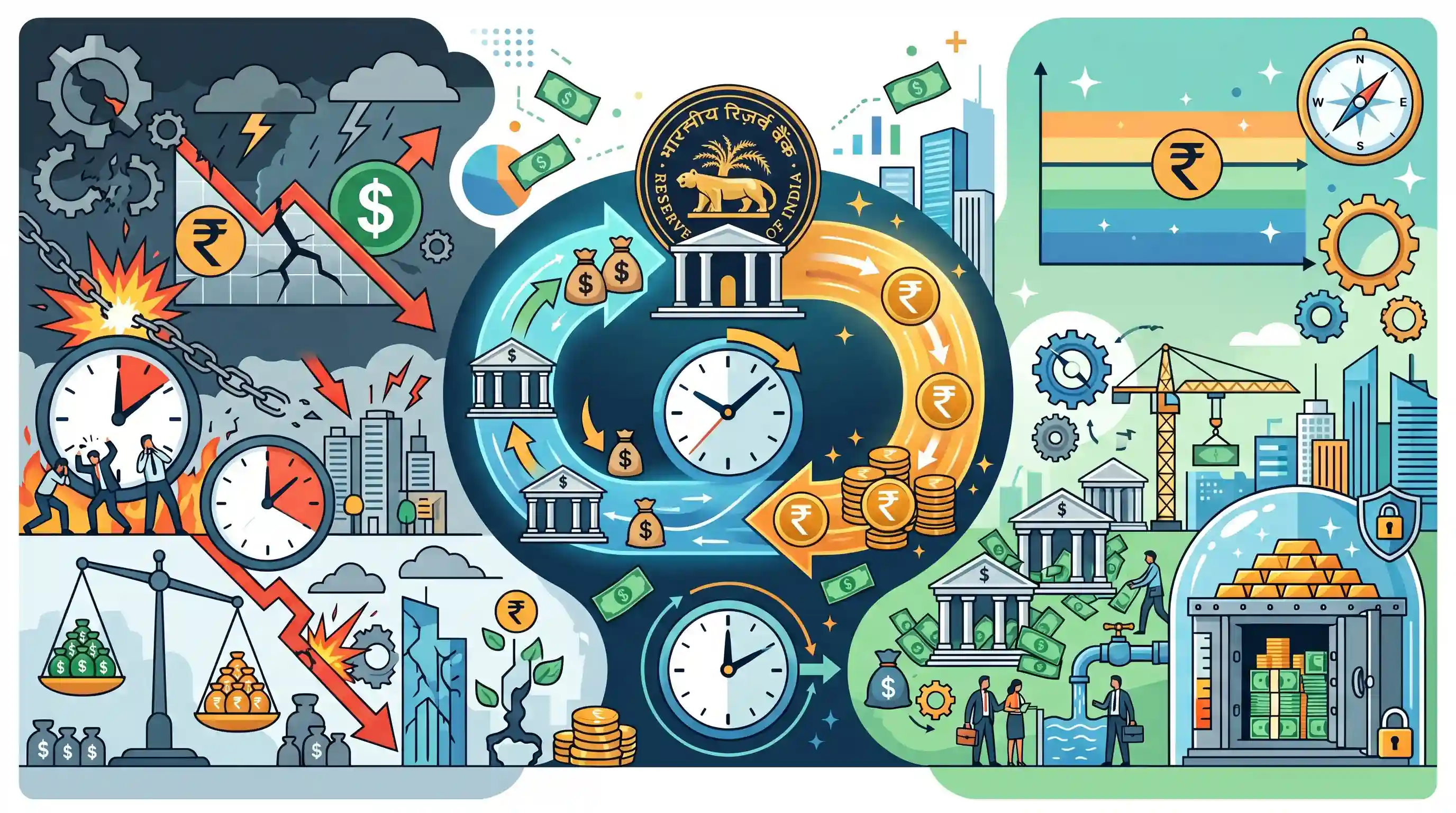
The Reserve Bank of India (RBI) has announced a $5 billion dollar-rupee buy/sell swap auction with a three-year tenor to infuse durable liquidity into the banking system and stabilize the currency market. The move comes as the Indian rupee depreciated past the 96-mark against the US dollar amid global uncertainties and geopolitical tensions. Under the arrangement, banks will sell US dollars to the RBI and agree to buy them back after three years, receiving upfront rupee liquidity. This allows the RBI to inject long-term rupee liquidity and manage exchange rate volatility without permanently depleting its foreign exchange reserves.
Key Points
- The RBI will conduct a $5 billion dollar-rupee buy/sell swap auction on May 26, 2026, for a tenor of three years.
- The measure responds to the Indian rupee depreciating past the 96-mark against the US dollar, driven by global uncertainties and geopolitical tensions.
- Under the swap, banks sell US dollars to the RBI and simultaneously agree to buy back the same amount after three years.
- This mechanism infuses durable, long-term rupee liquidity into the banking system without permanently altering the central bank\'s foreign exchange reserves.
- The auction aims to stabilize currency markets, ease tight banking liquidity conditions, and support credit growth.
Important Terms
Reserve Bank of India (RBI)

India’s central bank and statutory body responsible for regulating the banking system, controlling monetary policy, and managing foreign exchange reserves under the RBI Act, 1934.
UPSC context
GS Paper III (Indian Economy). Essential for topics on monetary policy, inflation management, and financial sector regulation.
Dollar-Rupee Buy/Sell Swap
A monetary tool where the RBI buys US Dollars from banks while agreeing to sell them back later, injecting immediate Rupee liquidity into the banking system.
UPSC context
GS Paper III (Economy). Tests understanding of non-traditional liquidity management and exchange rate stabilization mechanisms.
Durable Liquidity
The long-term or permanent money supply available in the banking system, typically managed via Open Market Operations (OMOs) or long-tenor currency swaps.
UPSC context
GS Paper III (Economy). Crucial for money supply, interest rate management, and credit growth topics.
Foreign Exchange (Forex) Reserves
Assets held by the central bank in foreign currencies, gold, and SDRs to ensure external solvency and maintain stability in the currency exchange rate.
UPSC context
GS Paper III (External Sector). Relevant for Balance of Payments and India's resilience against external economic shocks.
Currency Depreciation
A decrease in the value of a currency in a floating exchange rate system, primarily driven by market forces like demand-supply mismatches or capital outflows.
UPSC context
GS Paper III. Important for analyzing export competitiveness, imported inflation, and macro-economic stability.
Multiple Price Auction
An auction method where successful bidders pay the actual price/premium they quoted, rather than a single uniform price discovered at the cut-off.
UPSC context
GS Paper III. Specific financial term relevant to RBI's market operations and debt management techniques.
Prelims Trap
"A dollar-rupee buy/sell swap absorbs rupee liquidity from the system and permanently alters RBI's foreign exchange reserves."
A buy/sell swap INJECTS rupee liquidity (by buying dollars). The forex reserve change is temporary, as the transaction reverses at maturity, unlike permanent spot market interventions.
Static Concepts Connected
What is the mechanical difference between Buy/Sell and Sell/Buy forex swaps?
- Buy/Sell Swap: RBI buys dollars (spot) and sells them forward. It injects rupee liquidity and temporarily increases forex reserves.
- Sell/Buy Swap: RBI sells dollars (spot) and buys them forward. It absorbs excess rupee liquidity and temporarily drains forex reserves.
How do Forex Swaps differ from standard Open Market Operations (OMOs)?
- Underlying Asset: Both manage durable liquidity, but OMOs use government securities while swaps utilize foreign currency.
- Permanence: OMOs permanently alter the RBI's balance sheet. Swaps are reversible contracts that mature, keeping the long-term forex reserve base intact.
Cross-Topic Patterns
Domestic vs. Bilateral Currency Swaps
Aspirants must distinguish these domestic RBI liquidity auctions from bilateral sovereign swap lines (e.g., SAARC framework), which are used for balance of payments support between two nations.
Monetary Policy Trilemma (Impossible Trinity)
Managing rupee depreciation without tightening domestic liquidity highlights the 'Impossible Trinity'. RBI uses swaps to sidestep this, defending the rupee while simultaneously injecting domestic capital.

Expect a multi-statement question contrasting Buy/Sell vs. Sell/Buy forex swaps and their exact impacts on banking liquidity and forex.
Linked PYQs · 3
Linked PYQs · 3
- 2025PrelimsGS1
Which of the following are the sources of income for the Reserve Bank of India? I. Buying and selling Government bonds II. Buying and selling foreign currency III. Pension fund management IV. Lending to private companies V. Printing and distributing currency notes Select the correct answer using the code given below.
- 2024PrelimsGS1
Consider the following statements : 1. In India, Non-Banking Financial Companies can access the Liquidity Adjustment Facility window of the Reserve Bank of India. 2. In India, Foreign Institutional Investors can hold the Government Securities (G-Secs). 3. In India, Stock Exchanges can offer separate trading platforms for debts. Which of the statements given above is/are correct?
- 2018MainsGS3
How would the recent phenomena of protectionism and currency manipulations in world trade affect macroeconomic stability of India?
