RBI Gold Repatriation And Domestic Reserve Management Strategy
Source:Indian Express ↗
Why It Matters
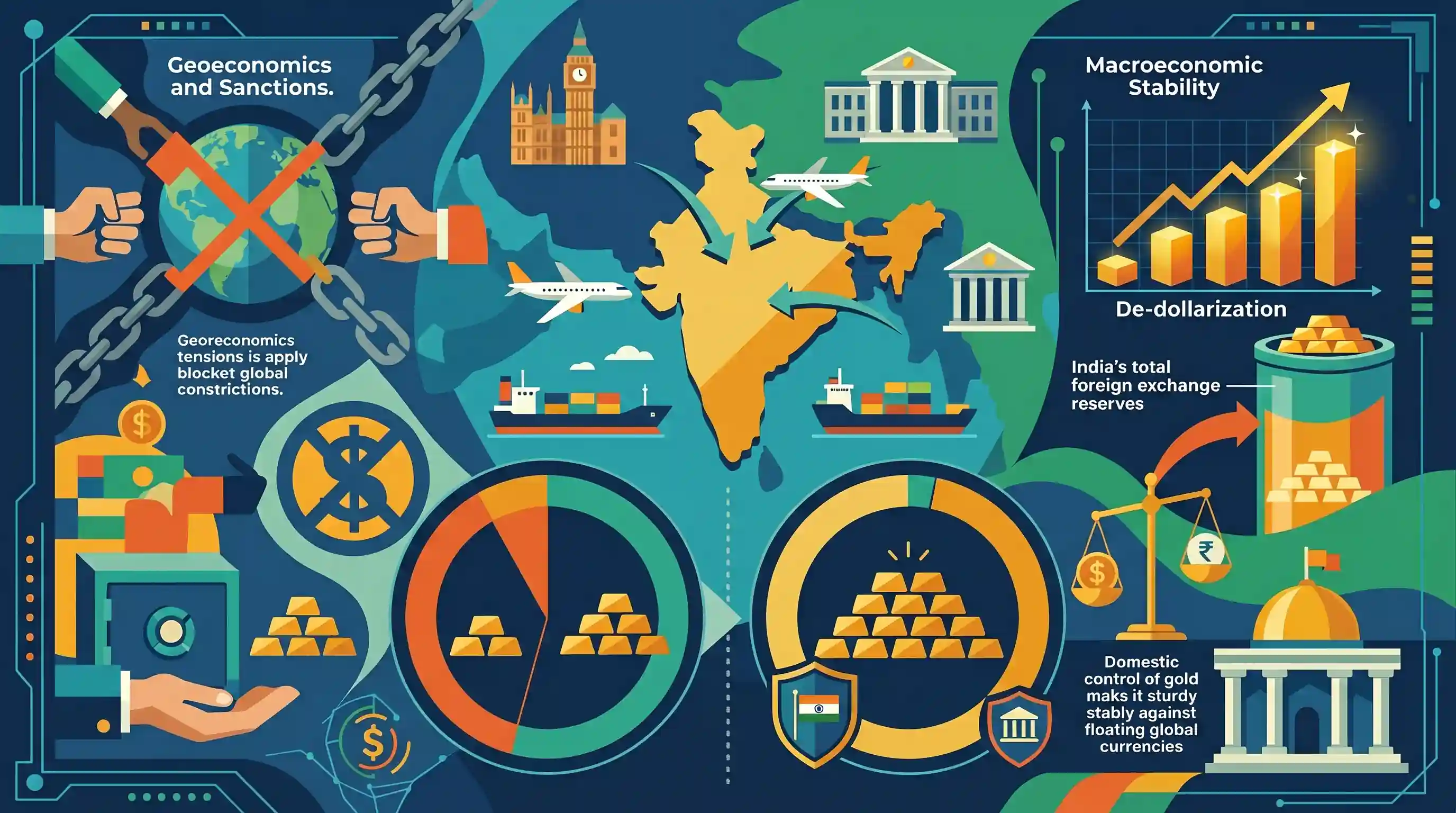
Highlights the intersection of geopolitical risk and macroeconomic policy, illustrating how global events (like sanctions on Russia) directly influence the RBI's asset management and reserve diversification strategies.
Summary
The Reserve Bank of India (RBI) has repatriated 168.06 metric tonnes of its gold reserves from the UK and the Bank for International Settlements in FY26. This move increases the share of domestically held gold to 77% of the RBI's total 880.52 MT reserves, up from 38% in FY23. The trend reflects a broader global shift towards "safe-haven" domestic storage by central banks, accelerated by geoeconomic uncertainties following the 2022 freezing of Russia's forex reserves by Western nations. Concurrently, due to appreciating global gold prices, the value of gold as a proportion of India's total foreign exchange reserves has climbed from 11.7% to 16.7%.
Key Points
- The RBI repatriated 168.06 MT of gold in FY26, the third consecutive year of moving over 100 MT back to India.
- Domestic storage now accounts for 77% (674.88 MT) of the RBI's total 880.52 MT gold reserves, a significant increase from 38% in March 2023.
- The strategic shift to domestic storage was triggered by the 2022 freezing of Russia's foreign exchange reserves, prompting central banks globally to mitigate geopolitical risks.
- Despite adding only 86 MT of gold over three years, gold's share in India's total forex reserves surged from 11.7% to 16.7% due to rising global gold prices.
- A World Gold Council survey indicated that 59% of central bank respondents now prefer storing gold domestically for security reasons.
Important Terms
Reserve Bank of India (RBI)

India's central bank, established in 1935, responsible for regulating the banking system, managing monetary policy, and overseeing the nation's foreign exchange and gold reserves to ensure financial stability.
UPSC context
GS-III Economy; tests understanding of monetary management, reserve diversification, and the central bank's role in maintaining macro-economic stability.
Bank for International Settlements (BIS)
An international financial institution owned by central banks to foster monetary cooperation. Known as the "bank for central banks," it serves as a global custodian and settlement agent for official reserves.
UPSC context
GS-III Economy; tests knowledge of international financial architecture and coordination between global central banks for financial stability.
Bank of England
The central bank of the United Kingdom and a primary global custodian for gold. It provides vaulting services for other nations, offering central banks access to the London gold market's liquidity.
UPSC context
GS-II/III Geopolitics and Economy; relevant for studying the custody of sovereign assets and shifts in global financial power dynamics.
Foreign Exchange (Forex) Reserves
Assets held by a central bank in foreign currencies, gold, and SDRs. They are used to back liabilities, influence exchange rates, and provide a buffer against external economic shocks.
UPSC context
GS-III Economy; critical for testing knowledge of the external sector, balance of payments, and currency management strategies.
World Gold Council (WGC)
A market development organization for the gold industry that tracks global demand. It provides data on central bank trends, such as the shift toward domestic storage and reserve diversification.
UPSC context
GS-III Economy; tests awareness of global commodity trends and their impact on sovereign financial and reserve strategies.
National Bank of Poland (NBP)
Poland's central bank, which has recently emerged as a top global gold buyer. Its strategy reflects a broader trend of central banks diversifying reserves to enhance strategic autonomy.
UPSC context
GS-III Economy; serves as a comparative case study for RBI's gold accumulation and global trends in reserve management.
Prelims Trap
Gold currently forms the largest component of India's foreign exchange reserves.
Despite its share rising to 16.7% due to price appreciation and accumulation, Foreign Currency Assets (FCAs) remain the overwhelmingly largest component of India's forex reserves.
Static Concepts Connected
What are the four components of India's Foreign Exchange Reserves?
- Foreign Currency Assets (FCAs): The largest component, consisting of foreign currencies like the US Dollar, Euro, Pound Sterling, and Japanese Yen.
- Gold Reserves: Physical and dematerialized gold held by the RBI, serving as a non-yielding safe-haven asset.
- Special Drawing Rights (SDRs): An international reserve asset created by the IMF to supplement member countries' official reserves.
- Reserve Tranche Position (RTP): The liquid portion of India's quota with the IMF that can be accessed without conditions.
What role does the Bank for International Settlements (BIS) play?
- Central Banks' Bank: It serves as a bank for central banks, fostering international monetary and financial cooperation.
- Reserve Management: It offers safe custody and management of foreign exchange and gold reserves for member central banks globally.
- Banking Supervision: It hosts the Basel Committee, which formulates global regulatory standards for bank capital and liquidity.
Cross-Topic Patterns
Forex shifts and Rupee Internationalization
The repatriation of gold aligns with broader de-dollarization efforts, mirroring India's push for Special Rupee Vostro accounts to insulate the domestic economy from Western financial sanctions.
SWIFT bans and Sovereign Nationalism
Freezing Russia's reserves in 2022 fundamentally shifted trust in Western financial hubs, directly driving this 'sovereign nationalism' in physical asset storage among emerging economies.

Expect a Prelims question linking forex reserve components, RBI's gold repatriation, and the macro trend of global de-dollarization.
Linked PYQs · 4
Linked PYQs · 4
- 2022PrelimsGS1
With reference to the Indian economy, consider the following statements: 1. If the inflation is too high, Reserve Bank of India (RBI) is likely to buy government securities. 2. If the rupee is rapidly depreciating, RBI is likely to sell dollars in the market. 3. If interest rates in the USA or European Union were to fall, that is likely to induce RBI to buy dollars. Which of the statements given above are correct?
- 2015MainsGS3
Craze for gold in Indians has led to a surge in import of gold in recent years and put pressure on balance of payments and external value of rupee. In view of this, examine the merits of the Gold Monetization Scheme.
- 2018MainsGS3
How would the recent phenomena of protectionism and currency manipulations in world trade affect macroeconomic stability of India?
- 2025MainsGS2
"With the waning of globalization, post-Cold War world is becoming a site of sovereign nationalism.” Elucidate.
