Stalled Southwest Monsoon Threatens Agriculture and Inflation
Source:The Hindu ↗
Why It Matters
Provides a vital contemporary context on how macro-climatic phenomena (El Niño, IOD, MJO) directly translate into economic challenges (food inflation, agricultural distress). It offers strong points for answers relating to crop diversification, water management, and the necessity of climate-resilient agriculture in India.
Summary
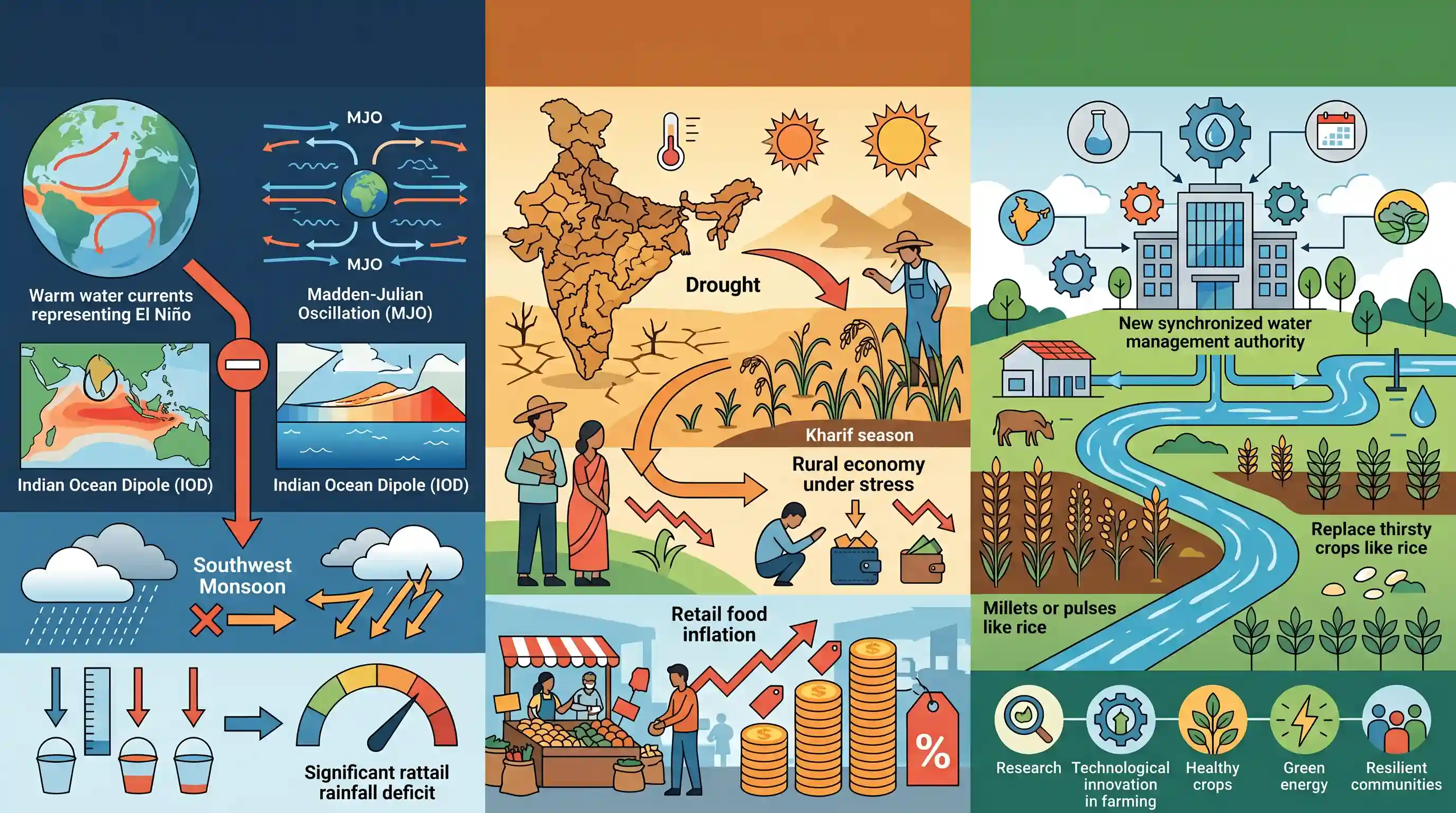
The editorial explores the stalling of India's Southwest Monsoon due to a moderate-to-strong El Niño, an unfavourable Madden-Julian Oscillation (MJO), and the absence of mitigation from the Indian Ocean Dipole (IOD). With a 43% rainfall deficit, agricultural stress is mounting, particularly in the kharif sowing season, threatening rural economies and triggering retail food inflation. The piece emphasizes the urgent need for long-term adaptation, suggesting a shift away from water-intensive crops and the creation of a centralized authority to synchronize inter-state water management with climate forecasts.
Key Points
- The Southwest Monsoon has stalled, creating a 43% rainfall deficit across Central and Northeast India due to a moderate-to-strong El Niño and unfavourable Madden-Julian Oscillation (MJO).
- The Indian Ocean Dipole (IOD) is currently unable to act as a buffer against these suppressive climate systems.
- The delayed rains severely threaten the kharif sowing window, prompting contingency measures in 111 highly vulnerable agricultural districts.
- Persistent heatwaves are causing reduced labour productivity and driving up retail food inflation, specifically in pulses and vegetables.
- The editorial advocates for transitioning away from water-intensive crops and establishing a nodal authority to coordinate water usage based on long-range IMD climate forecasts.
Important Terms
Southwest Monsoon

Seasonal winds reversing direction, bringing ~75% of India's rain from June-September; driven by differential heating between the Indian landmass and the ocean.
UPSC context
GS Paper I (Geography); tests understanding of India's primary climatic engine and its socio-economic impact.
El Niño
The "warm phase" of ENSO involving abnormal warming of the central/eastern equatorial Pacific, typically suppressing the Indian monsoon and increasing drought risk.
UPSC context
GS Paper I (Geography/Climatology); tests global atmospheric-oceanic teleconnections and their impact on Indian agriculture.
Madden-Julian Oscillation (MJO)
An eastward-moving tropical disturbance of clouds and rain (30-60 day cycle) that drives intra-seasonal monsoon variability and active/break spells.
UPSC context
GS Paper I (Geography); tests knowledge of intra-seasonal variability and short-term weather drivers.
Indian Ocean Dipole (IOD)
The sea surface temperature difference between the western and eastern Indian Ocean; its "positive" phase can offset El Niño's drying effects on India.
UPSC context
GS Paper I (Geography); tests regional oceanic influences on the monsoon compared to ENSO.
India Meteorological Department (IMD)
India's principal agency (Ministry of Earth Sciences) for meteorology and forecasting; critical for agricultural planning and disaster warnings.
UPSC context
GS Paper I/III; tests institutional frameworks for climate monitoring and agricultural advisory.
Kharif Crops
Monsoon-season crops sown with the rains (June-July) and harvested in autumn (Sept-Oct), including staples like rice, maize, and pulses.
UPSC context
GS Paper III (Agriculture); tests cropping patterns, food security, and the monsoon-economy link.
Ministry of Jal Shakti
Nodal ministry for integrated water management, river rejuvenation, and sanitation; manages inter-state water disputes and conservation schemes like "Catch the Rain."
UPSC context
GS Paper II/III; tests administrative reforms for water security and resource management.
Prelims Trap
"A positive Indian Ocean Dipole (IOD) exacerbates the negative impact of El Niño on the Indian Monsoon."
False. A positive IOD (warmer western Indian Ocean) enhances monsoon rainfall and acts as a buffer against El Niño. A negative IOD suppresses it.
Static Concepts Connected
How do the IOD and MJO influence the Indian Southwest Monsoon?
- Positive IOD: Warmer western Indian Ocean relative to the east enhances monsoon winds and moisture, often neutralizing El Niño's deficit.
- Madden-Julian Oscillation: An eastward-moving intraseasonal band of rain clouds. When situated over the Indian Ocean, it triggers strong monsoon pulses; moving away, it causes dry breaks.
How does a monsoon deficit translate into headline CPI inflation?
- Kharif Supply Shocks: Delayed sowing stunts production of rain-fed pulses, oilseeds, and vegetables, leading to acute supply constraints and price spikes.
- High Food Weightage: Food and beverages hold nearly 46% weight in the CPI. Thus, agricultural shortfalls disproportionately drive overall retail inflation.
Cross-Topic Patterns
MSP bias vs. Climate Resilience
Open-ended procurement of paddy and wheat disincentivizes farmers from shifting to climate-resilient pulses or millets, exacerbating groundwater depletion during monsoon deficits.
Federalism and Water Governance
Monsoon shortfalls instantly flare up inter-state river disputes (e.g., Cauvery). Proposed centralized water coordination challenges 'Water' being a State Subject under Schedule VII.

Expect a Prelims question pairing MJO periodicity with IOD phases, or a Mains Q linking El Niño to food inflation and crop diversification.
Linked PYQs · 5
Linked PYQs · 5
- 2017PrelimsGS1
With reference to 'Indian Ocean Dipole (IOD)' sometimes mentioned in the news while forecasting Indian monsoon, which of the following statements is/are correct? 1. IOD phenomenon is characterised by a difference in sea surface temperature between tropical Western Indian Ocean and tropical Eastern Pacific Ocean. 2. An IOD phenomenon can influence an El Nino's impact on the monsoon. Select the correct answer using the code given below:
- 2014MainsGS1
Most of the unusual climatic happenings are explained as an outcome of the El-Nino effect. Do you agree?
- 2023MainsGS3
Explain the changes in cropping pattern in India in the context of changes in consumption pattern and marketing conditions.
- 2021MainsGS3
What are the present challenges before crop diversification? How do emerging technologies provide an opportunity for crop diversification?
- 2025MainsGS3
Explain the factors influencing the decision of the farmers on the selection of high value crops in India.
