Southwest Monsoon Deficit and Indian Agricultural Economy
Source:The Hindu ↗
Why It Matters
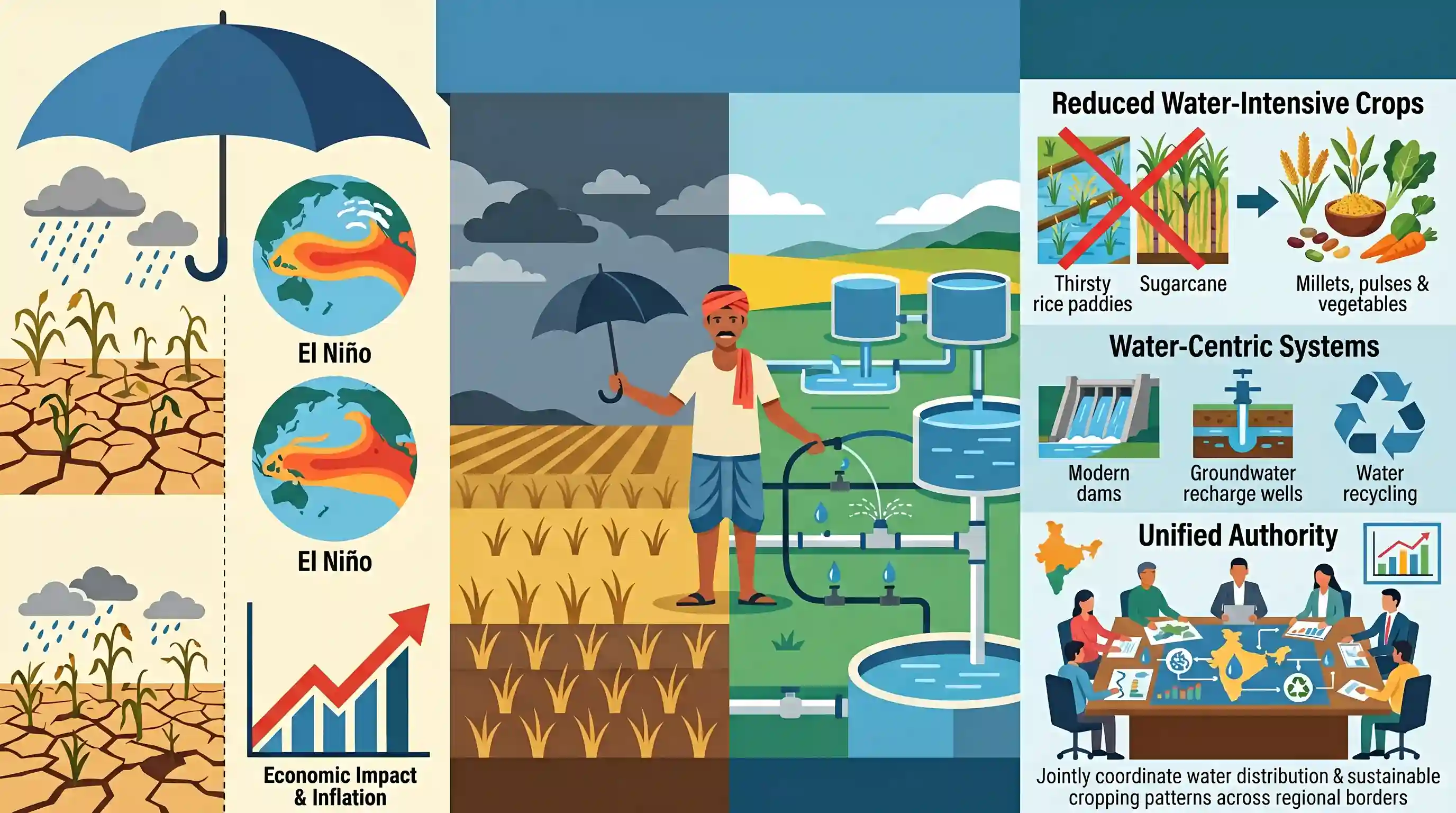
Highlights the compounding impacts of climate events on Indian agriculture and inflation, urging a governance shift from reactive to proactive water-centric crop planning. This is highly relevant for GS3 Mains (Irrigation and Cropping Patterns) and GS1 Prelims (Climatology).
Summary
The article highlights the threat of a widening southwest monsoon deficit and an impending El Niño to India's agriculture, rural economy, and inflation. Emphasizing the need to transition from a rain-centric to a water-centric agricultural system, it advocates for reduced reliance on water-intensive crops and the establishment of a unified authority to coordinate inter-state water use and cropping patterns.
Key Points
- The southwest monsoon deficit has widened to 43%, exacerbated by an expected El Niño, an unfavorable Madden-Julian Oscillation, and a neutral Indian Ocean Dipole.
- Agricultural production, particularly kharif sowing (rice, pulses, oilseeds) and plantation crops in the Western Ghats, faces severe risks due to high heat and lower soil moisture.
- Input stresses from global fertilizer supply chain issues (Chinese export curbs, West Asia tensions) compound the challenges for farmers.
- Lower agricultural yields threaten to drive up retail food inflation, further complicating monetary policy.
- The editorial advocates structural reforms, including shifting from a rain-centric to a water-centric agricultural model and deploying a dedicated authority to unify fragmented cropping and water governance.
Important Terms
India Meteorological Department (IMD)

Under the Ministry of Earth Sciences, the IMD is India's principal agency for meteorological observations, weather forecasting, and seismology, providing critical monsoon data and agromet advisories to farmers.
UPSC context
GS Paper I (Geography) and III (Disaster Management). Tests knowledge of institutional frameworks for climate monitoring and agricultural planning.
Southwest Monsoon
A seasonal wind reversal bringing roughly 75% of India’s annual rainfall (June–September), driven by differential heating between the Indian landmass and the surrounding oceans.
UPSC context
GS Paper I (Geography). Fundamental topic testing mechanisms of Indian climate and its socio-economic impact on agriculture.
El Niño
A climate phenomenon involving unusual warming of surface waters in the central/eastern tropical Pacific. It typically weakens the Indian monsoon, increasing the risk of agricultural drought.
UPSC context
GS Paper I (Geography) and III (Environment). Tests understanding of global climatic teleconnections and their impact on Indian food security.
Indian Ocean Dipole (IOD)
An oscillation of sea-surface temperatures between the western and eastern tropical Indian Ocean. A positive phase (warmer west) generally enhances the Indian monsoon and can offset El Niño’s effects.
UPSC context
GS Paper I (Geography). Tests advanced conceptual understanding of regional ocean-atmospheric couplings and year-to-year monsoon variability.
Jal Shakti Ministry
A nodal ministry formed in 2019 to oversee integrated water resources management, inter-state water disputes, river rejuvenation, and national drinking water security programs like Jal Jeevan Mission.
UPSC context
GS Paper II (Governance) and III (Water Management). Tests knowledge of administrative reforms for holistic water governance.
Cropping Patterns
The spatial and temporal arrangement of crops on a piece of land. Shifting toward more sustainable, water-centric patterns is vital for climate adaptation in rain-deficit regions.
UPSC context
GS Paper III (Agriculture). Crucial for questions on irrigation efficiency, crop diversification, and adaptation to monsoon variability.
Prelims Trap
"Like El Niño, the Madden-Julian Oscillation (MJO) is a stationary Pacific phenomenon that suppresses the Indian monsoon."
MJO is an eastward-traveling planetary wave, not stationary. While El Niño generally suppresses the monsoon, MJO actually enhances Indian monsoon convection when it passes over the Indian Ocean.
Static Concepts Connected
How do El Niño, IOD, and MJO distinctly impact the Indian Monsoon?
- El Niño: A warming of the central/eastern Pacific Ocean that creates high pressure over the Indian Ocean, typically suppressing Indian monsoon winds.
- Indian Ocean Dipole (IOD): The temperature difference between the western and eastern Indian Ocean. A positive phase (warmer west) counteracts El Niño and boosts monsoon rainfall.
- Madden-Julian Oscillation (MJO): An eastward-moving pulse of clouds and rainfall near the equator. It enhances monsoon convection when passing over the Indian Ocean.
Why is monetary policy often ineffective against monsoon-driven food inflation?
- Cost-Push Nature: Monsoon deficits cause immediate supply-side shocks and lower yields (cost-push inflation), rather than an increase in consumer demand (demand-pull inflation).
- Policy Limitations: Central bank rate hikes (like Repo Rate increases) compress aggregate demand but cannot resolve localized agricultural shortages or global fertilizer supply bottlenecks.
Cross-Topic Patterns
Monsoon deficit + Fertilizer Geopolitics
Climatic shocks (El Niño) compound with geopolitical shocks (West Asia LNG/ammonia disruptions, China export curbs), creating dual input-stress on India's agricultural output and subsidy burden.
Agro-climatic farming + Institutional fragmentation
A shift to 'water-centric' farming is hindered by siloed governance. Unifying Agriculture and Jal Shakti mandates is critical to enforce crop diversification and phase out water-guzzling monocultures.

Expect a multi-statement Prelims question in 2026 testing the interaction of MJO (moving) with stationary phenomena like ENSO and IOD.
Linked PYQs · 4
Linked PYQs · 4
- 2017PrelimsGS1
With reference to 'Indian Ocean Dipole (IOD)' sometimes mentioned in the news while forecasting Indian monsoon, which of the following statements is/are correct? 1. IOD phenomenon is characterised by a difference in sea surface temperature between tropical Western Indian Ocean and tropical Eastern Pacific Ocean. 2. An IOD phenomenon can influence an El Nino's impact on the monsoon. Select the correct answer using the code given below:
- 2020MainsGS3
Suggest measures to improve water storage and irrigation system to make its judicious use under depleting scenario.
- 2023MainsGS3
Explain the changes in cropping pattern in India in the context of changes in consumption pattern and marketing conditions.
- 2024MainsGS3
What are the major challenges faced by Indian irrigation system in recent times? State the measures taken by the government for efficient irrigation management.
