Judicial Oversight on Reflexive Arrests and Personal Liberty
Source:The Hindu ↗
આ શા માટે મહત્વનું છે
It addresses the vital intersection of criminal justice administration, civil liberties, and judicial oversight over executive and police powers, making it core to GS Paper 2 (Polity and Governance).
સારાંશ
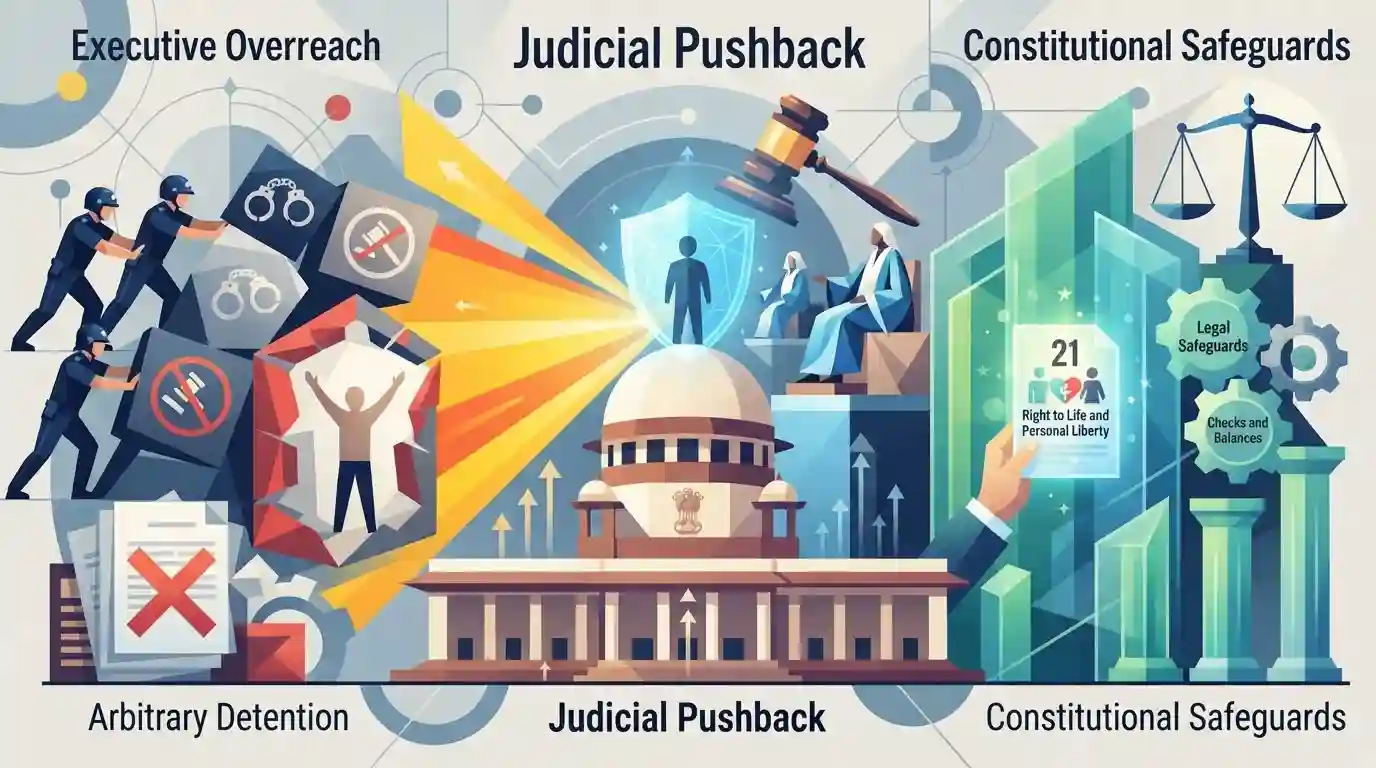
The Hindu editorial 'Ray of hope: on courts and reflexive arrests' explores the judicial pushback against routine and arbitrary arrests by law enforcement. It highlights how mechanical detention violates Article 21 and stresses the enforcement of legal safeguards to protect individual liberty and check executive overreach.
મુખ્ય મુદ્દા
- The article discusses the judiciary's increasing pushback against reflexive and routine arrests by law enforcement agencies, highlighting a ray of hope for civil liberties.
- Reflexive arrests violate fundamental constitutional guarantees under Article 21 (Right to Life and Personal Liberty).
- Courts are emphasizing that police powers to arrest should not be misused as an instrument of harassment or coercion, reiterating guidelines set in historical judgments like Arnesh Kumar v. State of Bihar.
- The editorial underscores the urgent need for structural accountability within the police machinery to curb arbitrary detentions and protect citizen rights.
મહત્વપૂર્ણ શબ્દો
Supreme Court of India

The apex judicial body of India, responsible for interpreting the Constitution, reviewing executive actions, and protecting fundamental rights, including personal liberty against arbitrary arrest.
UPSC context
UPSC Mains GS Paper II: Structure, Organization and Functioning of the Judiciary and judicial review of executive actions.
Article 21
Guarantees that no person shall be deprived of life or personal liberty except according to a procedure established by law that is fair, just, and reasonable.
UPSC context
UPSC Mains GS Paper II: Fundamental Rights and safeguards against arbitrary state action and executive overreach.
Arnesh Kumar v. State of Bihar
Landmark 2014 Supreme Court ruling establishing mandatory guidelines to prevent mechanical and routine arrests for offenses carrying imprisonment under seven years.
UPSC context
UPSC Mains GS Paper II: Judiciary, executive accountability, and protecting civil liberties against arbitrary policing.
પ્રિલિમ્સ ટ્રેપ
Offenses carrying a sentence of up to seven years permit routine and immediate arrest by the investigating officer without recorded justification.
Aspirants often assume that if an offense carries a sentence of up to 7 years, arrest is mandatory; however, Supreme Court guidelines prohibit mechanical detention without recorded satisfaction.
સંલગ્ન સ્થિર ખ્યાલો
What are the constitutional and statutory safeguards against arbitrary arrest in India?
- Article 21:: Guarantees protection of life and personal liberty, which cannot be deprived except according to procedure established by law.
- Article 22:: Mandates that no person arrested shall be detained without being informed of grounds and must be produced before a magistrate within 24 hours.
- Arnesh Kumar (2014):: Laid down mandatory checklists and procedures preventing automatic arrests for offenses carrying up to seven years imprisonment.
આંતર-વિષય પેટર્ન
Judicial Review vs Executive Overreach
The friction between executive law enforcement powers and judicial review under Article 21 directly reflects the classic checks and balances doctrine of the Basic Structure.
Criminal Law Reforms and Personal Liberty
Recent procedural transitions from the CrPC to the BNSS highlight how criminal law reforms intersect with fundamental rights safeguards.

Arnesh Kumar guidelines and Section 41 CrPC / BNSS arrest checks will feature in a statement-based Polity prelims question.
સંલગ્ન PYQ · 2
સંલગ્ન PYQ · 2
- 2024MainsGS2
Explain the reasons for the growth of public interest litigation in India. As a result of it, has the Indian Supreme Court emerged as the world's most powerful judiciary ?
- 2020MainsGS2
Judicial Legislation is antithetical to the doctrine of separation of powers as envisaged in the Indian Constitution. In this context justify the filing of large number of public interest petitions praying for issuing guidelines to executive authorities.
