Ratlam District Secures Top Rank in Madhya Pradesh CCTNS Evaluation
Source:the-times-of-india ↗
Why It Matters
This ranking highlights a successful, technology-driven model of policing in Madhya Pradesh. It serves as a key case study for e-governance, showing how grassroots-level administration can modernize the criminal justice delivery system through paperless workflows and real-time national data integration.
Summary
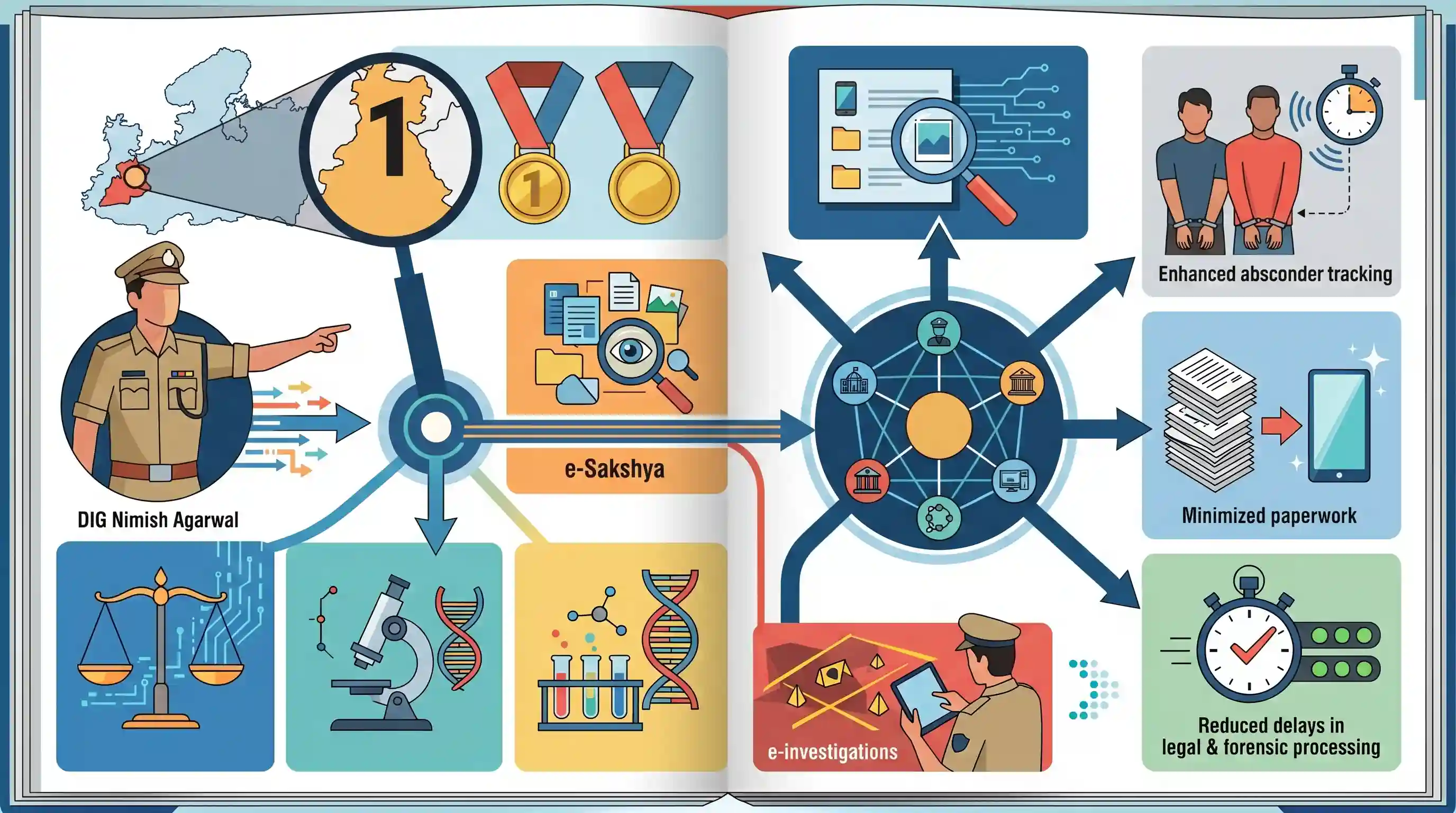
Ratlam district has emerged as the leader in digital policing by securing the first rank among Category 'A' districts in Madhya Pradesh's Crime and Criminal Tracking Network & Systems (CCTNS) rankings for May 2026. Released by the State Crime Records Bureau (SCRB), the rankings evaluate districts on compliance with CCTNS modules, database accuracy, and timely updates. Under DIG Nimish Agarwal, Ratlam has successfully established an end-to-end online crime management infrastructure, deploying advanced digital platforms such as e-Sakshya, e-Prosecution, e-FSL, and tablet-based e-investigations. Its seamless integration with the Inter-operable Criminal Justice System (ICJS) has enhanced tracking of absconders, minimized paperwork, and significantly reduced delays in legal and forensic processing.
Key Points
- Ratlam district secured the top position among Category 'A' districts in Madhya Pradesh's Crime and Criminal Tracking Network & Systems (CCTNS) rankings for May 2026, released by the State Crime Records Bureau (SCRB).
- Ratlam's performance shows consistent improvement, previously securing the first rank in March 2026 and the second rank in April 2026.
- The district's digital ecosystem incorporates specialized platforms like e-Sakshya (systematic documentation of crime scenes via photo/video), e-Prosecution, e-FSL, and e-Investigation.
- Integration with the Inter-operable Criminal Justice System (ICJS) enables investigators to access case histories from other districts and states, accelerating actions in multi-jurisdictional and inter-state cases.
- Operational efficiency has been improved through tablets issued for field investigations and the digitization of summons, warrants, postmortem reports, and medico-legal certificates.
Important Terms
Crime and Criminal Tracking Network & Systems (CCTNS)

A nationwide Indian e-governance project launched in 2009 that digitizes and connects all police stations to create a unified national database of crime and criminal records.
UPSC context
GS Paper 3 (Internal Security) & GS Paper 2 (Governance). Tests understanding of e-governance and administrative reforms in policing.
Inter-operable Criminal Justice System (ICJS)
A national platform integrating five core pillars of India’s justice delivery system—police, courts, prisons, prosecution, and forensics—for seamless, paperless end-to-end data exchange.
UPSC context
GS Paper 2 (Judiciary & Governance). Tests knowledge of digital infrastructure and technology-driven reforms in criminal justice delivery.
e-Sakshya
A secure mobile application developed by the NIC for police to record, time-stamp, and upload crime-scene evidence to maintain an uncompromised chain of digital custody.
UPSC context
GS Paper 3 (Security & Technology). Tests implementation of technology under India's new criminal laws like the BNSS.
e-Prosecution
A digital workflow application under the ICJS framework that assists public prosecutors in monitoring cases, analyzing charge sheets, and exchanging real-time digital files with police departments.
UPSC context
GS Paper 2 (Judiciary & e-Governance). Tests knowledge of digitization tools to speed up judicial trials and reduce undertrial pendency.
State Crime Records Bureau (SCRB)
A state-level police agency responsible for maintaining and analyzing crime statistics, acting as the local coordinating node for national databases managed by the NCRB.
UPSC context
GS Paper 3 (Internal Security). Tests understanding of federal institutional mechanisms for crime documentation and data coordination.
Prelims Trap
CCTNS is implemented by the National Informatics Centre (NIC) under the Ministry of Electronics and Information Technology.
While CCTNS is a Mission Mode Project under the NeGP, its nodal implementing agency is the National Crime Records Bureau (NCRB) under the Ministry of Home Affairs.
Static Concepts Connected
What are the five core pillars integrated under the Inter-operable Criminal Justice System (ICJS)?
- Police (CCTNS): Acts as the foundational database for FIR registry and tracking criminals.
- e-Courts: Enables digital transmission of chargesheets, judicial summons, and case histories to the judiciary.
- e-Prisons: Digitizes jail management, tracking inmate custody status, and linking profiles with court databases.
- Forensics and Prosecution: Links forensic science laboratories (e-FSL) and public prosecutors to accelerate trial preparation and evidence verification.
What is the origin and mandate of the CCTNS project?
- Genesis: Conceptualized post the 2008 Mumbai attacks to connect India's fragmented state police databases.
- Nodal Authority: Implemented as a Mission Mode Project by the National Crime Records Bureau under the Ministry of Home Affairs.
Cross-Topic Patterns
Digital Evidence vs. Constitutional Protections
Mandatory digital recording under BNSS intersects with Article 21 (Privacy) and Article 20(3) (Self-Incrimination) regarding the custodial integrity of digital evidence.
Federalism and Police Modernization
Though 'Police' is a State List subject, central systems like ICJS mandate national-level technological convergence, reshaping Center-State administrative relations.

Mandated digital investigations under BNSS by 2027 will trigger conceptual prelims questions on ICJS pillars and e-evidence admissibility.
Linked PYQs · 2
Linked PYQs · 2
- 2024MPPSC_PRELIMSGS1
What are the four pillars of E-Governance?
- 2021MPPSC_PRELIMSGS1
Important concept(s) introduced in IT Act, 2000
