India Economic Policy Response to US Protectionism
Source:The Hindu ↗
Why It Matters
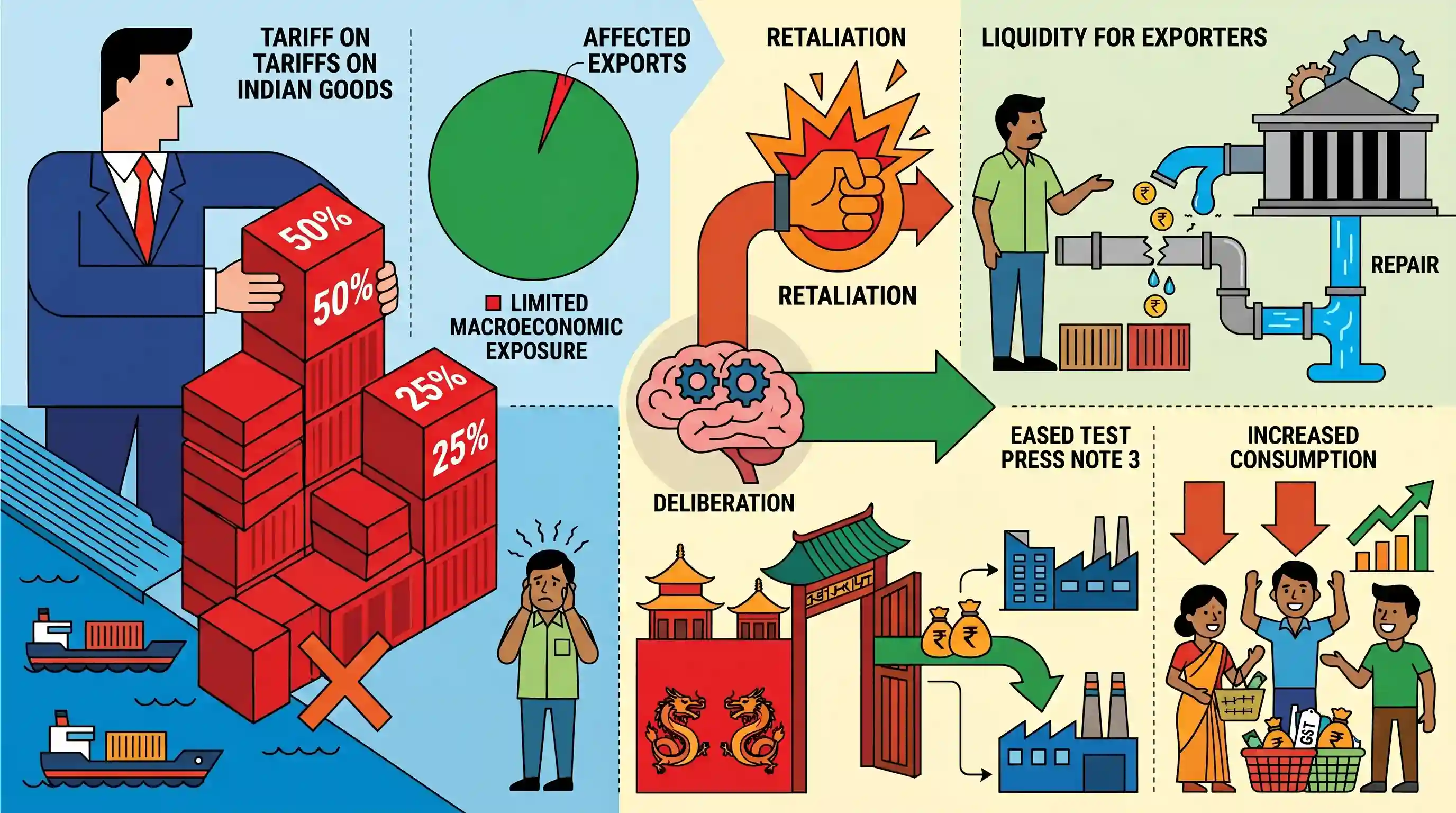
The article highlights India's economic diplomacy and domestic policy resilience in the face of protectionist trade measures by a major partner. It demonstrates the interplay between managing external shocks (tariffs) and executing internal adjustments (GST cuts, FDI liberalization) to sustain economic growth.
Summary
The article analyzes India's pragmatic response to the U.S.'s recent imposition of 50% baseline tariffs and an additional 25% 'penalty' tariff on Indian goods. Recognizing that the macroeconomic exposure is relatively limited—since the affected exports form a tiny fraction of India's GDP—the Indian government has avoided emotional retaliation to provocative U.S. statements. Instead, it is focusing on mitigating the localized impact by addressing the impending liquidity crunch for exporters. To counterbalance the trade friction, India is exploring strategic economic pivots, including easing COVID-19-era restrictions on Chinese FDI (Press Note 3) to attract investment and implementing GST rate cuts to stimulate domestic consumption.
Key Points
- The U.S. has imposed steep 50% baseline tariffs and a 25% 'penalty' tariff on certain Indian exports, raising concerns about trade friction.
- The overall macroeconomic impact on India is expected to be limited, as the affected exports constitute a very small proportion of India's total GDP.
- The Indian government has maintained a pragmatic, non-emotional stance, avoiding retaliatory escalation over provocative rhetoric from U.S. officials.
- To support affected exporters, the government is looking at targeted measures to prevent an impending liquidity crunch.
- India is exploring broader strategic economic adjustments, including potential GST rate cuts to stimulate domestic consumption and easing the COVID-19-era Press Note 3 to attract Chinese Foreign Direct Investment (FDI).
Important Terms
Press Note 3

A 2020 regulation requiring prior government approval for Foreign Direct Investment (FDI) from countries sharing a land border with India to prevent opportunistic takeovers during economic distress.
UPSC context
GS Paper III (Economy/Investment Models); critical for understanding India's strategic economic safeguards and recent shifts in FDI diplomacy.
Goods and Services Tax (GST)
A comprehensive, destination-based indirect tax levied on the supply of goods and services, aimed at creating a unified national market by subsuming various central and state taxes.
UPSC context
GS Paper III (Indian Economy/Fiscal Policy); essential for topics on taxation, federalism, and domestic consumption stimulus.
GST Rate Rationalization
The process of simplifying the multi-tiered GST tax structure by reducing the number of slabs and adjusting rates to boost consumption and reduce compliance burdens.
UPSC context
GS Paper III (Economy); tests knowledge of tax reforms as a tool for macroeconomic stabilization and ease of doing business.
Foreign Direct Investment (FDI) Policy
Investment by a foreign entity into an Indian business, which can come through the 'Automatic Route' (no prior approval) or the 'Government Route' (requires approval).
UPSC context
GS Paper III (Economy); core topic for external sector and investment trends.
Reciprocal Tariff
A tariff imposed by a country on imports from another country in response to similar tariffs or trade barriers placed on its own exports.
UPSC context
GS Paper II (International Relations) & GS III (Economy); relevant for trade wars, India-US bilateral relations, and WTO principles.
Macroeconomic Exposure
The degree to which a country's overall economic indicators—such as GDP, inflation, or exchange rates—are vulnerable to external shocks or trade disruptions.
UPSC context
GS Paper III (Economy); involves analyzing the systemic impact of external trade barriers on national growth and stability.
Prelims Trap
FDI from countries sharing a land border with India is strictly prohibited under Press Note 3.
Press Note 3 of 2020 does not prohibit FDI; it only mandates that such investments must come through the 'government route' (requiring prior approval).
Static Concepts Connected
What is the regulatory mechanism of Press Note 3 (2020) for FDI?
- Government Route: Requires prior government approval for FDI from entities in, or beneficial owners situated in, countries sharing a land border with India.
- Beneficial Ownership: Applies to indirect control, closing loopholes where investments are routed through third countries to mask true origin.
- Core Objective: Originally enacted to prevent opportunistic takeovers and acquisitions of vulnerable domestic Indian firms during the pandemic.
How does counter-cyclical fiscal policy operate during external trade shocks?
- Expansionary Policy: Involves increasing government spending or cutting taxes to stimulate a slowing economy and counter negative external shocks.
- Tax Cuts: Reducing indirect taxes like GST lowers retail prices, boosting consumers' disposable income and driving domestic demand.
- Domestic Buffering: By stimulating domestic consumption, the government offsets the macroeconomic drag caused by falling export revenues or hostile foreign tariffs.
Cross-Topic Patterns
Strategic FDI re-coupling (IR + Economy)
Easing Chinese FDI restrictions to counter U.S. tariff shocks shows how geoeconomics forces tactical alignments, insulating domestic capital needs from ongoing border disputes.
Export liquidity vs. WTO ASCM limits
Utilizing the Interest Equalisation Scheme provides crucial liquidity to exporters without violating the WTO's strict Agreement on Subsidies and Countervailing Measures (ASCM).

Expect a 2026 multi-statement question linking U.S. tariff impacts, counter-cyclical fiscal measures, and FDI routes like Press Note 3.
Linked PYQs · 4
Linked PYQs · 4
- 2012MainsGS2
Discuss the likely negative impact of the protectionist measures proposed by the US on India's software industry.
- 2020PrelimsGS1
With reference to Foreign Direct Investment in India, which one of the following is considered its major characteristic?
- 2021PrelimsGS1
Consider the following statements : The effect of devaluation of a currency is that it necessarily 1. improves the competitiveness of the domestic exports in the foreign markets 2. increases the foreign value of domestic currency 3. improves the trade balance Which of the above statements is/are correct?
- 2023MainsGS3
Faster economic growth requires increased share of the manufacturing sector in GDP, particularly of MSMEs. Comment on the present policies of the Government in this regard.
