Bihar Electoral Gender Ratio Drops Despite State Welfare Schemes
Source:Indian Express ↗
Why It Matters
Understanding the gap between state welfare initiatives and actual electoral participation is critical for GS-2 (Elections, Welfare Schemes). It highlights that social empowerment schemes do not automatically guarantee political empowerment or gender parity in voter rolls.
Summary
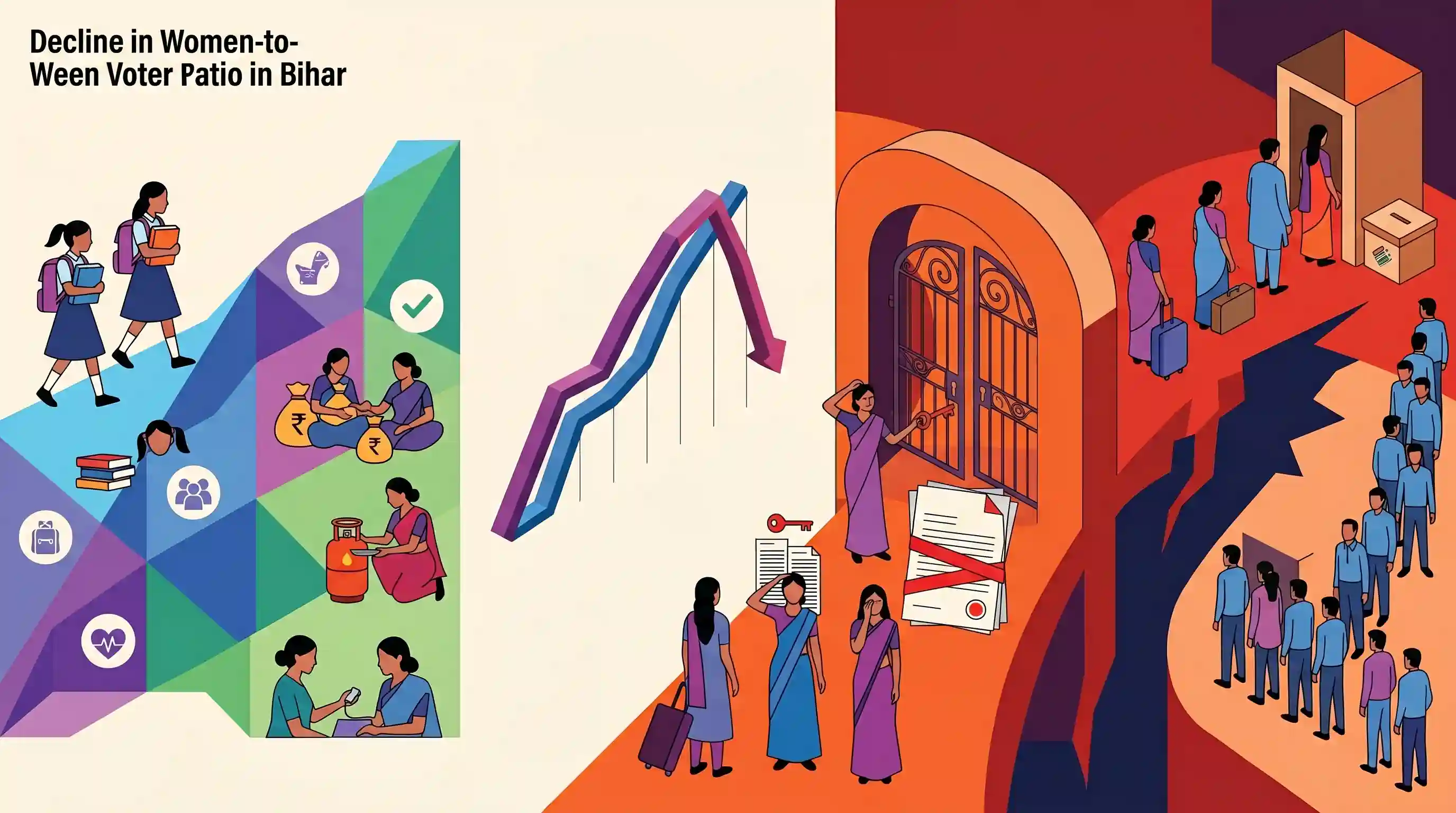
Despite a sustained state-level focus on women-centric welfare policies over the last decade and a half, the ratio of women to men voters in Bihar has declined for the first time in 15 years. This inverse trend exposes a crucial gap between the socio-economic targeting of women via welfare schemes and their actual political mobilization and voter registration. It underscores the ongoing demographic and administrative challenges in translating welfare-based gender equity into robust electoral and democratic participation.
Key Points
- For the first time in 15 years, the ratio of women to men voters in Bihar's electoral rolls has registered a decline, widening the electoral gender gap.
- This statistical drop occurs paradoxically against the backdrop of numerous women-centric welfare schemes initiated by the state government, such as the cycle scheme for girls and liquor prohibition.
- The trend indicates a potential disconnect between women's status as passive beneficiaries of social welfare and their active political empowerment through voter registration.
- The decline highlights the persistence of administrative and socio-cultural barriers in enrolling female voters, necessitating targeted interventions by the Election Commission and civil society.
Important Terms
Mukhyamantri Balika Cycle Yojana

Bihar government's scheme providing financial aid to Class 9 girls for purchasing bicycles. It aims to reduce secondary school dropout rates and promote female mobility and social empowerment in rural areas.
UPSC context
GS Paper 2 (Welfare Schemes) and Paper 1 (Social Empowerment). Tests knowledge of gender-based interventions and their impact on education.
Jeevika (Bihar Rural Livelihoods Project)
A World Bank-assisted project in Bihar promoting poverty alleviation through Self-Help Groups (SHGs). It focuses on the social and economic empowerment of rural women through financial inclusion and diversified livelihoods.
UPSC context
GS Paper 2 (Development Processes) and Paper 3 (Livelihoods). Tests understanding of SHG-led models for rural poverty alleviation and women’s empowerment.
Mukhyamantri Kanya Utthan Yojana
A flagship conditional cash transfer scheme in Bihar providing financial support from birth until graduation. It aims to prevent child marriage, improve sex ratios, and ensure higher education for girls.
UPSC context
GS Paper 2 (Issues related to Women/Children). Tests awareness of comprehensive social welfare models and their impact on demographic indicators.
Gender Ratio in Electoral Rolls
The number of female voters registered per 1,000 male voters on the electoral roll. This demographic metric reflects gender-based participation and inclusion within a region’s political system.
UPSC context
GS Paper 1 (Population Issues) and Paper 2 (Electoral Reforms). Tests analysis of demographic shifts and gender gaps in political representation.
Special Intensive Revision (SIR)
A time-bound exercise by the Election Commission to update electoral rolls by deleting dead, shifted, or duplicate voters. Recent data from Bihar showed this process impacted registered female voter ratios.
UPSC context
GS Paper 2 (Electoral Governance/RPA). Tests understanding of administrative procedures for maintaining the purity and accuracy of electoral databases.
Election Commission of India (ECI)
The autonomous constitutional body (Article 324) responsible for managing Union and State elections. It oversees the preparation of electoral rolls and promotes inclusive voter registration through the SVEEP program.
UPSC context
GS Paper 2 (Constitutional Bodies/RPA). Tests knowledge of the institution's role in ensuring free, fair, and inclusive democratic processes.
Prelims Trap
"Higher female voter turnout in recent elections indicates that the electoral gender ratio is now favorable for women."
Voter turnout is the percentage of registered voters who actually vote. Electoral sex ratio is the ratio of registered women to men, which often lags behind both demographic sex ratio and female turnout rates.
Static Concepts Connected
What are the constitutional and statutory provisions for voter registration in India?
- Article 326: Guarantees universal adult suffrage for elections to the Lok Sabha and State Legislative Assemblies without discrimination based on sex.
- RPA 1950: Governs the preparation, revision, and updating of electoral rolls, as well as the qualifications and disqualifications of voters.
- Ordinary Resident rule: Requires an individual to be an "ordinary resident" of a constituency to be enrolled, a rule often complicated by post-marriage female migration.
What is the ECI's SVEEP programme?
- Core Mandate: Systematic Voters’ Education and Electoral Participation is the Election Commission's flagship program for voter education and awareness.
- Bridging the Gap: It specifically targets demographic gaps in electoral rolls, utilizing targeted interventions to bridge the gender gap and combat urban and youth apathy.
Cross-Topic Patterns
Welfare schemes vs. Active political agency
The paradox of high female welfare beneficiaries (via SHGs and cash transfers) failing to register as voters exposes the limitations of state-led "passive empowerment" in driving active democratic participation.
Post-marriage migration and electoral rolls
Administrative disenfranchisement of women is closely tied to post-marriage relocation, connecting RPA 1950 residency rules with sociological migration patterns and document accessibility.

Expect a Prelims trap confusing "women voter turnout" with "electoral gender ratio," linked to Article 326 and ECI's SVEEP initiatives.
Linked PYQs · 5
Linked PYQs · 5
- 2021PrelimsGS1
Consider the following statements : 1. The Montagu-Chelmsford Reforms of 1919 recommended granting voting rights to all the women above the age of 21. 2. The Government of India Act of 1935 gave women reserved seats in legislature. Which of the statements given above is/are correct?
- 2017PrelimsGS1
Right to vote and to be elected in India is a
- 2024MainsGS1
Distinguish between gender equality, gender equity and women's empowerment. Why is it important to take gender concerns into account in programme design and implementation?
- 2019MainsGS2
Performance of welfare schemes that are implemented for vulnerable sections is not so effective due to absence of their awareness and active involvement at all stages of policy process. Discuss.
- 2023MainsGS2
Discuss the contribution of civil society groups for women's effective and meaningful participation and representation in state legislatures in India.
