RBI Notes Moderation in Monetary Policy Transmission
Source:The Hindu ↗
Why It Matters
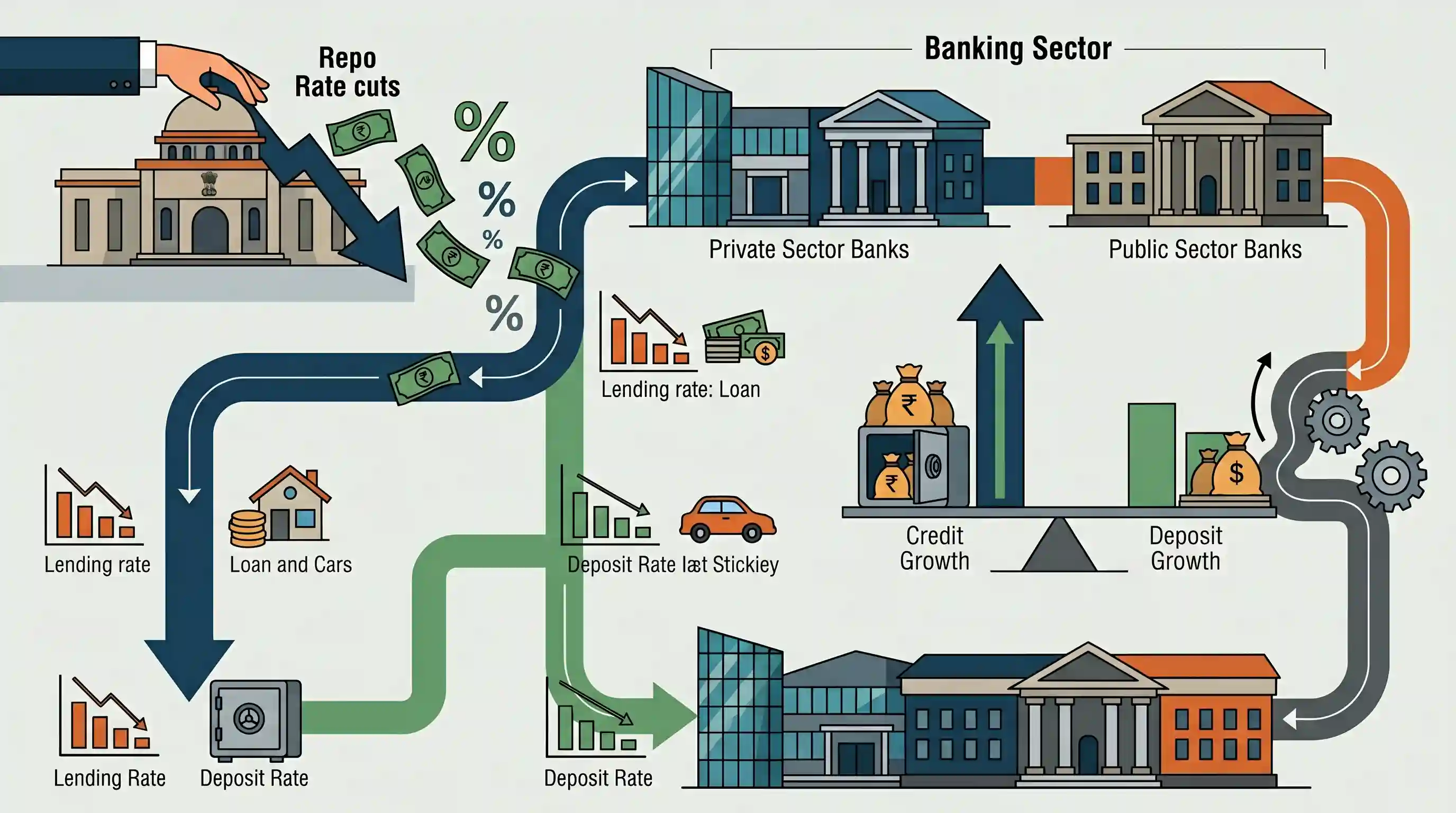
Effective monetary policy transmission is essential for the RBI to manage inflation and stimulate growth. Uneven pass-through of repo rate cuts impacts borrowing costs for consumers and businesses, while structural issues like the credit-deposit growth gap highlight challenges in banking sector liquidity.
Summary
The RBI's June 2026 bulletin reveals a moderation in the transmission of recent repo rate cuts to domestic lending and deposit rates as of May 2026. Monetary policy transmission remains asymmetric and uneven, with private banks lowering lending rates more swiftly than public sector banks, which instead prioritized cuts to deposit rates. Additionally, a persistent structural gap exists between credit growth and deposit growth, which complicates liquidity management for banks and further blunts the pass-through of the RBI's monetary easing cycle.
Key Points
- Transmission of RBI's monetary policy easing to bank lending and deposit rates moderated in May 2026.
- Repo rate increased by 250 basis points (May 2022-Jan 2025) and subsequently decreased by 85 bps (Feb 2025-April 2026).
- Private sector banks demonstrated stronger transmission of rate cuts to lending rates, whereas public sector banks transmitted more to deposit rates.
- Bank credit growth (17.7%) continued to significantly outpace deposit growth (12.2%), forcing banks to balance liquidity requirements.
Important Terms
Monetary Policy Transmission

The process through which central bank policy actions, like repo rate changes, influence economic variables such as borrowing costs, credit availability, and inflation, representing the "pass-through" of policy rates to the real economy.
UPSC context
GS3: Economy. Tests understanding of the mechanism from central bank actions to real economic outcomes like inflation and growth.
Repo Rate
The benchmark interest rate at which the Reserve Bank of India lends short-term funds to commercial banks against government securities. It is the primary tool for signaling monetary stance and managing liquidity.
UPSC context
GS3: Economy. Essential for Prelims and Mains regarding monetary policy tools, liquidity management, and borrowing costs.
Credit-Deposit Ratio
A financial metric measuring the proportion of a bank's total deposits deployed as loans. A high ratio suggests aggressive lending or deposit shortages, potentially signaling liquidity stress and hindering policy rate transmission.
UPSC context
GS3: Economy. Important for analyzing banking sector health, systemic liquidity risks, and structural constraints on credit growth.
Monetary Policy Committee (MPC)
A statutory six-member body chaired by the RBI Governor that determines benchmark interest rates. It is mandated to maintain price stability while supporting growth through a flexible inflation-targeting framework.
UPSC context
GS3: Economy. Focuses on institutional frameworks, the RBI Act amendment, inflation targeting, and rule-based monetary decision-making.
Public Sector Banks (PSBs)
Commercial banks where the government holds a majority stake (over 50%). They play a key role in financial inclusion but often experience slower interest rate transmission compared to private sector counterparts.
UPSC context
GS3: Economy. Relevant for banking reforms, NPA management, and comparative analysis of state-owned vs. private banking efficiency.
Private Sector Banks
Banks owned by private individuals or institutions rather than the government. In India, they are generally noted for higher operational efficiency and more rapid transmission of monetary policy changes.
UPSC context
GS3: Economy. Tests knowledge of banking competition, sectoral efficiency, and the role of private capital in financial intermediation.
Prelims Trap
Adoption of EBLR ensures immediate and uniform transmission of repo rate cuts to all bank loans.
EBLR is mandatory only for retail and MSME floating-rate loans. A large share of wholesale/corporate loans remain on MCLR, causing asymmetric and delayed overall transmission.
Static Concepts Connected
What structural factors hinder monetary policy transmission in India?
- High C-D Ratio: When credit demand outpaces deposit growth, banks must keep deposit rates high to attract funds, which directly limits their ability to cut lending rates.
- Small Savings Rates: Government-administered high rates on small savings schemes compete with bank deposits, enforcing downward stickiness on bank deposit rates.
- MCLR Overhang: A significant portion of legacy and corporate loans are still priced on internal benchmarks (MCLR), delaying the pass-through of repo rate changes.
How does the External Benchmark Lending Rate (EBLR) differ from MCLR?
- External Peg: While MCLR is based on internal cost of funds, EBLR forces banks to link specific floating-rate loans to external anchors like the Repo Rate or FBIL yields.
- Reset Frequency: Interest rates under EBLR must be reset at least once in three months, ensuring faster transmission compared to the annual resets often seen with MCLR.
Cross-Topic Patterns
Credit-Deposit Ratio & Liquidity Risks
A widening gap between credit and deposit growth forces banks to rely on wholesale funding, linking poor monetary transmission directly to Basel III Liquidity Coverage Ratio (LCR) vulnerabilities.
Small Savings vs. Bank Deposits
Sticky administered rates on PPF and NSC prevent banks from lowering deposit rates, demonstrating how fiscal policy decisions (small savings) complicate RBI's monetary policy transmission.

Expect a 2026 prelims question linking a high credit-deposit ratio to downward stickiness in lending rates during an RBI easing cycle.
Linked PYQs · 3
Linked PYQs · 3
- 2016PrelimsGS1
What is/are the purpose/purposes of the 'Marginal Cost of Funds based Lending Rate (MCLR)' announced by RBI? 1. These guidelines help improve the transparency in the methodology followed by banks for determining the interest rates on advances. 2. These guidelines help ensure availability of bank credit at interest rates which are fair to the borrowers as well as the banks. Select the correct answer using the code given below.
- 2024MainsGS3
What are the causes of persistent high food inflation in India? Comment on the effectiveness of the monetary policy of the RBI to control this type of inflation.
- 2017MainsGS3
Among several factors for India's potential growth, savings rate is the most effective one. Do you agree? What are the other factors available for growth potential?
