Andaman Limestone Caves Biodiversity Discovery and Subterranean Fauna
Source:The Hindu ↗
Why It Matters
It draws attention to the often-overlooked subterranean ecosystems and endemic fauna, reinforcing the necessity of protecting karst landscapes and localized micro-habitats from ecological degradation.
Summary
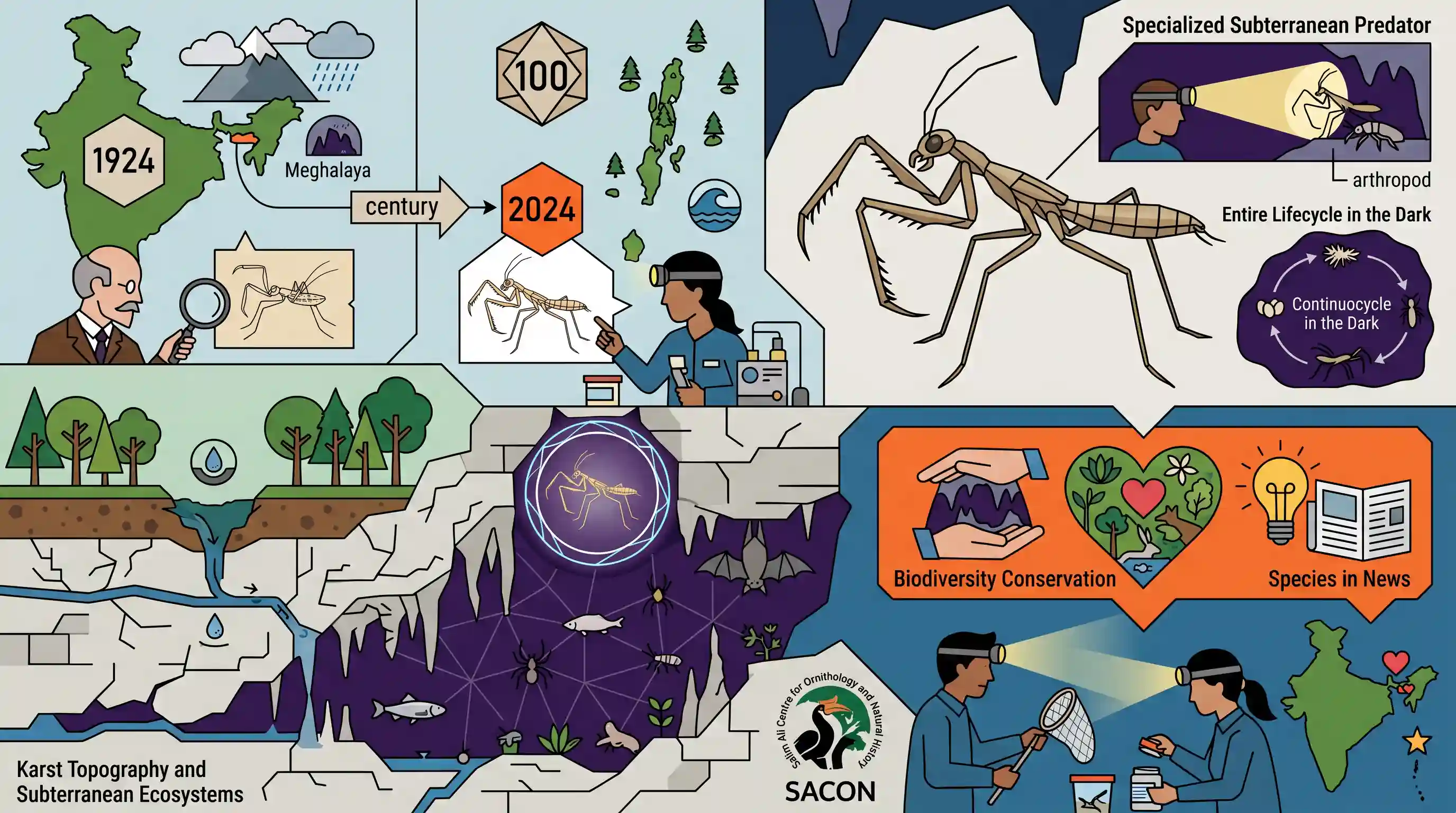
A rare species of thread-legged assassin bug (Myiophanes kempi) has been rediscovered in the limestone caves of the Andaman Islands a century after it was first described. Originally identified from the Siju Cave in Meghalaya in 1924, this specialized subterranean predator spends its entire lifecycle in the dark, feeding on small arthropods. The discovery, facilitated by researchers from the Salim Ali Centre for Ornithology and Natural History, underscores the unique and fragile biodiversity harbored within India's karst ecosystems and cave environments.
Key Points
- A rare thread-legged assassin bug (Myiophanes kempi), not seen for 100 years, was rediscovered in the limestone caves of the Andaman Islands.
- The species was first described in 1924 by a British entomologist from specimens collected at Siju Cave in Meghalaya.
- This bug is a highly specialized subterranean predator belonging to the Reduviidae family, completing its entire lifecycle in dark cave ecosystems.
- The rediscovery highlights the relatively unexplored biodiversity of karst topography and subterranean habitats in India.
Important Terms
Myiophanes kempi

A rare, cave-dwelling predator from the Reduviidae family, recently rediscovered in Andaman limestone caves after 100 years. It is specialized for life in complete darkness.
UPSC context
GS Paper III: Biodiversity. Tests knowledge of 'Species in News' and unique adaptations in Indian subterranean ecosystems.
Salim Ali Centre for Ornithology and Natural History (SACON)
An autonomous research institution under the Ministry of Environment, Forest and Climate Change (now under Wildlife Institute of India), dedicated to bird conservation and natural history.
UPSC context
GS Paper III: Environmental Institutions. Relevant for governance and institutional frameworks for biodiversity conservation in India.
Siju Cave
A 4.7-km long limestone cave system in Meghalaya’s South Garo Hills; one of India's most researched caves for its unique biospeleology (cave-dwelling fauna).
UPSC context
GS Paper I & III: Geography/Biodiversity. Tests awareness of significant geological sites and karst hotspots in Northeast India.
Karst Topography
A landscape formed by the dissolution of soluble rocks like limestone, dolomite, and gypsum, characterized by sinkholes, caves, and underground drainage systems.
UPSC context
GS Paper I: Physical Geography. Core geomorphology topic involving landform evolution through chemical weathering and groundwater action.
Troglobitic Species
An organism that is physically and physiologically adapted to live exclusively in the dark environment of caves throughout its entire lifecycle.
UPSC context
GS Paper III: Environment and Ecology. Relevant for understanding niche specialization and evolutionary adaptations in fragile ecosystems.
Prelims Trap
The recently rediscovered thread-legged assassin bug is endemic to the limestone caves of the Andaman Islands.
It was originally discovered in Siju Cave, Meghalaya in 1924. Thus, despite its rediscovery in the Andamans, it is not strictly endemic to the archipelago.
Static Concepts Connected
What are the primary landforms associated with Karst topography?
- Erosional features: Includes sinkholes, dolines, uvalas, and lapies, formed by the chemical weathering and dissolution of soluble rocks like limestone and dolomite.
- Depositional features: Includes stalactites (hanging), stalagmites (rising), and pillars, formed by the slow precipitation of calcium carbonate from dripping water in caves.
What is the administrative status of SACON?
- Nodal Ministry: It is an autonomous Centre of Excellence under the Ministry of Environment, Forest and Climate Change (MoEFCC).
- Location & Trap: Headquartered in Coimbatore, Tamil Nadu. This frequently causes confusion with the Salim Ali Bird Sanctuary, which is located in Goa.
Cross-Topic Patterns
Convergent evolution in troglobites
Subterranean species independently evolve similar traits like blindness, lack of pigmentation, and elongated sensory appendages to survive extreme, dark, nutrient-poor cave ecosystems.
Cave geography match-ups
Siju Cave (Meghalaya) often features in mapping questions alongside Borra and Belum caves to test knowledge of India's prominent limestone and karst landscapes across different tectonic zones.

Expect a matched-pair question linking notable Indian cave systems (Siju, Borra, Belum) with their states or specific karst geomorphology.
Linked PYQs · 3
Linked PYQs · 3
- 2024PrelimsGS1
The organisms “Cicada, Froghopper and Pond skater" are:
- 2020PrelimsGS1
With reference to India's biodiversity, Ceylon frogmouth, Coppersmith barbet, Gray-chinned minivet and White-throated redstart are
- 2019PrelimsGS1
What is common to the places known as Aliyar, Isapur and Kangsabati?
