Snowfall in Saudi Arabia points to extreme regional climate shifts
Source:Indian Express ↗
Why It Matters
The event serves as a prime case study for GS-1 Geography and Climatology regarding anomalous weather phenomena in arid regions. It underscores the broader narrative of changing global climate patterns and the increasing frequency of extreme weather, which are recurring themes in UPSC Mains questions.
Summary
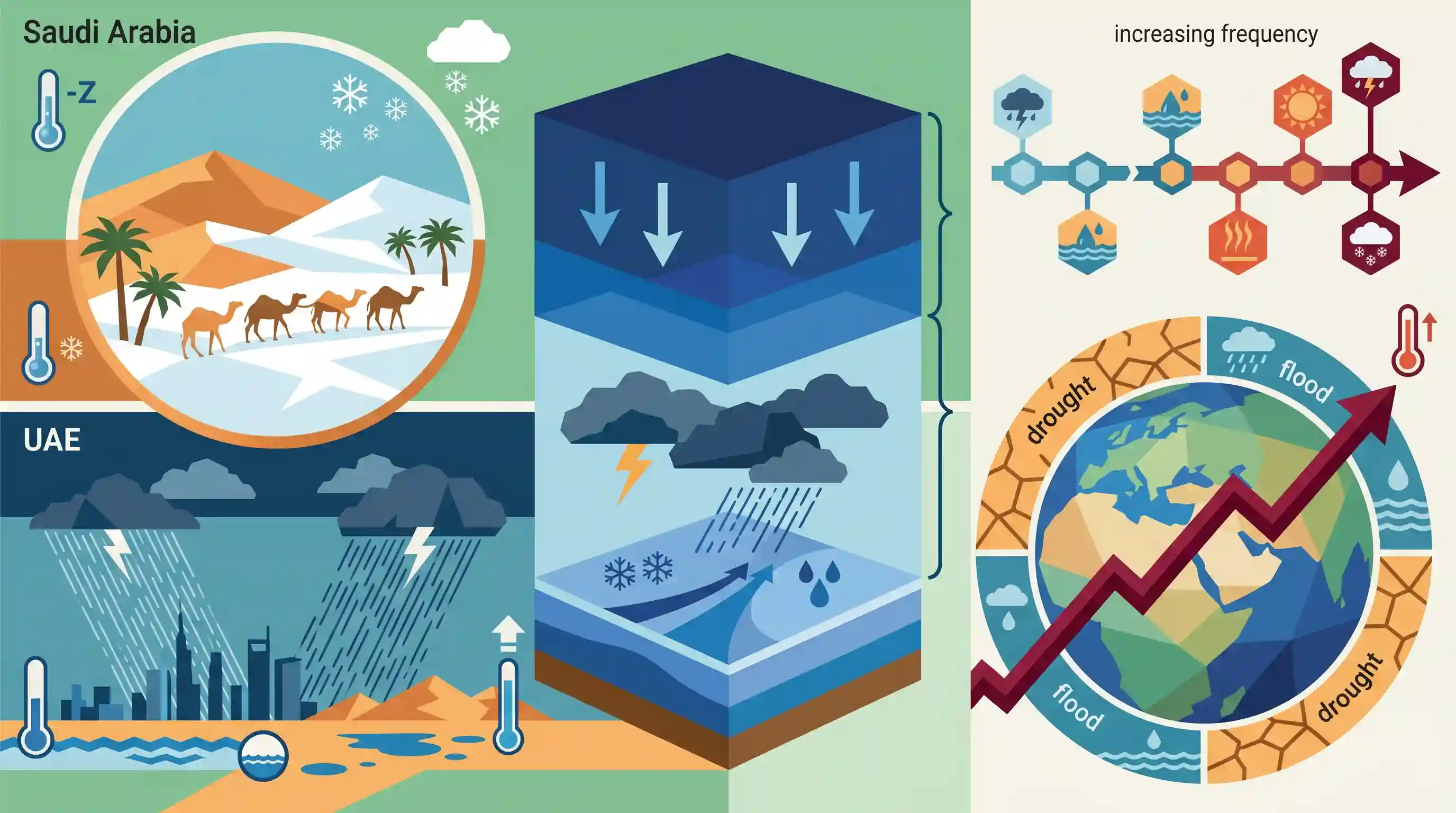
Saudi Arabia recently experienced its most significant snowfall in over three decades, transforming arid landscapes like the Al-Nafud desert into snow-covered regions. This rare meteorological event was triggered by an unusual combination of sub-zero surface temperatures, extreme cooling in the upper atmosphere, and moisture supplied by rain-bearing thunderclouds. Alongside recent unprecedented heavy rainfall in the UAE, these anomalies highlight the increasing frequency of extreme and erratic weather patterns in the historically hot and dry Middle East, raising concerns about broader regional climate shifts.
Key Points
- Saudi Arabia experienced its heaviest snowfall in over 30 years, affecting desert regions like Tabuk, Al-Jawf, and the Al-Nafud desert.
- The rare phenomenon was caused by a sharp drop in surface temperatures below zero degrees Celsius, coupled with significant cooling in the upper atmosphere.
- Rain-bearing thunderclouds brought moisture that precipitated as snow due to the freezing conditions.
- The event mirrors other recent weather anomalies in the Middle East, such as the unprecedented heavy rainfall that flooded parts of the UAE.
- Meteorologists emphasize that while snow in these regions is extremely rare, the increasing frequency of extreme weather events requires closer study of regional climate shifts.
Important Terms
World Meteorological Organization (WMO)

A specialized United Nations agency responsible for international cooperation on atmospheric science, climatology, and hydrology. It coordinates global weather data exchange and monitors climate change indicators.
UPSC context
GS Paper II (International Organizations) and GS Paper III (Environment); focuses on global climate governance and reporting.
National Center of Meteorology (NCM)
Saudi Arabia's state authority established to provide weather forecasts, climate monitoring, and early warnings. It plays a critical role in the Kingdom's Vision 2030 disaster preparedness.
UPSC context
GS Paper I (Physical Geography) and GS Paper III (Disaster Management); tests knowledge of national meteorological institutions.
Low-Pressure System
An atmospheric region where the pressure is lower than the surrounding areas. It typically facilitates rising air, cloud formation, and precipitation, such as the storms recently seen in Saudi Arabia.
UPSC context
GS Paper I (Climatology); fundamental concept for understanding weather patterns and cyclone formation.
Polar Air Mass
A large body of cold, dry air originating from high latitudes (Arctic or Siberia). Its southward movement into the Arabian Peninsula was a primary driver for the rare sub-zero temperatures.
UPSC context
GS Paper I (World Physical Geography); tests the mechanics of air mass movement and its climatic impacts.
Warming Paradox
A climate concept where rising global temperatures lead to increased moisture and atmospheric instability, paradoxically resulting in extreme localized cold events or heavy snowfall in typically arid regions.
UPSC context
GS Paper III (Environment/Climate Change); an emerging concept useful for "Critically Analyze" questions on climate anomalies.
Jet Stream
High-altitude, fast-flowing air currents that influence weather patterns. Their erratic shifting, often linked to Arctic warming, can steer cold polar air toward lower latitudes like the Middle East.
UPSC context
GS Paper I (Climatology); essential for explaining regional weather variability and monsoon dynamics.
Prelims Trap
Arid regions like Al-Nafud never experience sub-zero temperatures due to extreme daytime insolation.
Deserts rapidly lose heat during winter due to lack of insulating cloud cover. When an anomalous cold air mass meets moisture, snow easily occurs.
Static Concepts Connected
What are the major desert systems of the Arabian Peninsula?
- Rub' al-Khali: Also known as the "Empty Quarter," it is the world's largest continuous sand desert, dominating the southern Arabian Peninsula.
- Al-Nafud: A major sand sea in the northern peninsula, recently notable for rare snowfalls. Known for large crescent-shaped sand dunes.
- Ad-Dahna: A narrow, sandy corridor that acts as a bridge connecting the northern Al-Nafud desert to the southern Rub' al-Khali.
How does a weakening Polar Vortex cause unseasonal extreme weather?
- Normal State: A strong polar vortex contains frigid Arctic air at the poles, held in place by a fast, tight polar jet stream.
- Weakened Vortex: Warming disrupts the vortex, making the jet stream wavy (Rossby waves). This allows frigid Arctic air to spill southward into subtropical and mid-latitude regions.
- Subtropical Impact: This southward dip causes sudden, extreme cold snaps and rare snowfall in historically hot regions like the Middle East.
Cross-Topic Patterns
Warming paradox & Clausius-Clapeyron relation
Rising temperatures allow the atmosphere to hold ~7% more moisture per degree, turning rare rainstorms in arid regions into unprecedented extreme snow or flash floods.
West Asia borders mapping linkage
The Tabuk region's proximity to Jordan, the Red Sea, and the Gulf of Aqaba makes it a prime candidate for West Asian geographic boundary mapping questions.

Expect a 2026 map-based prelims question pairing Arabian deserts (Al-Nafud, Rub' al-Khali) with polar vortex extreme weather mechanisms.
Linked PYQs · 3
Linked PYQs · 3
- 2014MainsGS1
Most of the unusual climatic happenings are explained as an outcome of the El-Nino effect. Do you agree?
- 2023PrelimsGS1
Consider the following statements: Statement-I: Israel has established diplomatic relations with some Arab States. Statement-II: The 'Arab Peace Initiative' mediated by Saudi Arabia was signed by Israel and Arab League. Which one of the following is correct in respect of the above statements?
- 2014PrelimsGS1
The seasonal reversal of winds is the typical characteristic of
