Namo Bharat Rail Services Drastically Reduce Delhi Meerut Travel Time
Source:The Hindu ↗
Why It Matters
Provides concrete examples of India's dual focus on physical infrastructure (RRTS, Expressways) and digital infrastructure (Health IDs, UPI). These are highly relevant for GS3 questions on infrastructure-led economic growth and GS2 questions on e-governance and health sector interventions.
Summary
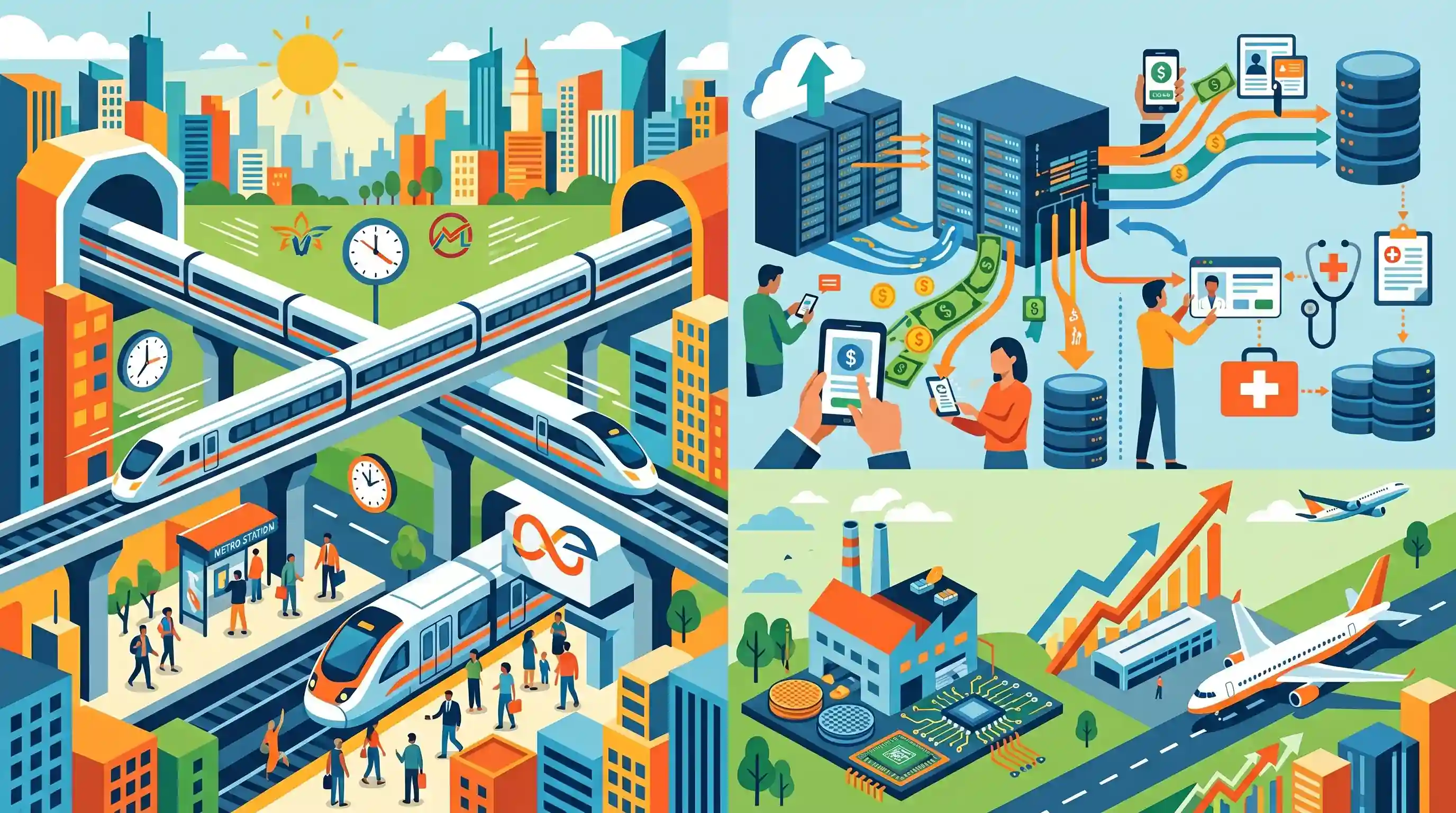
The inauguration of the Namo Bharat Rapid Rail and Meerut Metro in Uttar Pradesh signifies a major leap in regional transport infrastructure, drastically reducing the travel time between Delhi and Meerut. Alongside physical infrastructure, the state and central government highlighted substantial achievements in digital public infrastructure and e-governance, specifically the integration of digital health IDs through the Ayushman Bharat scheme and massive digital transaction volumes that save public funds. Additional regional developments such as new semiconductor projects and airports aim to bolster Uttar Pradesh's economic growth.
Key Points
- Prime Minister Narendra Modi launched the Namo Bharat Rapid Rail and Meerut Metro, which will reduce the Delhi-Meerut travel time from 4-5 hours to roughly 40-45 minutes.
- Uttar Pradesh CM highlighted structural developments in the state, including semiconductor projects in Gautam Buddh Nagar and the upcoming Noida International Airport.
- The 'One Health' initiative under the Ayushman Bharat scheme will equip citizens with digital health IDs, establishing direct access between doctors and patients.
- Digital Public Infrastructure across India has expanded to cover 1.4 billion citizens and enabled 20 billion transactions, saving significant funds and facilitating transparent governance.
Important Terms
Namo Bharat Rapid Rail

India's first Regional Rapid Transit System (RRTS) trainset, designed for semi-high-speed (up to 180 km/h) intercity travel, currently operating on the 82 km Delhi-Ghaziabad-Meerut corridor.
UPSC context
GS Paper III: Infrastructure (Railways). Tests understanding of modern transit solutions, regional connectivity, and National Capital Region (NCR) decongestion strategies.
Meerut Metro
A rapid transit system serving Meerut, Uttar Pradesh. It is unique for sharing tracks and infrastructure with the Namo Bharat RRTS, representing India's first integrated regional-cum-city rail model.
UPSC context
GS Paper III: Infrastructure (Urban Transport). Tests knowledge of Multi-Modal Integration and innovative transit infrastructure to support sustainable urbanization.
Regional Rapid Transit System (RRTS)
A high-speed, high-frequency rail-based commuter system for distances of 100-200 km. It is designed to bridge the gap between heavy rail and metro systems for regional mobility.
UPSC context
GS Paper III: Infrastructure. Important for understanding regional development, reduced urban migration to metros, and "Transit-Oriented Development" (TOD) in NCR.
Ayushman Bharat Digital Mission (ABDM)
A national initiative to create a unified digital health ecosystem. It facilitates the electronic storage and exchange of health records through unique IDs, registries, and interoperable platforms.
UPSC context
GS Paper II: Health/Governance. Relevant for discussions on Universal Health Coverage (UHC), e-governance, and tech-driven public service delivery.
ABHA (Ayushman Bharat Health Account)
A 14-digit unique identifier that enables citizens to store and share their medical records digitally with healthcare providers. It is the cornerstone of the Ayushman Bharat Digital Mission.
UPSC context
GS Paper III: Science & Technology; GS Paper II: Governance. Tests knowledge of digital identity systems and data-driven healthcare administration.
Digital Public Infrastructure (DPI)
Foundational digital systems (like Aadhaar, UPI, and ABHA) that allow governments to deliver services efficiently at scale, fostering transparency, financial inclusion, and economic growth.
UPSC context
GS Paper III: Science & Technology/Economy. A core theme in India's G20 leadership and domestic digital transformation/e-governance strategy.
Prelims Trap
"Creating a digital health ID under the Ayushman Bharat Digital Mission is mandatory to access public healthcare."
Creating an ABHA ID is entirely voluntary. UPSC frequently sets traps by claiming digital governance initiatives (like health IDs or specific Aadhaar linkages) are mandatory to access basic services.
Static Concepts Connected
What are the three foundational layers of India's Digital Public Infrastructure (India Stack)?
- Identity Layer: Provides a unique, universally verifiable digital identity for citizens (e.g., Aadhaar), forming the bedrock for targeted service delivery.
- Payments Layer: Enables interoperable, fast, and low-cost digital payment settlements across banks and service providers (e.g., UPI).
- Data Exchange Layer: Facilitates secure, consent-based sharing of personal data across institutions using the Data Empowerment and Protection Architecture (DEPA).
How does the Regional Rapid Transit System (RRTS) fundamentally differ from conventional Metro systems?
- Speed and Scope: RRTS is designed for regional, inter-city travel with speeds up to 180 kmph and fewer stops, whereas metros focus on high-frequency intra-city commutes.
- Governance Structure: Implemented by the NCRTC, which is a joint venture between the Central Government and four states (Delhi, Haryana, Rajasthan, UP), demonstrating cooperative federalism.
Cross-Topic Patterns
Intersecting DPI and Universal Health
The ABDM leverages India's DPI consent layer, linking longitudinal health records to ABHA IDs. This shifts the policy focus from mere physical health infrastructure to data-driven healthcare governance.
Urban Sprawl + Transit-Oriented Development
High-speed corridors like the RRTS complement Transit-Oriented Development (TOD) policies, deliberately pulling demographic and real estate pressure away from Delhi's core to satellite nodes like Meerut.

Expect a 2026 multi-statement question combining India's DPI data-exchange layers with the voluntary nature of Ayushman Bharat Health IDs.
Linked PYQs · 4
Linked PYQs · 4
- 2021MainsGS3
“Investment in infrastructure is essential for more rapid and inclusive economic growth.” Discuss in the light of India's experience.
- 2024MainsGS2
e-governance is not just about the routine application of digital technology in service delivery process. It is as much about multifarious interactions for ensuring transparency and accountability. In this context evaluate the role of the 'Interactive Service Model' of e-governance.
- 2024MainsGS2
In a crucial domain like the public healthcare system the Indian State should play a vital role to contain the adverse impact of marketisation of the system. Suggest some measures through which the State can enhance the reach of public healthcare at the grassroots level.
- 2023MainsGS2
e-governance, as a critical tool of governance, has ushered in effectiveness, transparency and accountability in governments. What inadequacies hamper the enhancement of these features ?
