Deforestation Risks and Forest Conservation Policy Needs
Source:Indian Express ↗
Why It Matters
The 'Development vs. Environment' debate is a core theme in the UPSC syllabus, particularly in GS3. Aspirants must understand the critical limitations of policies like compensatory afforestation (CAMPA) and the overarching need for sustainable development to address questions on climate change mitigation and environmental impact assessments.
Summary
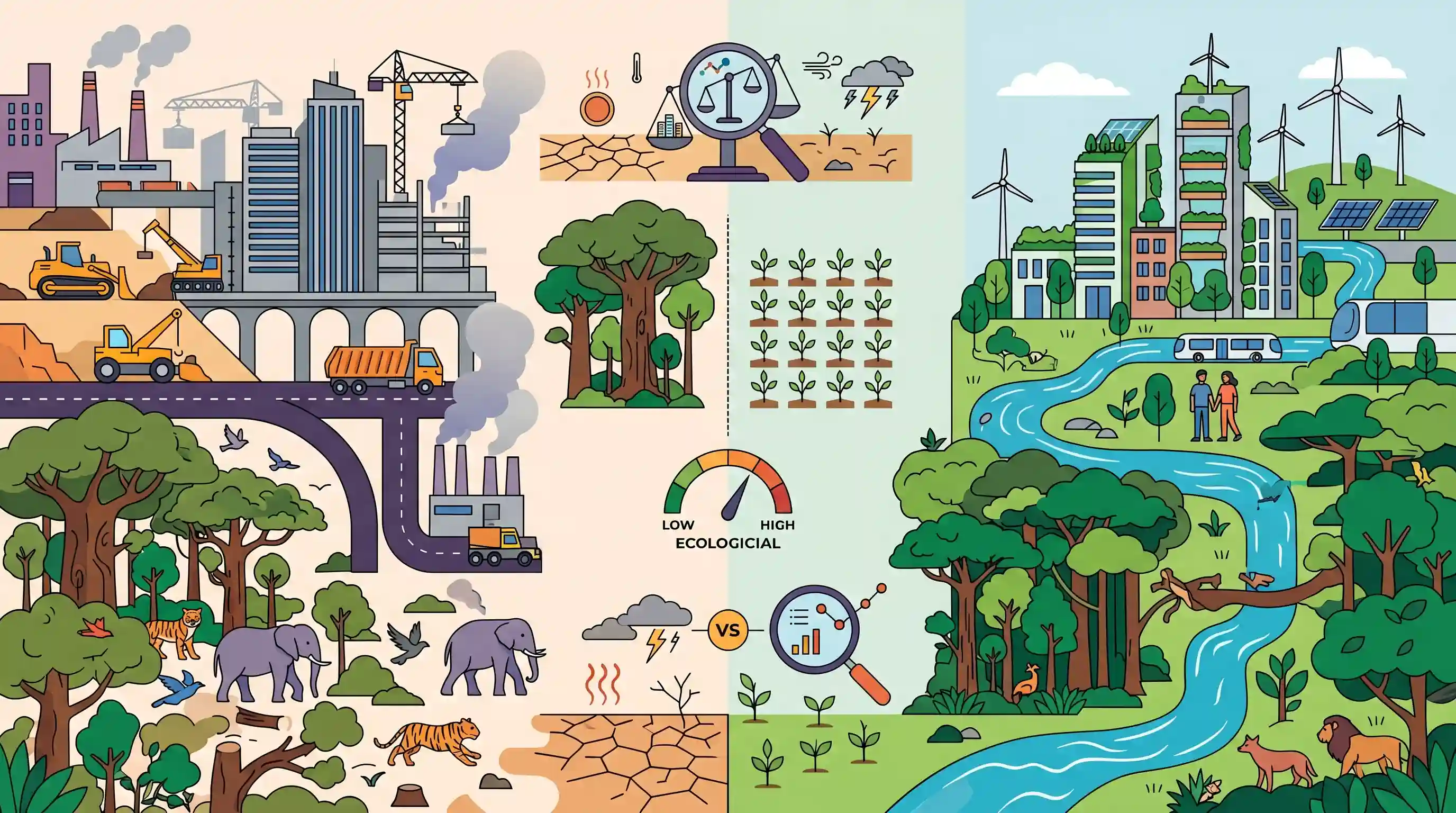
The article examines the growing tension between rapid infrastructural development and India's shrinking forest cover. It underscores that forest conservation is no longer a peripheral issue but an urgent necessity, as the destruction of old-growth forests severely impacts biodiversity and climate resilience. The piece critically evaluates mitigation strategies like compensatory afforestation, noting that newly planted trees cannot immediately replace the ecological functions of mature forests. Ultimately, it advocates for a sustainable development approach where economic progress does not come at the irreversible cost of environmental degradation.
Key Points
- Rapid urbanization, infrastructure projects, and industrial expansion are leading to a significant reduction in India's green cover and the destruction of mature forests.
- Compensatory afforestation efforts, while well-intentioned, often fail to replicate the complex biodiversity and ecological services provided by old-growth forests that are cleared for development.
- Deforestation directly accelerates climate change by removing crucial carbon sinks, exacerbating extreme weather events, soil erosion, and biodiversity loss.
- There is an urgent need for sustainable development models that harmonize economic growth with strict environmental conservation, including rigorous Environmental Impact Assessments (EIAs).
Important Terms
Forest (Conservation) Act (FCA)

A 1980 law regulating the diversion of forest land for non-forestry purposes. The 2023 amendment narrows its scope and exempts specific strategic projects from clearance requirements.
UPSC context
GS III: Conservation. Tests legislative changes and the "development vs. environment" debate in sensitive ecological zones.
Compensatory Afforestation Fund (CAF) Act
A 2016 law managing funds paid by developers for forest diversion. It ensures money is spent on afforestation and wildlife management to offset ecological loss.
UPSC context
GS III: Environmental Degradation. Crucial for questions on mitigation strategies and the efficiency of ecological compensation mechanisms.
CAMPA
The statutory body managing funds collected for compensatory afforestation. It distributes money between states and the center for biodiversity conservation and catchment area treatment.
UPSC context
GS III: Conservation. Frequently tested in Prelims regarding statutory bodies and Mains regarding institutional transparency.
National Forest Policy, 1988
India's vision document aiming for 33% forest cover. It prioritizes environmental stability and ecological balance over commercial timber extraction through community-led conservation.
UPSC context
GS III: Environment. Tests historical policy shifts from exploitation to community participation and ecological resilience.
MoEFCC
The nodal central ministry for planning and overseeing India's environmental and forestry policies, managing international climate commitments and domestic regulatory clearances.
UPSC context
GS III: Environmental Policy. Essential for identifying the administrative authority behind major conservation schemes and legislative notifications.
Sustainable Development
Development meeting present needs without compromising future generations. It requires balancing economic progress with the preservation of mature forests and biodiversity.
UPSC context
GS III: Sustainable Development. A core concept testing the integration of economic growth with long-term environmental health.
Prelims Trap
CAMPA funds are managed centrally and distributed equally among states for afforestation.
Under the Compensatory Afforestation Fund (CAF) Act 2016, 90% of the collected funds go to the respective State CAFs, while only 10% goes to the National CAF.
Static Concepts Connected
How is the Compensatory Afforestation Fund (CAF) structured and utilized?
- Fund distribution: 90% of the funds are deposited into State CAFs, and 10% into the National CAF.
- Permitted uses: Funds must primarily be used for compensatory afforestation, assisted natural regeneration, and forest fire prevention.
- Prohibited uses: Funds cannot be used for administrative purposes like paying salaries, travel allowances, or expanding office infrastructure.
What are the mandatory core stages of an Environmental Impact Assessment (EIA)?
- Screening and Scoping: Determining whether a project requires an EIA and finalizing the Terms of Reference (ToR) for the study.
- Public Consultation: Gathering concerns from locally affected persons (though certain strategic or pipeline projects are exempted).
- Appraisal: The Expert Appraisal Committee (EAC) reviews the final EIA report and public hearing outcomes to grant or reject clearance.
Cross-Topic Patterns
Urban flooding + Disaster Management
The loss of urban green cover reduces natural water sinks, directly linking localized deforestation to GS3 Disaster Management topics like urban flooding seen in Bengaluru and Chennai.
Forest Amendment + Border Infrastructure
The 2023 Forest Conservation Amendment exempts strategic projects within 100km of borders, pitting ecological preservation directly against internal and national security imperatives.

Expect a multi-statement Prelims question contrasting the ecological utility of old-growth forests vs CAMPA-funded monoculture plantations.
Linked PYQs · 4
Linked PYQs · 4
- 2019PrelimsGS1
Consider the following statements : 1. As per law, the Compensatory Afforestation Fund Management and Planning Authority exists at both National and State levels. 2. People's participation is mandatory in the compensatory afforestation programmes carried out under the Compensatory Afforestation Fund Act, 2016. Which of the statements given above is/are correct?
- 2021PrelimsGS1
With reference to the 'New York Declaration on Forests', which of the following statements are correct? 1. It was first endorsed at the United Nations Climate Summit in 2014. 2. It endorses a global timeline to end the loss of forests. 3. It is a legally binding international declaration. 4. It is endorsed by governments, big companies and indigenous communities. 5. India was one of the signatories at its inception. Select the correct answer using the code given below.
- 2014MainsGS3
Environmental Impact Assessment studies are increasingly undertaken before a project is cleared by the Government. Discuss the environmental impacts of coal-fired thermal plants located at coal pitheads.
- 2025MainsGS3
Mineral resources are fundamental to the country's economy and these are exploited by mining. Why is mining considered an environmental hazard? Explain the remedial measures required to reduce the environmental hazard due to mining.
