Madhya Pradesh High Court Clarifies Abortion Rules for Rape Survivors
Source:the-print ↗
Why It Matters
Highlights judicial intervention to safeguard reproductive rights of sexual assault survivors by clarifying the provisions of the MTP Act and POCSO Rules. Relevant for GS-II (Polity and Governance, Vulnerable Sections).
Summary
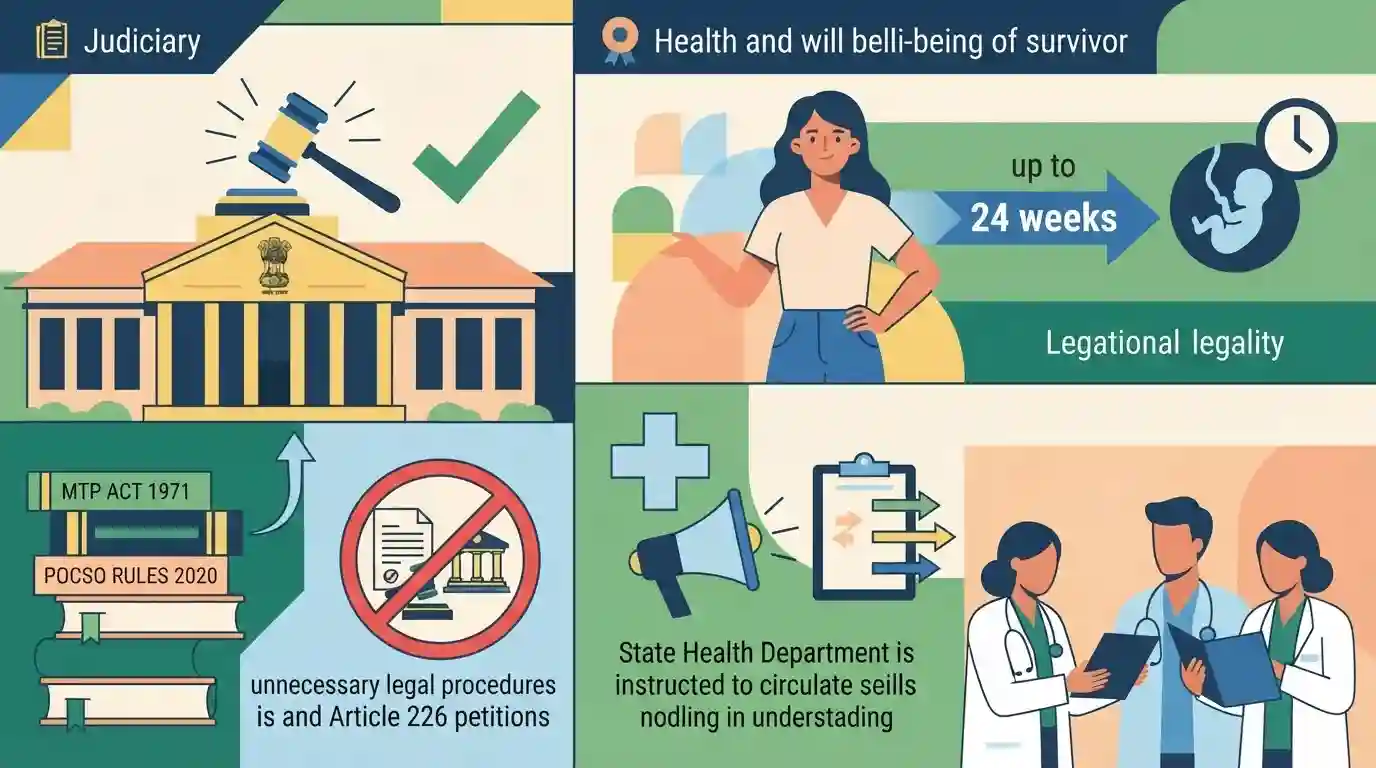
The Madhya Pradesh High Court has ruled that rape survivors do not need court approval to terminate pregnancies up to 24 weeks. Citing the Medical Termination of Pregnancy (MTP) Act, 1971, and POCSO Rules, 2020, the court emphasized that victims should not be subjected to unnecessary legal procedures under Article 226. The state Health Department has been instructed to circulate this directive to medical practitioners.
Key Points
- The Madhya Pradesh High Court ruled that survivors of sexual assault do not require court permission to terminate a pregnancy up to 24 weeks.
- The court clarified that under Section 3 of the MTP Act, 1971, the opinion of one medical practitioner is required for abortions up to 20 weeks, and two for pregnancies between 20-24 weeks.
- The POCSO Rules 2020 also stipulate that medical care providers should not demand legal or magisterial requisition to provide emergency care.
- The state Health Department was directed to disseminate this order to ensure smooth implementation and avoid unnecessary legal hurdles for rape survivors.
Important Terms
Medical Termination of Pregnancy (MTP) Act, 1971

A central legislation governing abortion in India. Amended in 2021, it allows registered medical practitioners to terminate pregnancies up to 20 weeks (one doctor) or 24 weeks (two doctors) for specific vulnerable categories, including rape survivors.
UPSC context
Crucial for GS-2 (Social Justice, Health) regarding reproductive rights, legal access to abortion, and the bodily autonomy of vulnerable women.
Protection of Children from Sexual Offences (POCSO) Rules, 2020
Procedural rules under the POCSO Act specifying guidelines for the care and protection of child sexual abuse survivors. They cover medical counseling for pregnancy termination, preservation of forensic evidence, and the appointment of support persons.
UPSC context
Highly relevant for GS-2 (Vulnerable Sections, Child Rights) in understanding institutional mechanisms and statutory safeguards for minor sexual assault survivors.
Article 226 of the Constitution of India
A constitutional provision empowering High Courts to issue writs (such as habeas corpus and mandamus) to any person or authority for the enforcement of Fundamental Rights and other legal rights within their territorial jurisdiction.
UPSC context
Vital for GS-2 (Indian Polity, Judiciary) to understand the scope of High Court writ jurisdiction, judicial review, and the protection of citizens' rights.
Prelims Trap
Under the MTP Act, all women can terminate a pregnancy up to 24 weeks with the approval of a single medical practitioner.
The 24-week limit applies only to special categories (like rape survivors) and requires two doctors. The general limit is 20 weeks with one doctor's opinion.
Static Concepts Connected
What are the key provisions of the Medical Termination of Pregnancy (Amendment) Act, 2021?
- Gestational limits: Limit increased from 20 to 24 weeks for special categories (rape survivors, victims of incest, vulnerable women).
- Medical opinions: Opinion of 1 doctor required for up to 20 weeks; 2 doctors needed for pregnancies between 20-24 weeks.
- Medical Boards: State-level Medical Boards must authorize any abortion beyond 24 weeks, permitted strictly in cases of substantial foetal abnormalities.
- Confidentiality clause: Name and particulars of a woman terminating her pregnancy cannot be revealed except to legally authorized persons.
How does reproductive autonomy connect to Fundamental Rights in India?
- Article 21: The Supreme Court has ruled that a woman's right to make reproductive choices is a fundamental right to personal liberty under Article 21.
- Right to Privacy: The decision to carry a pregnancy to full term or terminate it is protected under a woman's fundamental right to privacy (Puttaswamy judgment).
Cross-Topic Patterns
MTP Act + POCSO Rules synergy
The intersection of MTP and POCSO clarifies that healthcare providers face no legal bar, such as waiting for a magistrate's requisition, to provide emergency abortion care to minor sexual assault survivors.
Article 226 & judicial economy
High Courts are actively discouraging unnecessary writ petitions under Article 226 for rights already statutorily guaranteed by acts like MTP, reflecting a push toward administrative efficiency and reducing judicial pendency.

Expect a Prelims question comparing MTP Act limits (20 vs 24 weeks, doctor count) intertwined with Article 21 reproductive rights.
Linked PYQs · 3
Linked PYQs · 3
- 2022MPPSC_PRELIMSGS1
According to which Article of the Indian Constitution, can the President of India (in consultation with the Chief Justice) transfer a Judge of a High Court from one court to another?
- 2023MPPSC_PRELIMSGS1
What is the maximum age limit of a High Court Judge?
- 2020MPPSC_PRELIMSGS1
Article 24 of the Constitution of India prohibits the employment of child in factories related to hazardous works. Such prohibition is
