Madhya Pradesh High Court Rules on Pregnancy Termination for Survivors
Source:The Hindu ↗
Why It Matters
This ruling is significant for understanding the intersection of women's rights, healthcare legislation (MTP Act), and the judicial interpretation of bodily autonomy in India. It highlights administrative and legal procedures concerning survivors of sexual assault.
Summary
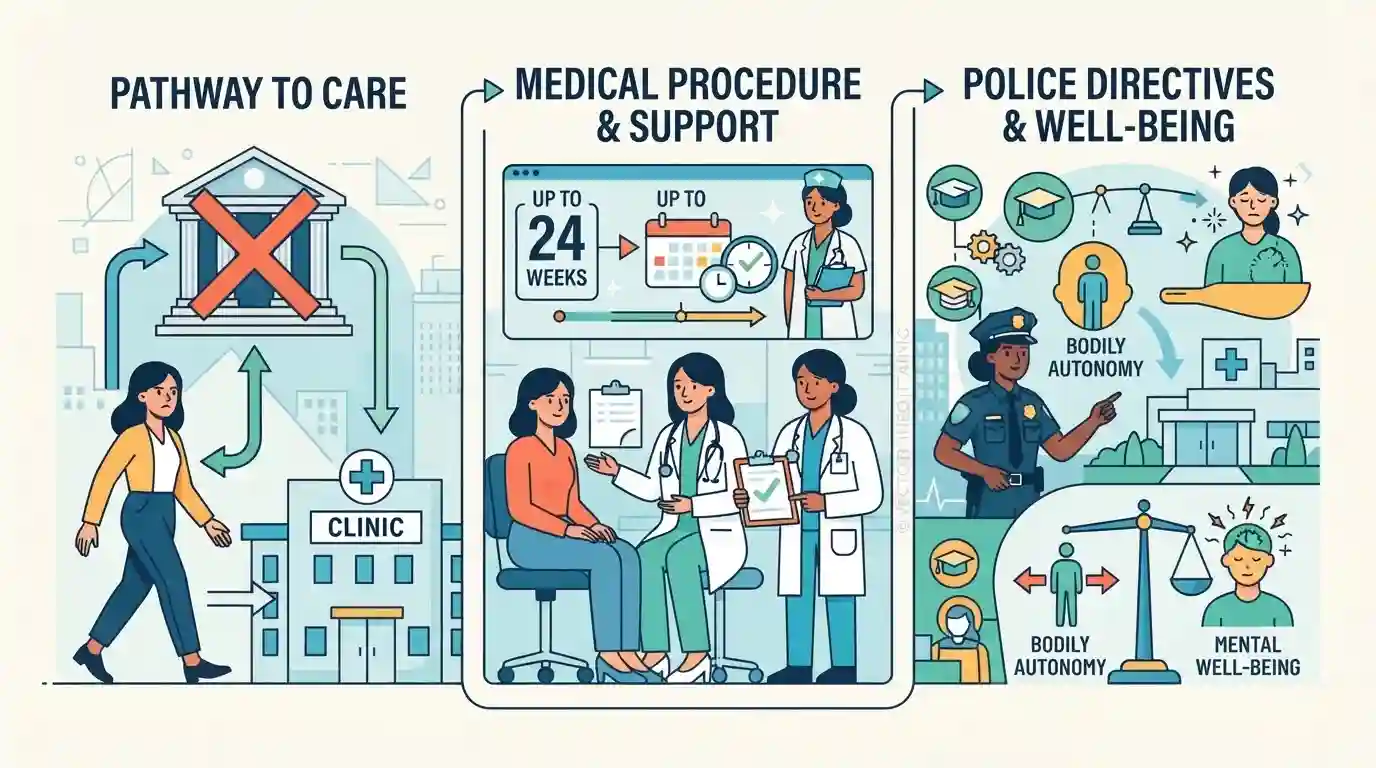
The Madhya Pradesh High Court has clarified that rape survivors seeking to terminate pregnancies up to 24 weeks do not need to seek judicial approval. Under the Medical Termination of Pregnancy (MTP) Act, 1971, survivors can approach a Registered Medical Practitioner (RMP) directly. The court noted that the mandatory court route often causes undue delay and exacerbates the trauma of the victim. It also issued directives for the police to educate victims about their rights and facilitate medical interventions if requested, aiming to protect the bodily autonomy and mental well-being of survivors.
Key Points
- The Madhya Pradesh High Court ruled that rape survivors do not require court permission to medically terminate a pregnancy of up to 24 weeks under the MTP Act.
- The judgment emphasized that forcing survivors to undergo the lengthy process of seeking court approval adds to their physical and mental trauma.
- The court directed the police to proactively inform victims about their rights and assist them in appearing before a Registered Medical Practitioner (RMP) if they wish to terminate the pregnancy.
- Justice Anand Pathak of the Gwalior Bench delivered the order, underlining the importance of preserving the victim's bodily autonomy and mental health.
Important Terms
Medical Termination of Pregnancy (MTP) Act, 1971

A law providing the legal framework for safe abortions in India. The 2021 amendment raised the upper gestation limit to 24 weeks for special categories, including rape survivors, to reduce unsafe abortions and protect maternal health.
UPSC context
Crucial for GS-2 (Social Justice, Health). Tests knowledge of women's reproductive rights, maternal healthcare, and legal reforms.
Bodily Autonomy
The fundamental right to govern one's own body and make reproductive choices without external coercion. The Supreme Court recognizes it as an integral part of the Right to Life and Personal Liberty under Article 21.
UPSC context
Vital for GS-2 (Polity/Constitution). Frequently tested in questions about fundamental rights, privacy, and judicial interpretations of Article 21.
Registered Medical Practitioner (RMP)
A qualified doctor, possessing recognized medical credentials and registered with a State Medical Council, who is legally authorized under the MTP Act to evaluate, approve, and perform pregnancy terminations safely.
UPSC context
Relevant for GS-2 (Governance/Health). Highlights the regulatory mechanism that ensures safe, legal medical procedures and prevents unregulated medical practices.
Prelims Trap
Court approval or a Medical Board is mandatory to terminate a pregnancy between 20 and 24 weeks for rape survivors.
Under the MTP Act 2021, terminating a pregnancy between 20-24 weeks for vulnerable categories only requires two RMPs. Medical Boards are exclusively for fetal abnormalities beyond 24 weeks.
Static Concepts Connected
What are the key gestational limits under the Medical Termination of Pregnancy (Amendment) Act 2021?
- Up to 20 weeks: Only one Registered Medical Practitioner (RMP) is needed for abortions up to 20 weeks for all women.
- 20 to 24 weeks: Requires the opinion of two RMPs for special categories of women (rape survivors, minors, differently-abled).
- Beyond 24 weeks: Requires approval from a State-level Medical Board, and is only permitted in cases of substantial fetal abnormalities.
How does the Indian legal framework interact with abortion and reproductive rights?
- Article 21 purview: The Supreme Court recognizes a woman's right to reproductive choices as an intrinsic part of personal liberty and bodily autonomy under Article 21.
- Exception to IPC: The MTP Act acts as a statutory exception to Section 312 of the IPC (now BNS equivalent), which generally criminalizes voluntary miscarriage.
- Unmarried women: The 2021 amendment explicitly replaced "husband" with "partner", extending contraceptive failure as a legal ground for abortion to unmarried women.
Cross-Topic Patterns
Reproductive Autonomy as Right to Privacy
The evolution of Article 21 from the Puttaswamy privacy judgment directly laid the groundwork for courts to expand unmarried women's and assault survivors' access to safe abortions without judicial delays.
Law Enforcement's Role in Healthcare Access
The court's mandate for police to proactively educate victims about medical rights bridges the critical gap between criminal justice procedures (BNS/BNSS) and immediate public health interventions.

Expect a multi-statement Prelims question mixing MTP Act gestation limits (20/24 weeks) with Medical Board requirements and Article 21.
Linked PYQs · 3
Linked PYQs · 3
- 2022MPPSC_PRELIMSGS1
According to which Article of the Indian Constitution, can the President of India (in consultation with the Chief Justice) transfer a Judge of a High Court from one court to another?
- 2023MPPSC_PRELIMSGS1
What is the maximum age limit of a High Court Judge?
- 2025MPPSC_PRELIMSGS1
The objective of "Mukhyamantri Ladli Behna Yojana" implemented in entire Madhya Pradesh, in addition to economic self-reliance is:
