Ramanathapuram cotton farmers demand fair prices and MSP
Source:The Hindu ↗
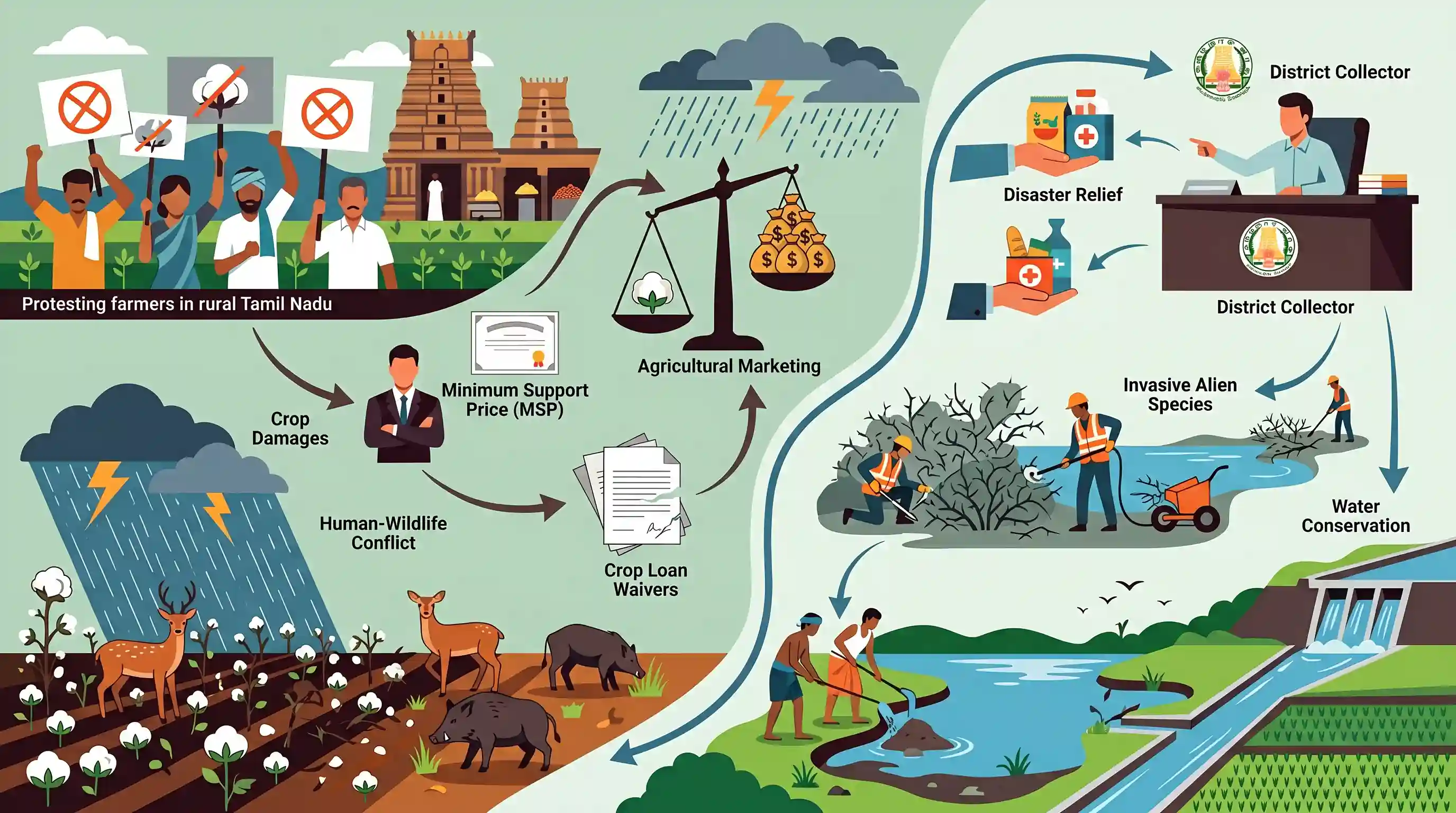
Why It Matters
The article serves as an excellent grassroots case study for GS3 Agriculture, illustrating the persistent bottlenecks in APMCs where middlemen (commission agents) exploit farmers, defeating the purpose of regulated markets. It also highlights the ecological and administrative intersection of using rural employment schemes (MGNREGA) for environmental restoration, specifically targeting the invasive Prosopis juliflora to rejuvenate local waterbodies.
Summary
Farmers in Ramanathapuram, Tamil Nadu, are protesting severe price suppression of their cotton produce, fetching only ₹45/kg instead of the Union-advised ₹100/kg. The farmers blame syndicates of commission agents operating within agricultural regulated markets for the low prices, demanding a formal Minimum Support Price (MSP) for cotton and waivers for crop loans. Alongside marketing grievances, farmers sought compensation for crop damages caused by unseasonal rains and human-wildlife conflict involving deer and wild boars. In response, the District Collector assured farmers of impending disaster relief and outlined plans to clear the invasive Prosopis juliflora from waterbodies using MGNREGA workers, while restoring lakes through the community-based kudimaramathu scheme.
Key Points
- Ramanathapuram farmers are facing steep price drops for cotton, receiving only ₹45/kg against the Union government's advisory of up to ₹100/kg.
- Farmers allege that commission agents in regulated markets form syndicates to deliberately suppress prices and exploit growers.
- They have demanded the immediate declaration of a Minimum Support Price (MSP) for cotton to prevent distress sales.
- Additional demands include compensation for crop damage caused by unseasonal rains and wildlife (deer and wild boars).
- The district administration plans to use the MGNREGA scheme to clear the invasive species Prosopis juliflora (seemai karuvelam) from local waterbodies.
- Ponds and lakes will be restored using the traditional kudimaramathu (community maintenance) scheme ahead of the rainy season.
Important Terms
Minimum Support Price (MSP)

A government-backed price floor for 22 mandated crops (including cotton) to protect farmers from price volatility and distress sales.
UPSC context
GS Paper 3 (Agriculture). Tests understanding of price stabilization, farmer welfare, and food security mechanisms.
MGNREGA
Social security law guaranteeing 100 days of unskilled manual work annually to rural households, used here for clearing invasive species from waterbodies.
UPSC context
GS Paper 2 (Welfare Schemes). Tests knowledge of rural employment, poverty alleviation, and decentralized planning.
Agricultural Regulated Market (APMC)
State-notified market yards (mandis) governed by committees to ensure transparent trade and protect farmers from exploitation by intermediaries.
UPSC context
GS Paper 3 (Agriculture Marketing). Tests knowledge of APMC reforms, price discovery, and agricultural supply chains.
Prosopis juliflora
An aggressive invasive alien tree species that depletes groundwater and outcompetes native flora in arid and semi-arid regions.
UPSC context
GS Paper 3 (Environment/Biodiversity). Tests understanding of invasive species impact on ecosystems and water conservation challenges.
Kudimaramathu scheme
A traditional, community-led water management system in Tamil Nadu where local stakeholders participate in restoring and maintaining irrigation tanks.
UPSC context
GS Paper 3 (Water Resources). Tests understanding of traditional conservation practices and community participation in resource management.
Human-Wildlife Conflict
Interactions between humans and animals resulting in negative outcomes such as crop raiding, livestock loss, or human/wildlife injury.
UPSC context
GS Paper 3 (Environment). Tests knowledge of conservation challenges, mitigation strategies, and the impact on local livelihoods.
Prelims Trap
Farmers are demanding a Minimum Support Price (MSP) for cotton because it currently falls outside the central MSP regime.
Cotton is actually one of the 22 mandated crops under the central MSP regime. The distress sale happens due to poor state procurement infrastructure, not the absence of an MSP.
Static Concepts Connected
What are India's prominent traditional community water harvesting systems?
- Kudimaramathu: Tamil Nadu's ancient, community-managed participatory system for maintaining and desilting minor irrigation tanks and lakes.
- Ahar Pynes: Traditional floodwater harvesting systems indigenous to South Bihar, utilizing channels and retention ponds.
- Johads: Small earthen check dams traditionally used in Rajasthan to capture monsoon runoff and recharge aquifers.
Why is Prosopis juliflora (seemai karuvelam) considered a severe ecological threat?
- Groundwater Depletion: It possesses aggressive, deep root systems that severely deplete local soil moisture and drastically lower the water table.
- Allelopathic Effect: The plant releases toxic biochemicals into the soil that inhibit the germination and survival of native flora.
- Habitat Alteration: It forms dense, impenetrable thickets that wipe out pastoral grazing lands and displace local biodiversity.
Cross-Topic Patterns
APMC Cartelization vs. MSP Policy
Poor APMC regulation and cartelization by commission agents often defeat central MSP announcements. This highlights the governance gap between CACP price policies and actual state-level procurement infrastructure.
Human-Wildlife Conflict as Agrarian Distress
Crop depredation by wild boars and herbivores is increasingly driving agrarian distress. This links wildlife management (Wildlife Protection Act schedules) directly to agricultural safety nets like PMFBY.

Expect a paired-matching Prelims question linking traditional water harvesting systems (Kudimaramathu) or invasive species to their impacts.
Linked PYQs · 4
Linked PYQs · 4
- 2018MainsGS3
What do you mean by Minimum Support Price (MSP)? How will MSP rescue the farmers from the low income trap?
- 2022MainsGS3
What are the main bottlenecks in upstream and downstream process of marketing of agricultural products in India?
- 2014MainsGS3
There is also a point of view that Agricultural Produce Market Committees (APMCs) set up under the State Acts have not only impeded the development of agriculture but also have been the cause of food inflation in India. Critically examine.
- 2018PrelimsGS1
Why is a plant called Prosopis juliflora often mentioned in news?
