Ram Janmabhoomi Trust to Convene Meeting in Ayodhya
Source:The Hindu ↗
Why It Matters
The governance, transparency, and accountability of major religious trusts like the Shri Ram Janmabhoomi Teerth Kshetra Trust are highly relevant for GS Paper 2 and UP-specific knowledge. The handling of financial irregularities and investigations by the SIT highlights mechanisms of the rule of law.
Summary
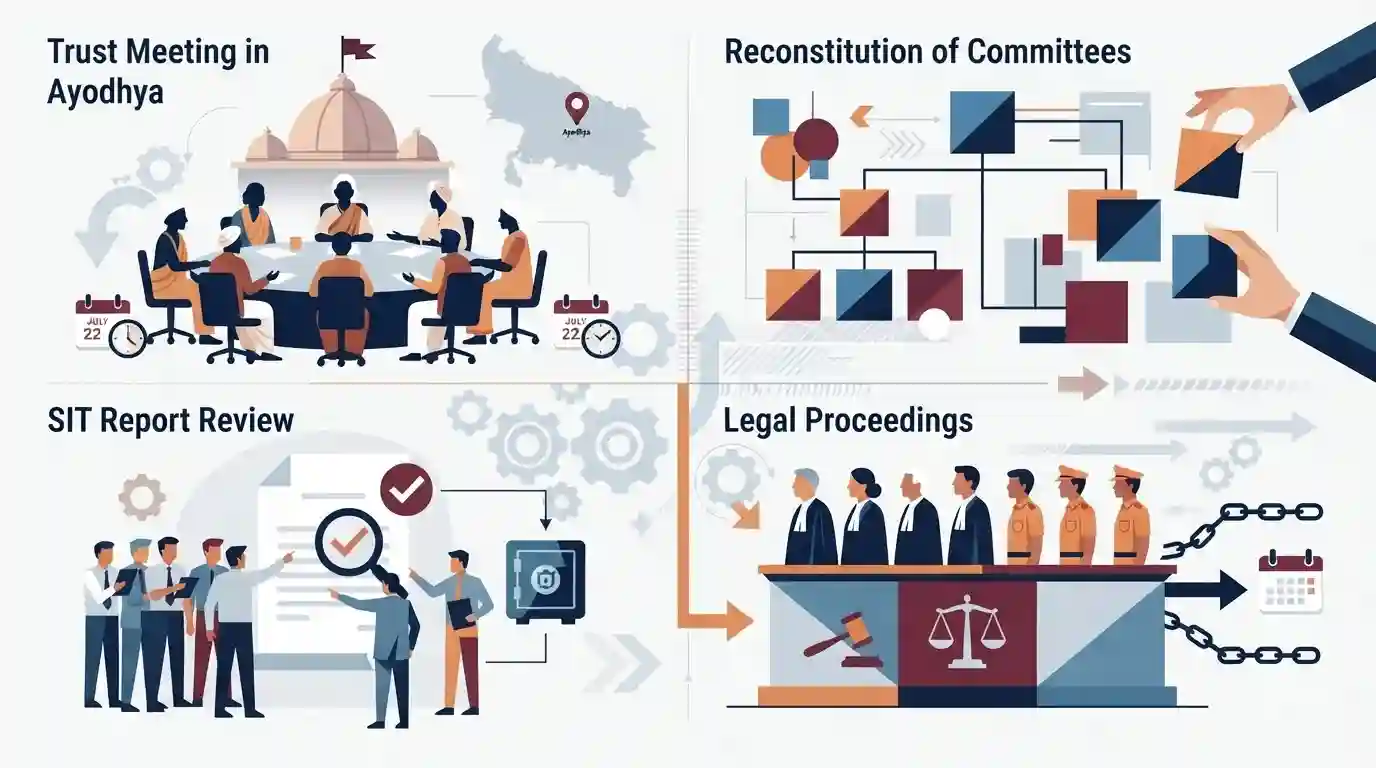
The Shri Ram Janmabhoomi Teerth Kshetra Trust is scheduled to meet in Ayodhya on July 22 to discuss the reconstitution of its committees and review the Special Investigation Team's (SIT) final report on the alleged embezzlement of temple donations. The meeting follows the recent resignations of key trust officials, including general secretary Champat Rai, and the extension of judicial custody for the eight accused individuals.
Key Points
- The Shri Ram Janmabhoomi Teerth Kshetra Trust will meet in Ayodhya on July 22 to confirm recent proceedings and review the final SIT report on donation embezzlement.
- The Trust's previous meeting on July 6 saw the resignations of general secretary Champat Rai and member Anil Mishra.
- Krishna Mohan has been appointed as the acting general secretary of the Trust.
- Eight individuals accused in the donation theft case have had their judicial custody extended.
Important Terms
Shri Ram Janmabhoomi Teerth Kshetra Trust

A public religious trust established by the Government of India in 2020 to construct and manage the Ram Mandir. It operates under a trust deed, concentrating administrative and financial control among its trustees.
UPSC context
Important for GS-2 (Governance), illustrating trust-based administration versus statutory oversight models in the management of charitable public institutions.
Special Investigation Team (SIT)
A specialized panel of law enforcement officials formed to thoroughly investigate high-profile, sensitive, or complex criminal cases where standard policing resources or impartiality may be insufficient.
UPSC context
Relevant to GS-2 and GS-3; tests knowledge of ad-hoc investigative agencies, law enforcement mechanisms, and administrative accountability.
Judicial Custody
The detention of an accused person in a prison under the direct supervision of a magistrate. During this time, police cannot interrogate the suspect without explicit court approval.
UPSC context
Highly relevant for GS-2 Polity. Frequently tested in Prelims regarding fundamental rights, the criminal justice system, and BNSS provisions.
Prelims Trap
"The Shri Ram Janmabhoomi Teerth Kshetra Trust is a statutory body established by a dedicated Act of Parliament."
It is a public religious trust formed via an executive Gazette notification by the Central Government, not by a dedicated parliamentary statute.
Static Concepts Connected
How does the Ram Temple Trust's legal status differ from temples like Tirupati?
- Executive vs Statutory: The Ram Temple Trust was formed by a Central executive Gazette notification, whereas TTD is governed by a dedicated state legislature statute.
- Financial Governance: Statute-backed temples follow codified rules under state acts for donation management, while the Ram Trust relies on internal administrative trust structures.
What are the legal distinctions between Police and Judicial Custody?
- Supervisory Authority: In police custody, the accused is held in a police lock-up. In judicial custody, the accused is lodged in jail under a Magistrate's supervision.
- Interrogation Rules: Police can interrogate suspects directly in police custody; in judicial custody, they cannot interrogate the accused without prior court approval.
Cross-Topic Patterns
Executive vs Statutory Bodies
The formation of the Ram Temple Trust via executive resolution mirrors the frequent UPSC Prelims theme comparing non-statutory entities (like NITI Aayog) with statutory bodies.
Temple Admin & Article 26
Financial controversies in public trusts often revive Constitutional debates around Article 26 (right to manage religious affairs) versus state intervention in temple governance.

Prelims 2026 may feature a comparative question contrasting the executive-notified Ram Temple Trust with statutory bodies like the TTD.
Linked PYQs · 2
Linked PYQs · 2
- 2020UPPSC_PRELIMSGS1
Which of the following cities of Uttar Pradesh is/are covered under the 'Heritage City Development and Augmentation Yojana (HRIDAY)' ? 1. Varanasi 2. Mathura 3. Prayagraj 4. Ayodhya Select the correct answer from the codes given below.
- 2021UPPSC_PRELIMSGS1
The functions of the State Public Service Commission of Uttar Pradesh can be extended by
