Ram Temple Trust autonomy in appointing CEO clarified by Misra
Source:The Hindu ↗
Why It Matters
UPPSC PCS frequently tests candidates on Uttar Pradesh-specific cultural geography, state-specific committees, and administrative structures of major spiritual and cultural institutions like the Shri Ram Janmabhoomi Teerth Kshetra trust. Landmarks in Ayodhya (e.g., Sugriv Kila, Angad Teela) are crucial for UP GK.
Summary
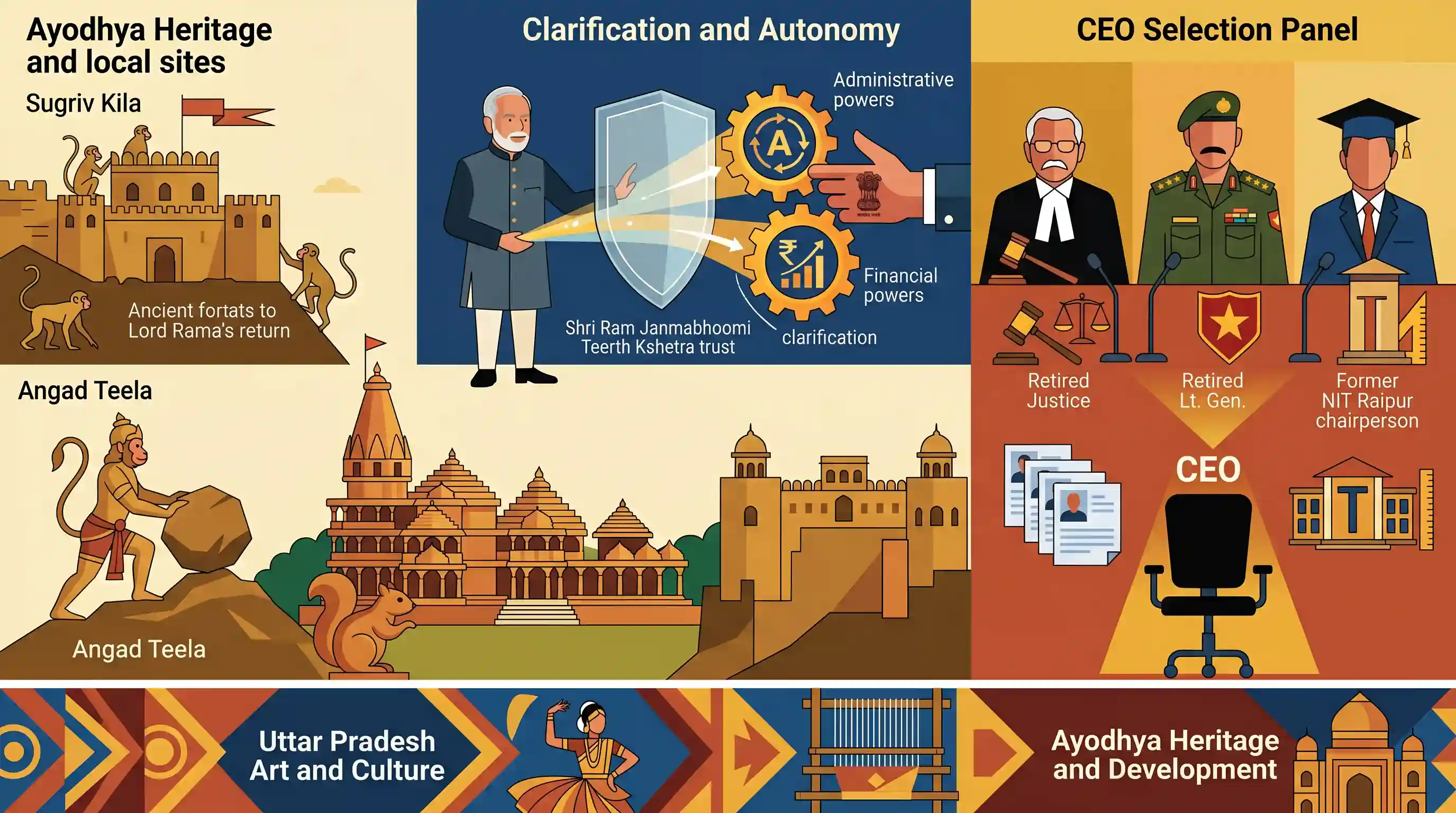
Nripendra Misra, Chairman of the Ram Mandir Construction Committee, clarified that the Shri Ram Janmabhoomi Teerth Kshetra trust possesses full autonomy to decide the administrative and financial powers of the Ayodhya Ram temple's first-ever Chief Executive Officer (CEO), free from government interference. To select the candidates, a three-member panel has been established comprising retired Justice Pramod Kohli, retired Lt. Gen. Vishnukant Chaturvedi, and former NIT Raipur chairperson Suresh Haware. The article also mentions adjacent local cultural sites such as Sugriv Kila and Angad Teela in Ayodhya.
Key Points
- The Shri Ram Janmabhoomi Teerth Kshetra trust is an autonomous body that will independently determine the administrative and financial powers of the Ayodhya Ram Temple's first Chief Executive Officer (CEO).
- The central government has no direct administrative role or interference in deciding the powers or functioning of the CEO, according to Ram Mandir Construction Committee Chairman Nripendra Misra.
- A three-member panel has been constituted to recommend suitable candidates for the CEO post. The panel members are retired Justice Pramod Kohli, retired Lieutenant General Vishnukant Chaturvedi, and former NIT Raipur chairperson Suresh Haware.
- Adjacent historical and religious landmarks in Ayodhya, such as Sugriv Kila and Angad Teela, continue to be key areas of focus in the surrounding developmental and architectural landscape.
- Allegations of donation embezzlement raised by opposition parties were dismissed as politically motivated, with the trust maintaining transparency in its financial transactions.
Important Terms
Shri Ram Janmabhoomi Teerth Kshetra Trust

An autonomous trust set up by the Government of India in 2020, following the Supreme Court's Ayodhya verdict, tasked with overseeing the construction, finances, and administrative management of the Ram Mandir in Ayodhya.
UPSC context
Relevant for GS Paper I (Art & Culture) and GS Paper II (Governance), testing temple administration, autonomous bodies, and judicial verdicts.
Ram Mandir Construction Committee
A specialized committee established under the Shri Ram Janmabhoomi Teerth Kshetra trust, responsible for managing, planning, and executing the physical construction and structural completion of the Ram Temple complex in Ayodhya.
UPSC context
Relevant for GS Paper I (Art & Culture) and GS Paper II (Governance), testing institutional frameworks and execution of major heritage projects.
Sugriv Kila
An ancient heritage site and fort in Ayodhya mythologically linked to Sugriva, the Vanara king from the Ramayana, serving as an important cultural and pilgrimage landmark near the Ram Janmabhoomi complex.
UPSC context
Relevant for GS Paper I (Art & Culture), testing historical heritage sites, local art, and tourism potential in regional cultural circuits.
Angad Teela
A significant cultural and spiritual site located within the Ram Janmabhoomi temple complex in Ayodhya, associated with the Ramayana character Angada and used for hosting public discourses, cultural programs, and symbolic monuments.
UPSC context
Relevant for GS Paper I (Art & Culture), testing cultural heritage, local traditions, and epic-mythology-linked conservation sites.
Prelims Trap
The Shri Ram Janmabhoomi Teerth Kshetra is a statutory body established by a dedicated state-enacted legislative temple administration statute.
The trust was set up by the Union Govt under an executive notification (not a dedicated state statute like Tirupati's TTD Act) using the 1993 land acquisition act to comply with the SC's judicial mandate.
Static Concepts Connected
What is 'Shebaitship' under Hindu Law, and how did the Supreme Court address it in the Ayodhya dispute?
- Concept Definition: A shebait is the custodian of a Hindu deity's property, holding the duty to manage and preserve the temple's temporal and spiritual assets.
- Legal Nature: Shebaitship is recognized in Indian jurisprudence as a property right that is inheritable, yet carries fiduciary obligations toward the deity.
- 2019 SC Verdict: The Supreme Court rejected the Nirmohi Akhara's exclusive legal claim to shebaitship but directed their inclusion in the new trust to ensure representation.
What are the five distinct modes of the Nagara architectural style based on Shikhara designs?
- Latina (Rekha-Prasada): A simple, single curved tower with a square base and walls that curve inward towards a top point.
- Phamsana: Structures composed of multiple horizontal slabs that rise in a straight, sloped incline rather than a curve, creating a broader, shorter roof.
- Shekhari: Features a central dominant spire (mula-shikhara) surrounded by half-spires and miniature secondary spires (urushringas) attached to its body.
- Bhumija: A distinct style utilizing miniature spires organized in horizontal and vertical grids along the main shikhara walls, popularized under the Paramara dynasty.
Cross-Topic Patterns
Temple Autonomy vs Article 26
Explores the delicate balance between state control of secular aspects of temples (under Article 25(2)(a)) and the fundamental right of religious denominations to manage their own affairs (Article 26).
Guilds, Shilpa Shastras & Intangible Heritage
Highlights how traditional temple-building guilds (like the Sompura family) transmit classical architectural knowledge from Shilpa Shastras without relying on modern structural steel.

A 2026 question may combine Nagara temple taxonomy (Latina/Bhumija) with the constitutional limits of state control over temple trusts.
Linked PYQs · 1
Linked PYQs · 1
- 2020UPPSC_PRELIMSGS1
Which of the following cities of Uttar Pradesh is/are covered under the 'Heritage City Development and Augmentation Yojana (HRIDAY)' ? 1. Varanasi 2. Mathura 3. Prayagraj 4. Ayodhya Select the correct answer from the codes given below.
