Religious trust governance and leadership accountability norms
Source:Indian Express ↗
Why It Matters
This event highlights the governance of major public and religious trusts in India, particularly how internal constitutional clauses operate. From a GS2 perspective, it aligns with questions on public charitable trusts, their administrative rules, and developmental/social impact. From a GS4 perspective, it serves as a contemporary case study of leadership taking moral responsibility and resigning to preserve institutional credibility amid administrative lapses, directly relating to the theme of probity in public life.
Summary
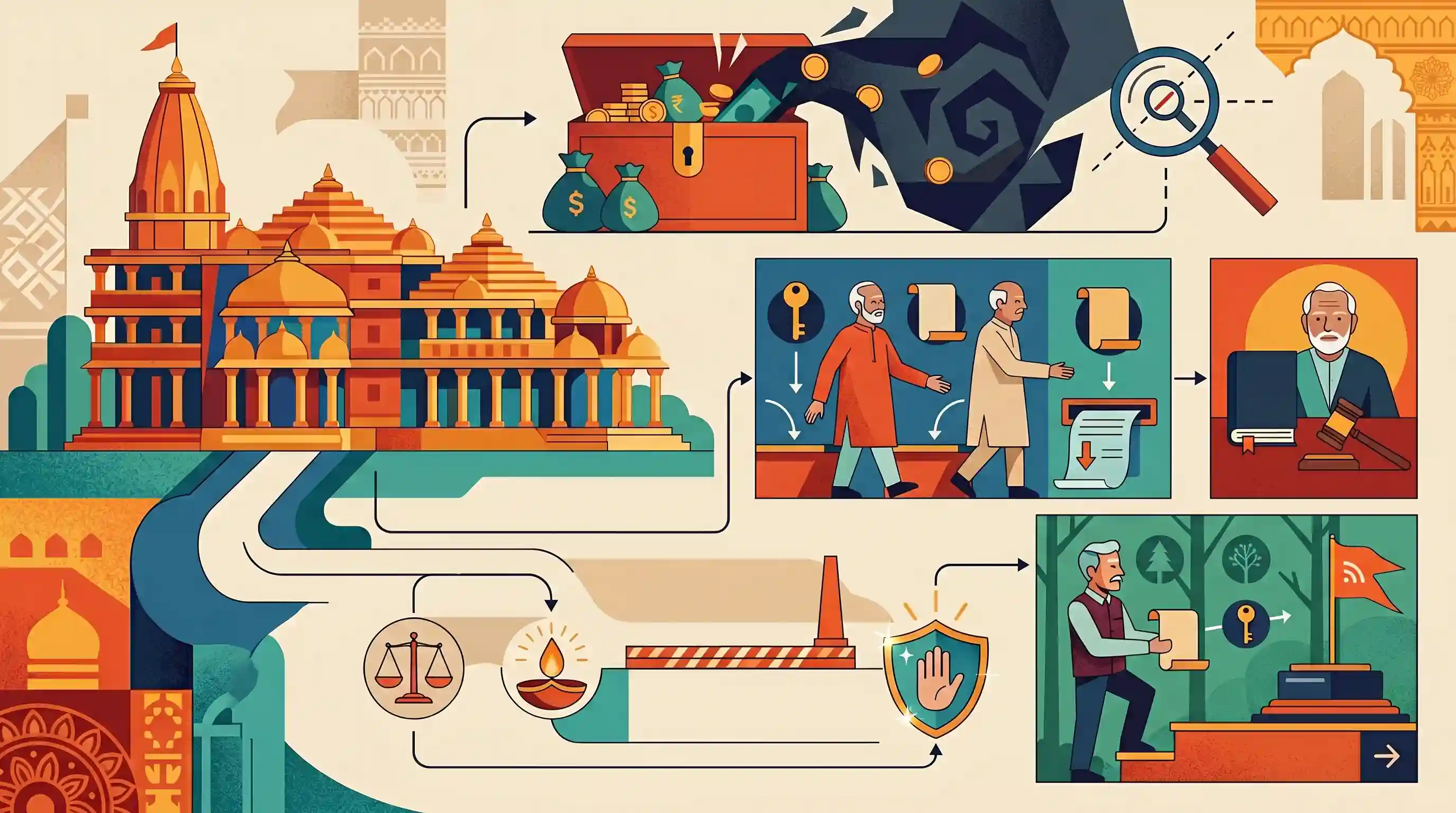
The Shri Ram Janmabhoomi Teerth Kshetra Trust has accepted the resignations of its General Secretary Champat Rai and Trustee Anil Mishra following a controversy surrounding donation theft at the temple complex. K. Parasaran, a key trustee, clarified that under the Trust’s constitution, resignations are automatically accepted upon submission. Krishna Mohan, a retired Indian Forest Service officer and RSS leader, has been appointed as the interim general secretary. The decision-makers emphasized that the resignations reflect a standard of high moral responsibility, as the leaders felt it improper to continue in their executive roles while an active investigation into the theft was underway.
Key Points
- Resignations over Controversy: Shri Ram Janmabhoomi Teerth Kshetra Trust's General Secretary Champat Rai and Trustee Anil Mishra resigned following a donation theft controversy.
- Immediate Constitutional Acceptance: Former Attorney General and trustee K. Parasaran pointed out that according to the Trust's constitution, a resignation is deemed accepted the moment it is submitted.
- Interim Leadership: Krishna Mohan, a 74-year-old former Indian Forest Service (IFoS) officer and RSS office-bearer, has been assigned additional responsibilities as the interim general secretary.
- Moral Accountability: Trust Treasurer Swami Govind Dev Giri Ji Maharaj noted that the resignations were born out of deep personal pain and a sense of moral responsibility, with Rai feeling it was inappropriate to continue until justice was served.
- Institutional Decision-making: The crucial meeting in Ayodhya was attended by seven of the nine permanent members, including Trust Chairman Nritya Gopal Das, to address governance and operational issues.
Important Terms
Shri Ram Janmabhoomi Teerth Kshetra Trust

A public trust established by the Government of India in 2020 to oversee and manage the construction, maintenance, and administration of the Ram Mandir complex in Ayodhya.
UPSC context
GS Paper II (Polity and Governance); tests knowledge of non-statutory bodies, judicial mandates, and trust governance.
Rashtriya Swayamsevak Sangh (RSS)
A prominent Indian right-wing, socio-cultural, and nationalist volunteer organization founded in 1925, focused on character-building, discipline, and promoting Hindu cultural identity.
UPSC context
GS Paper I (Modern History) and GS Paper II (Civil Society Groups); tests socio-cultural movements and non-state actors.
Probity in Governance
Adherence to high moral and ethical standards, such as absolute integrity, uprightness, and honesty, in administrative processes and public decision-making.
UPSC context
GS Paper IV (Ethics and Integrity); tests administrative ethics, public service values, and institutional accountability.
Public Charitable Trust
A legal, non-profit entity established to manage assets and properties for philanthropic, educational, religious, or public welfare purposes for the benefit of the general public.
UPSC context
GS Paper II (Polity - Development Processes and NGOs); tests the regulatory framework of non-profit organizations.
Special Investigation Team (SIT)
A specialized, temporary investigative group constituted by the executive or judiciary to conduct focused, impartial, and highly skilled probes into complex or sensitive cases.
UPSC context
GS Paper II (Executive/Judiciary) and GS Paper III (Security); tests ad-hoc investigative mechanisms and law enforcement accountability.
Prelims Trap
Public charitable and religious trusts in India are registered and primarily governed under the Indian Trusts Act, 1882.
Section 1 of the Indian Trusts Act, 1882 explicitly excludes public or private religious or charitable endowments. These are instead governed by state-specific laws or Section 92 of the CPC.
Static Concepts Connected
How are public charitable and religious trusts regulated in India given the exclusion in the Indian Trusts Act, 1882?
- Exclusion from 1882 Act: Section 1 of the Indian Trusts Act, 1882 restricts its scope to private trusts, leaving public and religious endowments outside its purview.
- Civil Procedure Code (CPC): Section 92 of the Civil Procedure Code (CPC), 1908 allows the Advocate General or interested persons to file suits for addressing mismanagement in public trusts.
- State-level Legislations: Several states have enacted specific legislations (such as the Bombay Public Trusts Act, 1950) to supervise and register public trusts via a Charity Commissioner.
What is the legal status of a temple deity as a 'juristic person' under Indian law?
- Juristic Personality: Indian jurisprudence treats a temple deity as a legal or juristic person capable of holding property, suing, and being sued.
- Fiduciary Management: The deity is legally treated as a perpetual minor; its properties are managed on its behalf by a shebait, trustee, or manager in a fiduciary capacity.
- Ownership of Assets: Donations and offerings belong to the deity, and any financial misappropriation constitutes a breach of trust towards this distinct legal entity.
Cross-Topic Patterns
Probity in Governance + Public Trust Ethics
Resigning during active investigations, even without statutory compulsion, exemplifies GS-IV principles of subjective accountability and maintaining institutional trust.
Section 2(h) of RTI + Religious Trusts
The exemption of non-government funded religious trusts from the RTI Act highlights the ongoing debate between institutional transparency and administrative autonomy under Article 26.

UPSC may couple the legal status of deities as juristic persons with the statutory exemptions of the Indian Trusts Act, 1882.
Linked PYQs · 3
Linked PYQs · 3
- 2024MainsGS2
Public charitable trusts have the potential to make India's development more inclusive as they relate to certain vital public issues. Comment.
- 2019MainsGS4
What do you understand by probity in governance ? Based on your understanding of the term, suggest measures for ensuring probity in government.
- 2022MainsGS4
Discuss the significance of 'Probity in public life' for effective governance.
