Ram temple donation embezzlement SIT probe monitored by Supreme Court
Source:The Hindu ↗
Why It Matters
This development highlights the Supreme Court's active role in supervising executive investigations to ensure financial accountability and transparency in public-trust funds, aligning closely with UPPSC syllabus themes of governance, judicial oversight, and institutional accountability.
Summary
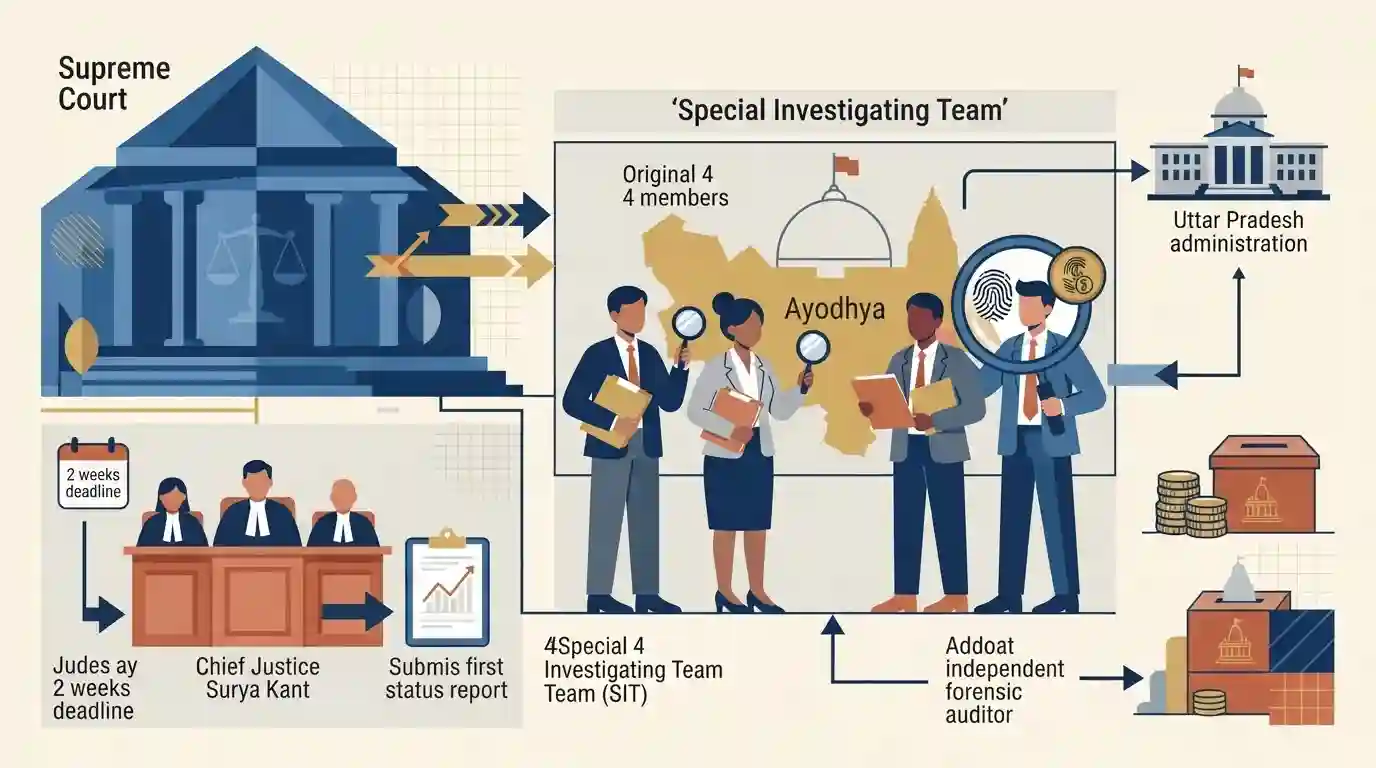
The Supreme Court has ordered the Uttar Pradesh government to expand its 4-member Special Investigating Team (SIT) probing the alleged embezzlement of Ram temple construction donations in Ayodhya by including an independent forensic auditor. The SIT, headed by IGP Kiran S, must submit its first status report within two weeks to a bench led by Chief Justice Surya Kant.
Key Points
- The Supreme Court of India directed the Uttar Pradesh government to include an independent forensic auditor in the Special Investigating Team (SIT) probing the alleged embezzlement of public donations for the Ram temple in Ayodhya.
- The SIT was originally established as a four-member team by the UP government, led by Inspector General of Police (IGP) Kiran S, and including a DIG-rank officer, SSP, and ASP.
- The addition of an independent forensic auditor or chartered accountant as a fifth member is meant to professionalize the financial investigation and trace the money trail.
- Solicitor General Tushar Mehta, representing the UP government, agreed to the court's recommendation to ensure transparency.
- A three-judge bench of the Supreme Court, comprising Chief Justice Surya Kant, Justice Joymalya Bagchi, and Justice V. Mohana, ordered the SIT to submit its first status report within two weeks.
Important Terms
Supreme Court of India

The apex judicial body in India, established under Part V of the Constitution. It acts as the final court of appeal, the ultimate interpreter of the Constitution, and the primary guarantor of fundamental rights.
UPSC context
GS Paper 2 (Polity). Central to understanding constitutional supremacy, judicial review, judicial activism, and the separation of powers.
Special Investigating Team (SIT)
A specialized law enforcement task force appointed by the government or judiciary to conduct impartial and thorough investigations into complex, high-profile, or sensitive criminal cases.
UPSC context
GS Paper 2 (Governance). Demonstrates judicial oversight and the necessity for independent policing mechanisms to ensure unbiased criminal investigations.
Forensic Audit
An in-depth examination of financial records designed to uncover fraud, embezzlement, or other financial crimes. The resulting facts and evidence are specifically structured for admissibility in legal proceedings.
UPSC context
GS Paper 3 (Economy) & GS Paper 2 (Governance). Crucial for ensuring financial transparency, corporate governance, and tackling white-collar crimes.
Embezzlement
The fraudulent appropriation or diversion of funds or assets by an individual or entity to whom they have been legally entrusted.
UPSC context
GS Papers 2 & 4 (Governance, Probity). Highlights the importance of institutional integrity, anti-corruption measures, and ethics in public administration.
Uttar Pradesh Government
The state-level executive and legislative authority governing Uttar Pradesh. It functions under India's federal framework and holds the primary responsibility for state administration and law enforcement.
UPSC context
GS Paper 2 (Polity). Relevant to the study of federalism, state executive powers, and the constitutional duties of state governance.
Prelims Trap
"The CAG is mandated to conduct forensic audits of all public charitable trusts receiving donations exceeding a specified threshold."
The CAG does not automatically audit private religious or charitable trusts. Its mandate covers government receipts/expenditures and bodies substantially financed by the state.
Static Concepts Connected
How are Special Investigation Teams (SITs) constituted and what is their legal backing?
- Who constitutes: They can be formed by the Supreme Court, High Courts, Central Government, or State Governments to handle sensitive or complex cases.
- Legal backing: SITs lack a distinct statutory act; their personnel draw investigative powers from the CrPC/BNSS and state police acts.
- Judicial monitoring: Court-appointed SITs frequently file sealed 'status reports' to insulate the investigation from executive interference and ensure transparency.
What distinguishes a Forensic Audit from a standard Statutory Audit?
- Core objective: Statutory audits ensure financial statements present a 'true and fair view'; forensic audits actively investigate suspected fraud, embezzlement, or misappropriation.
- Legal admissibility: Forensic audits are specifically designed to collect and produce structured evidence that is legally admissible for criminal prosecution in courts.
- Investigation scope: Unlike statutory audits that often rely on sampling, forensic audits deeply trace specific money trails and scrutinize suspicious transactions.
Cross-Topic Patterns
Judicial monitoring of executive probes
The SC mandating auditors and status reports exemplifies 'continuous mandamus'—where courts actively monitor ongoing investigations to ensure fairness, linking GS2 Judiciary to Governance.
Religious trusts and financial compliance
Large public donations to trusts intersect with GS3 money laundering risks, highlighting the legal vacuum in standardizing rigorous forensic audits for private religious charities.

Expect a GS2 mains question evaluating the efficacy of 'court-monitored SITs' versus statutory bodies like CBI in ensuring fair probes.
Linked PYQs · 2
Linked PYQs · 2
- 2021UPPSC_PRELIMSGS1
The Public Accounts Committee of Indian Parliament scrutinizes the
- 2024UPPSC_PRELIMSGS1
Match List-I with List-II and select the correct answer from the codes given below. List-I: (A) Consolidated Fund of India. (B) Finance Commission (C) Financial Emergency (D) Comptroller and Auditor General of India List-II: 1. Article 266 2. Article 360 3. Article 280 4. Article 148 A B C D
