Ayodhya Ram Temple Trust Functionaries Directed to Stay in Ayodhya
Source:The Hindu ↗
Why It Matters
The administrative and financial oversight of major religious and cultural structures like the Ram Temple in Ayodhya highlights the role of the state in ensuring accountability in public/religious endowments. It is crucial for understanding UP-specific administrative structures (SITs, role of Divisional Commissioners) and cultural affairs.
Summary
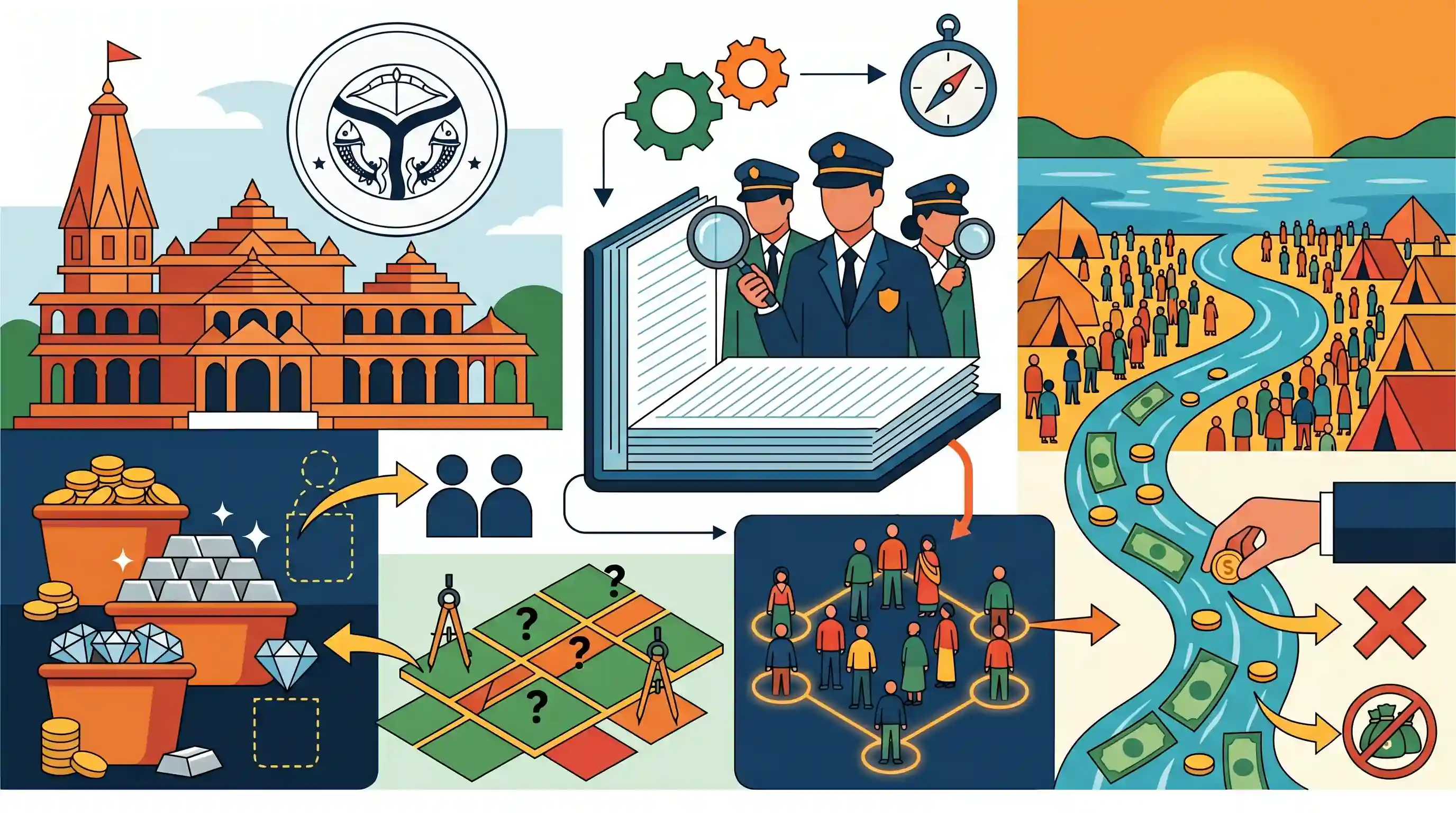
The Uttar Pradesh government has constituted a high-level 3-member Special Investigation Team (SIT) led by Lucknow Divisional Commissioner Vijay Vishwas Pant to probe allegations of embezzlement, land procurement irregularities, and missing gold, silver, and diamond offerings at the Ayodhya Ram Temple. The SIT has directed members and functionaries of the Shri Ram Janmabhoomi Teerth Kshetra Trust, including its general secretary Champat Rai, to remain in Ayodhya to assist with the investigation. The probe heavily centers on transactions and donations that occurred during the massive footfalls of the Maha Kumbh Mela in early 2025.
Key Points
- A three-member Special Investigation Team (SIT) was constituted by the Uttar Pradesh government on June 13 to probe allegations of financial irregularities, land purchase discrepancies, and embezzlement of donations at the Ayodhya Ram Temple.
- The SIT is composed of Lucknow Divisional Commissioner Vijay Vishwas Pant, Inspector General of Police S. Kiran, and Finance Department Special Secretary Neel Ratan.
- The investigation covers allegations of misappropriation of gold, silver, and diamonds offered by devotees, building material procurement, and land acquisition deals made by the Shri Ram Janmabhoomi Teerth Kshetra Trust.
- A significant portion of the alleged irregularities is believed to have occurred during the high-footfall Maha Kumbh Mela period in January-February 2025, when daily temple footfalls averaged 10 lakh people.
- SIT has instructed the temple trust officials and physical verification team members, including General Secretary Champat Rai, not to leave Ayodhya without prior permission to facilitate ongoing questioning.
Important Terms
Shri Ram Janmabhoomi Teerth Kshetra Trust

A 15-member trust established by the Indian government in February 2020 following the Supreme Court's landmark Ayodhya verdict, mandated to oversee the construction, management, and long-term administration of the Ram Mandir.
UPSC context
GS Paper II: Governance, specifically the management of public/religious trusts and state-citizen interactions in heritage development.
Special Investigation Team (SIT)
A temporary, specialized ad hoc investigative body constituted by Indian courts or governments to probe specific, complex, or high-profile cases where standard law enforcement is deemed insufficient or biased.
UPSC context
GS Paper II: Statutory, regulatory and various quasi-judicial bodies; and reforms in police and the criminal justice system.
Hindu Religious and Charitable Endowments (HR&CE)
Regulatory frameworks and specialized state government departments established under Concurrent List Entry 28 to manage, audit, and administer the financial and secular activities of prominent Hindu temple trusts.
UPSC context
GS Paper II: Governance and Indian Constitution (Articles 25 and 26), assessing the balance between state regulation and religious freedom.
Article 142 of the Indian Constitution
A unique constitutional provision granting the Supreme Court plenary and discretionary power to pass any decree or order necessary for doing 'complete justice' in any pending cause or matter.
UPSC context
GS Paper II: Indian Constitution, assessing judicial activism, judicial restraint, and the separation of powers.
Prelims Trap
The Ram Temple Trust is automatically subject to regular, mandatory annual audits by the CAG under Article 149.
CAG does not automatically audit public trusts. Under Section 20 of the CAG Act, 1971, CAG audit of trusts requires a formal request by the President or Governor in public interest, after prior consultation with the CAG.
Static Concepts Connected
Constitutional Status and Regulation of Religious Trusts in India
- Seventh Schedule Placement: Under Entry 28 of List III (Concurrent List), both Union and State governments can legislate on charities, charitable/religious endowments, and religious institutions.
- Trusts and Trustees: Entry 10 of List III governs 'Trusts and trustees', granting joint jurisdiction to legislate on trust frameworks.
- Article 26 Limitations: Article 26 guarantees religious denominations the right to manage their own affairs, but this remains subject to public order, morality, health, and state regulatory laws.
CAG's Audit Mandate over Non-Governmental and Trust Bodies
- Section 20 Consent Audit: CAG can audit bodies not substantially funded by the government only if requested by the President or Governor, following prior consultation with the CAG.
- No Default Jurisdiction: The CAG does not possess automatic or default constitutional jurisdiction to audit private, public, or religious charitable trusts.
Cross-Topic Patterns
Tourism Infrastructure vs. Heritage Schemes
While Ayodhya is a major religious tourism hub, its historic exclusion from schemes like HRIDAY highlights the evolving policy shift towards project-specific public-private trust models.
Secularism and State Regulation of Trusts
Financial probes into major shrines test the boundaries of Article 26 (freedom to manage religious affairs) against the State's power to regulate secular financial aspects.

Jurisdictional limits of CAG under Section 20 over public trusts versus their Seventh Schedule Concurrent status likely for 2026.
Linked PYQs · 2
Linked PYQs · 2
- 2020UPPSC_PRELIMSGS1
Which of the following cities of Uttar Pradesh is/are covered under the 'Heritage City Development and Augmentation Yojana (HRIDAY)' ? 1. Varanasi 2. Mathura 3. Prayagraj 4. Ayodhya Select the correct answer from the codes given below.
- 2025UPPSC_PRELIMSGS1
Pushkar Kumbh Mela 2025 was held in May 2025 in which of the following State(s)? 1. Rajasthan 2. Uttar Pradesh 3. Uttarakhand Select the correct answer from the code given below :
