PIL in Supreme Court Seeks Forensic Audit of Ram Temple Trust Finances
Source:The Hindu ↗
Why It Matters
This development illustrates the delicate constitutional balance under Indian secularism, where the state/judiciary can regulate the 'secular, financial, and administrative affairs' of a religious denomination (Article 26(d)) while keeping core religious practices (Article 26(b)) autonomous. It provides an excellent case study of judicial oversight, Public Interest Litigations (PILs), and institutional transparency in public/religious trusts receiving massive domestic and foreign donations.
Summary
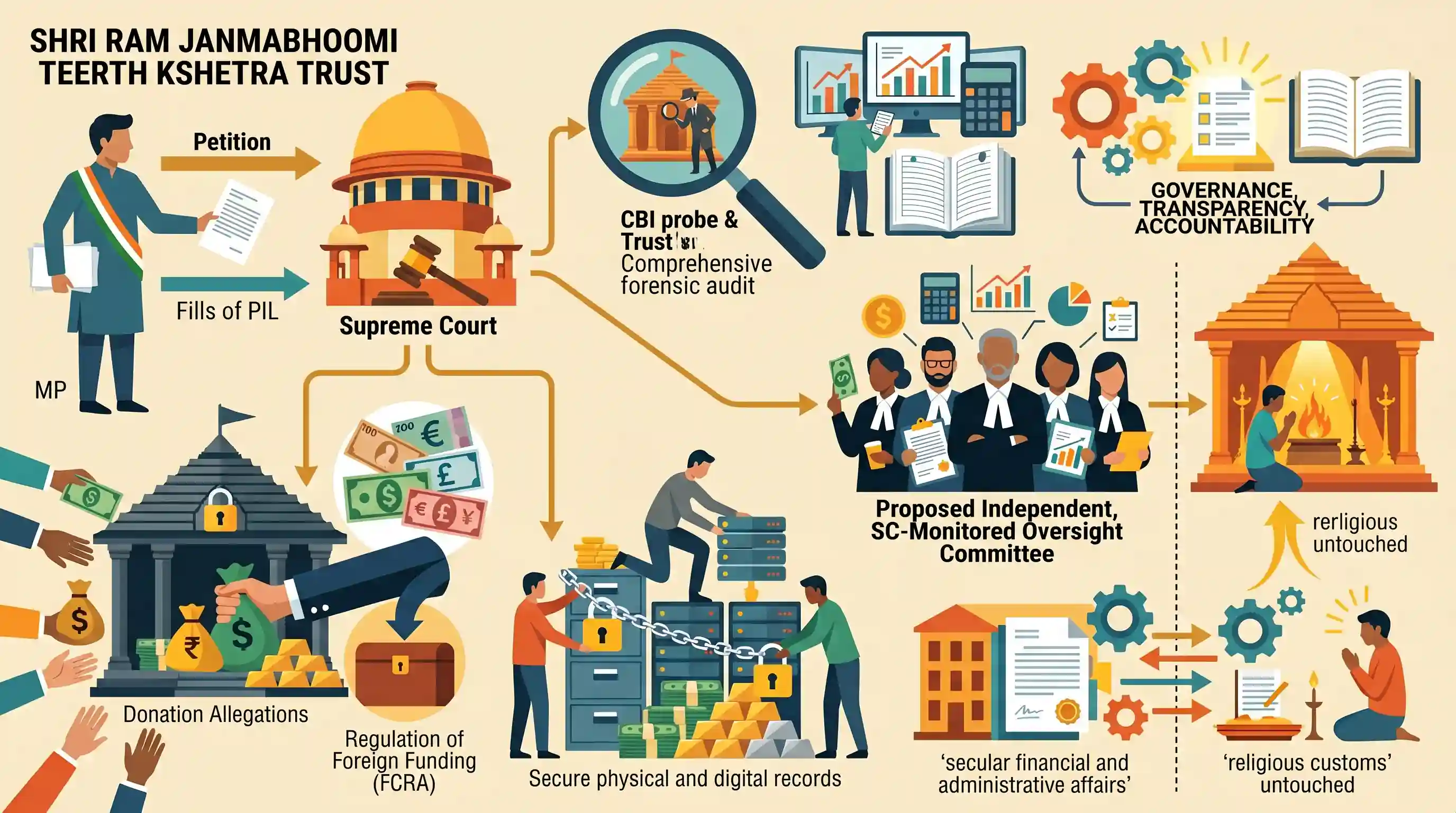
RJD MP Sudhakar Singh has filed a Public Interest Litigation (PIL) in the Supreme Court of India seeking a CBI probe and a comprehensive forensic audit into allegations of donation theft and embezzlement at the Shri Ram Janmabhoomi Teerth Kshetra Trust. The petition urges the court to secure and preserve all physical and digital records of donations, including cash, gold, silver, and foreign contributions. Furthermore, it seeks the creation of an independent, SC-monitored temporary oversight committee consisting of retired judges and financial experts to administer the 'secular financial and administrative affairs' of the Trust without disrupting its religious customs.
Key Points
- RJD MP Sudhakar Singh has filed a Public Interest Litigation (PIL) in the Supreme Court seeking a CBI probe and a forensic audit of the Shri Ram Janmabhoomi Teerth Kshetra Trust's finances due to allegations of donation embezzlement.
- The petition requests a complete statement of all offerings, including cash, digital payments (UPI), bank transfers, gold, silver, and foreign contributions, received by the Trust since its inception.
- It seeks the constitution of an independent, temporary, Supreme Court-monitored oversight committee (comprising retired judicial officers and financial experts) to supervise the 'secular, financial, and administrative affairs' of the Trust, without interfering with its core religious rituals and customs.
- To prevent evidence tampering, the PIL requests judicial intervention to preserve all material records, including ledger books, cash books, vouchers, CCTV footage, UPI logs, emails, and database servers.
- The controversy highlights the larger legal and constitutional debate under Article 26 of the Constitution over state control/oversight versus religious autonomy (e.g., the VHP's demand to free temples from state control) concerning the management of public religious endowments of exceptional public importance.
Important Terms
Foreign Contribution (Regulation) Act (FCRA)

An Act of Parliament enacted to regulate the acceptance and utilization of foreign funds by individuals or organizations, ensuring such contributions do not prejudice national security, public interest, or democratic sovereignty.
UPSC context
GS Paper II (Polity & Governance). Crucial for questions on NGO regulation, transparency, civil society funding, and national security challenges.
Shri Ram Janmabhoomi Teerth Kshetra Trust
A trust established by the Government of India in February 2020, following a Supreme Court directive, to oversee the construction, management, and financial administration of the Ram Mandir in Ayodhya.
UPSC context
GS Paper II & IV. Tests governance of religious public trusts, secular oversight, financial accountability, and ethics/probity in handling public funds.
Central Bureau of Investigation (CBI)
India's premier non-constitutional, non-statutory investigating agency, established in 1963 on the Santhanam Committee's recommendation, which derives its power from the Delhi Special Police Establishment Act, 1946 to probe corruption and serious crimes.
UPSC context
GS Paper II. Tests knowledge of central investigative agencies, federalism concerns (like state consent), and institutional reforms.
Supreme Court of India
The apex judicial authority of India, established under Article 124, serving as the ultimate interpreter of the Constitution, guardian of fundamental rights, and final court of appeal.
UPSC context
GS Paper II. Tests understanding of the integrated judiciary, PIL jurisdiction, judicial review, and separation of powers.
Constitution of India
The supreme law of India, establishing the political framework, powers of state organs, and fundamental rights and duties of citizens while guaranteeing the nation's secular and federal character.
UPSC context
GS Paper II. Core of the polity syllabus; tests constitutionalism, federal balance, secularism (Articles 25-26), and judicial powers.
Prelims Trap
The Shri Ram Janmabhoomi Teerth Kshetra Trust is a public authority under the RTI Act, 2005 due to its government-mandated creation.
The CIC and High Courts have clarified that autonomous religious trusts without direct government or budgetary funding do not qualify as public authorities under Section 2(h).
Static Concepts Connected
What is the difference between Article 26(b) and Article 26(d) regarding religious property?
- Matters of Religion: Article 26(b) guarantees the absolute right to manage 'matters of religion' such as essential rituals, ceremonies, and internal religious doctrines.
- Administration of Property: Article 26(d) allows religious denominations to administer property, but explicitly states it must be done 'in accordance with law', permitting state regulation.
- Judicial Doctrine: Established in the Shirur Mutt case (1954) that the State can regulate secular, financial, and administrative aspects of religious institutions without destroying core administrative rights.
What determines if a private or religious trust is a 'public authority' under the RTI Act?
- Section 2(h) definition: Section 2(h) defines public authority as bodies established by Constitution, Parliament, State Legislature, or government notification, or substantially financed/controlled by the government.
- Exclusion of private trusts: The Supreme Court and High Courts hold that autonomous religious trusts not receiving direct government budgetary funding do not fall under RTI, despite statutory regulation.
Cross-Topic Patterns
FCRA restrictions vs. Freedom of Religion
MHA's strict FCRA banking rules for religious trusts highlight the state's power to regulate foreign money inflows while balancing Article 26 rights.
State temple control vs. Religious autonomy
Demands to free temples from State endowment acts contrast with judicial attempts to enforce public transparency and audits in autonomous religious bodies.

Constitutional distinction between Article 26(b) religious practice and 26(d) secular administration of assets is a high-yield 2026 topic.
Linked PYQs · 3
Linked PYQs · 3
- 2024MainsGS2
Discuss India as a secular state and compare with the secular principles of the US constitution.
- 2024MainsGS2
Explain the reasons for the growth of public interest litigation in India. As a result of it, has the Indian Supreme Court emerged as the world's most powerful judiciary ?
- 2015MainsGS2
Examine critically the recent changes in the rules governing foreign funding of NGOs under the Foreign Contribution (Regulation) Act (FCRA), 1976.
