Ram Janmabhoomi Trust Resignations and Embezzlement Probe
Source:The Hindu ↗
Why It Matters
This development is critical for UPPSC aspirants as it intersects the administrative and legal aspects of the high-profile Shri Ram Janmabhoomi Teerth Kshetra Trust (created post the 2019 Supreme Court Ayodhya verdict) and the practical enforcement of the newly enacted Bharatiya Nyaya Sanhita (BNS) in prosecution of financial fraud, breach of trust, and criminal conspiracy.
Summary
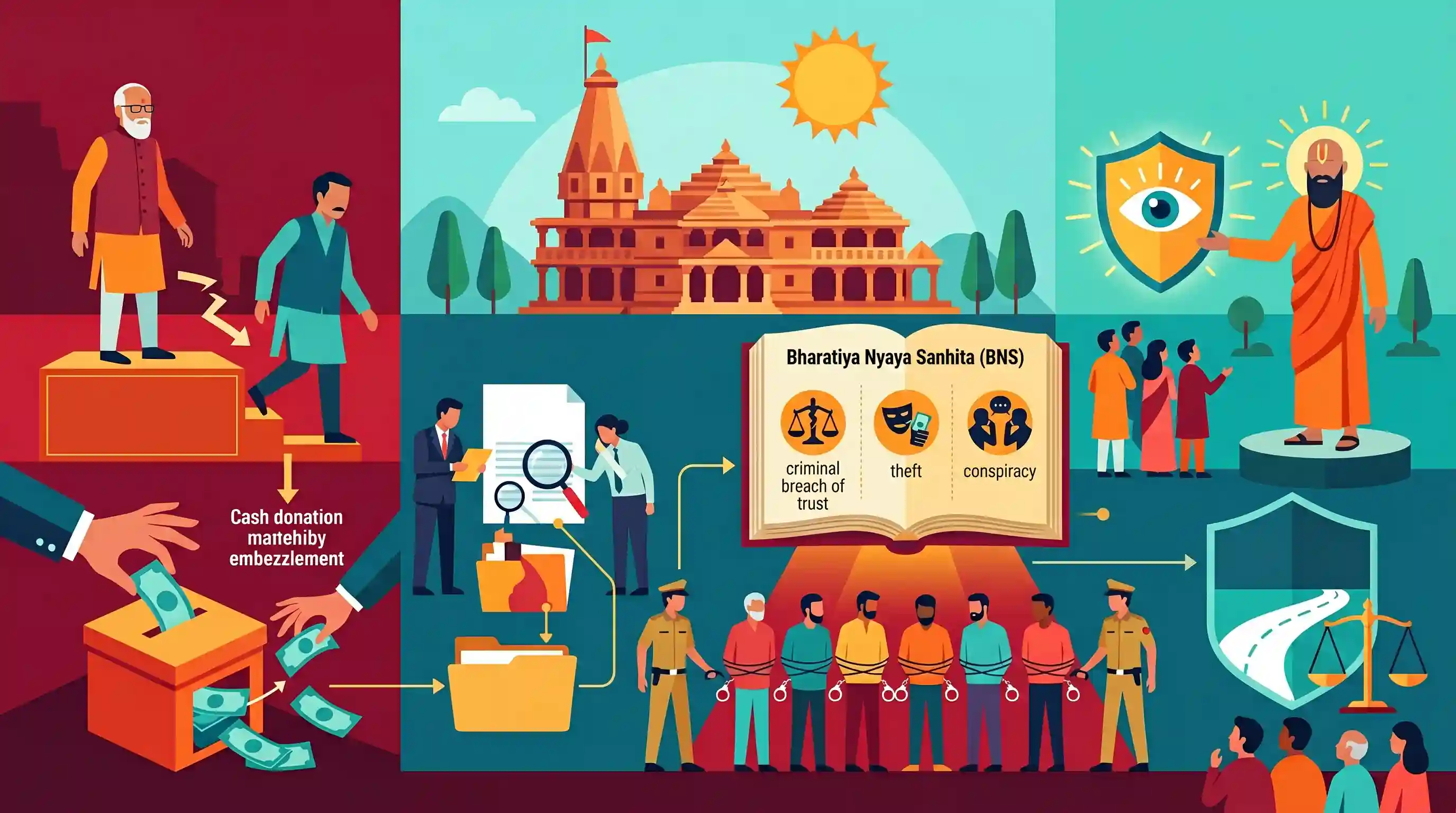
In June 2026, Champat Rai, the General Secretary of the Shri Ram Janmabhoomi Teerth Kshetra Trust, and member Anil Mishra resigned amid a controversy surrounding cash donation embezzlement from the Ram Temple boxes in Ayodhya. Following an interim report by a state-appointed Special Investigation Team (SIT), the Ayodhya police arrested eight accused individuals under several sections of the recently implemented Bharatiya Nyaya Sanhita (BNS), including provisions on criminal breach of trust, theft, and conspiracy. The trust’s treasurer, Swami Govind Dev Giri, assured devotees of transparency and a fair investigation.
Key Points
- Champat Rai (General Secretary of Shri Ram Janmabhoomi Teerth Kshetra Trust and Vice-President of VHP) and Anil Mishra (Trust Member) have submitted their resignations following allegations of donation box embezzlement at the Ram Temple in Ayodhya.
- The Trust\'s Treasurer, Pujya Swami Govind Dev Giri Maharaj, confirmed the resignations and announced that the Trust will make a final decision during its next meeting.
- Ayodhya police registered an FIR on June 25, 2026, based on an interim report from a Special Investigation Team (SIT) formed by the Uttar Pradesh government.
- All eight accused—Avinash Shukla, Anukalp Mishra, Luvkush Mishra, Manish Kumar Yadav, Karunesh Pandey, Rama Shankar Mishra, Subhash Srivastava, and Rama Shankar Yadav (alias Tinnu)—have been arrested and sent to judicial custody.
- The accused are booked under multiple provisions of the Bharatiya Nyaya Sanhita (BNS), including Section 305 (theft in dwelling house/temple), Section 306 (theft by clerk/servant), Section 317 and 317(5) (criminal breach of trust by an agent or public servant), Section 61 (criminal conspiracy), and Section 3(5) (joint liability/common intention).
- The Trust assured devotees that all physically hand-delivered offerings, including silver bricks and jewelry, are fully safe and accounted for, while promising a fair investigation into the cash box theft.
Important Terms
Bharatiya Nyaya Sanhita (BNS), 2023

India's primary criminal code enacted in 2023, replacing the colonial-era Indian Penal Code of 1860, focusing on modern legal provisions, victim protection, and updated definitions of offenses.
UPSC context
GS Paper II (Polity & Governance). Tests knowledge of criminal justice system reforms, legal updates, and administrative reforms.
Shri Ram Janmabhoomi Teerth Kshetra Trust
A 15-member public trust established by the Indian Government in 2020, following a Supreme Court directive, to manage the construction and administration of the Ram Temple in Ayodhya.
UPSC context
GS Paper II (Polity). Tests public endowment administration, state-religion relations, and landmark judicial decrees.
Special Investigation Team (SIT)
An ad hoc, specialized investigative body temporarily constituted in India by a court or government to probe high-profile, complex, or sensitive cases requiring unbiased, specialized focus.
UPSC context
GS Paper II (Polity & Governance). Tests understanding of specialized investigation mechanisms, judicial activism, and institutional accountability.
Vishwa Hindu Parishad (VHP)
A right-wing Hindu nationalist organization founded in 1964 by M. S. Golwalkar and others, acting as a prominent cultural and religious affiliate within the RSS-led Sangh Parivar.
UPSC context
GS Paper II (Polity & Governance). Tests understanding of pressure groups, secularism, communalism, and socio-religious dynamics in India.
Prelims Trap
Article 26 provides religious denominations absolute autonomy over financial and property administration free from state legislative control.
Article 26(d) subjects property administration to secular laws 'in accordance with law', and Article 25(2)(a) allows state regulation of financial activities.
Static Concepts Connected
How does the Constitution regulate religious and charitable endowments?
- Concurrent List Entry 28: Places 'charities, charitable institutions, and religious endowments' under List III, allowing both Centre and States to legislate.
- Article 25(2)(a): Empowers the State to regulate or restrict any economic, financial, political, or other secular activity associated with religious practice.
- Article 26(d): Guarantees religious denominations the right to administer their property, but explicitly mandates this must be "in accordance with law."
What is the Ratilal Panachand Gandhi vs State of Bombay precedent?
- Secular-Religious Divide: Distinguishes between essential religious practices (fully protected) and secular management of trust property (subject to state regulation).
- Financial Supervision: Affirmed that state-appointed authorities can supervise trust funds to prevent misappropriation without violating religious freedom.
Cross-Topic Patterns
Temple Autonomy and Article 25(2)(a)
Connects state control of temples (like HR&CE acts) with the federal friction over managing wealthy autonomous religious trusts created under judicial directives.
BNS Transition and Fiduciary Liability
Links the transition from IPC Section 409 to BNS Section 316(5) with administrative challenges during high-profile trust embezzlement trials.

Questions on the constitutional limits of state intervention in secular activities of religious trusts (Art 25 vs 26) likely in GS-2.
Linked PYQs · 3
Linked PYQs · 3
- 2023UPPSC_PRELIMSGS1
Which of the following statement is correct? (1) Ram Ganga river joins the Ganga at Kannauj. (2) River Betwa joins the Yamuna near Prayagraj. Select the correct answer using the code given below –
- 2018UPPSC_PRELIMSGS1
Supreme Courts Judgement regarding homosexuality is related to which of the following?
- 2022UPPSC_PRELIMSGS1
The concept of 'Basic Structure of the Constitution' was propounded by the Supreme Court in the case of
