Ayodhya Trust Donations Embezzlement SIT Report to Supreme Court
Source:The Hindu ↗
কেন এটি গুরুত্বপূর্ণ
This article highlights critical governance and legal issues: the accountability of public charitable trusts, the procedural rules governing police inquiries before FIR registration, the scope of CAG audits over non-governmental religious trusts, and the role of judicial oversight (Supreme Court monitoring) in maintaining public faith in major social institutions.
সারসংক্ষেপ
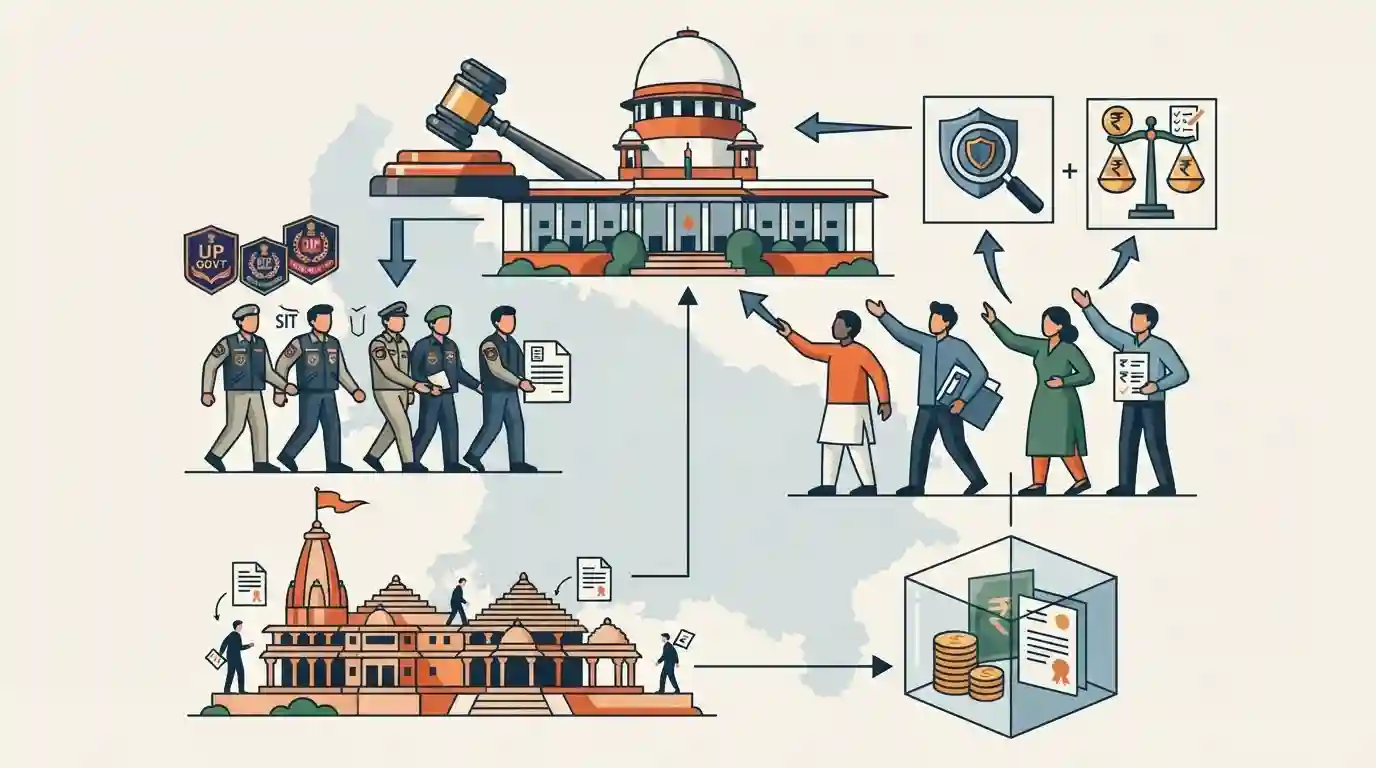
The Special Investigation Team (SIT) appointed by the Uttar Pradesh government is set to submit an interim report to the Supreme Court regarding financial irregularities and embezzlement of donations at the Shri Ram Janmabhoomi Teerth Kshetra Trust in Ayodhya. Preliminary findings have already led to arrests and high-profile resignations. The Supreme Court is considering pleas for a court-monitored CBI probe, forensic audit, and a CAG audit of the trust's finances.
মূল বিষয়
- The Special Investigation Team (SIT) investigating the alleged embezzlement of donations at the Ayodhya Ram temple is scheduled to submit its interim report to the Supreme Court on Monday.
- The three-member SIT, comprising Lucknow Divisional Commissioner Vijay Vishwas Pant, IG Kiran S, and Special Secretary (Finance) Neel Ratan, was constituted by the Uttar Pradesh government at the trust's request.
- A preliminary report submitted in June 2026 triggered the registration of an FIR, the arrest of eight accused, cash recovery, and the resignations of former trust general secretary Champat Rai and trustee Anil Mishra.
- The Supreme Court is hearing petitions that seek a court-monitored CBI probe, a forensic audit, and a CAG audit of the trust's financial records.
- Petitioners have raised procedural concerns, particularly questioning how the SIT commenced its inquiry before an official FIR was registered.
- The upcoming final report is expected to recommend long-term administrative reforms and improvements in the temple trust's donation-counting system.
গুরুত্বপূর্ণ শব্দ
Shri Ram Janmabhoomi Teerth Kshetra Trust

A public religious trust established by the Government of India in 2020, following a 2019 Supreme Court mandate, to manage the construction and administration of the Ram Mandir in Ayodhya.
UPSC context
GS Paper II (Polity & Governance); tests concepts of public charitable trusts, statutory versus non-statutory bodies, and institutional accountability.
Special Investigation Team (SIT)
A temporary, specialized probe team composed of law enforcement officers, constituted by the judiciary or executive to investigate highly sensitive, complex, or high-profile cases of public importance.
UPSC context
GS Paper II (Polity/Governance) and GS Paper III (Internal Security); tests investigative autonomy, police reforms, and judicial oversight of probes.
Comptroller and Auditor General (CAG)
An independent constitutional authority under Article 148, mandated as the guardian of the public purse to audit all receipts and expenditures of the Central and State governments.
UPSC context
GS Paper II (Polity & Governance); tests constitutional bodies, legislative control over the executive, and financial accountability.
Central Bureau of Investigation (CBI)
India's premier central investigating agency, operating under the Delhi Special Police Establishment Act, 1946, responsible for probing major cases of corruption, economic offenses, and serious inter-state crimes.
UPSC context
GS Paper II (Polity & Governance); tests non-constitutional regulatory bodies, federal issues like state consent, and administrative reforms.
Supreme Court of India
The apex judicial body and the final court of appeal under Articles 124–147, serving as the ultimate interpreter of the Constitution and the guardian of fundamental rights.
UPSC context
GS Paper II (Judiciary); tests judicial review, original/appellate jurisdictions, and the court's role in ensuring rule of law.
প্রিলিমস ফাঁদ
The CAG has automatic, statutory jurisdiction to audit any public charitable trust established by government initiative.
CAG only audits non-govt bodies if substantially state-funded, or under Section 20 of CAG Act on executive request, or by judicial mandate; it is not automatic.
সংযুক্ত স্থির ধারণা
What is the scope of CAG's audit jurisdiction over non-government bodies?
- Primary Mandate: CAG primarily audits bodies substantially financed by government grants under Sections 14 and 15 of the CAG Act, 1971.
- Special Request: Under Section 20, the President or Governor can request CAG to audit a body's accounts, subject to CAG's consent.
- Judicial Clarification: In 2014, the Supreme Court ruled CAG can audit private entities if they share revenue from public/natural resources with the state.
How can the CBI bypass the requirement of state consent?
- General Rule: Section 6 of the DSPE Act, 1946, mandates that the CBI must obtain state government consent to investigate.
- Judicial Override: The Supreme Court (Article 32) and High Courts (Article 226) can direct the CBI to investigate without state consent.
- Constitutional Validity: In the 2010 CPDR case, the SC held that this judicial power does not violate federal principles, as it protects fundamental rights.
আন্তঃবিষয় প্যাটার্ন
State control of religious trusts vs Secularism
Analyzes how state intervention in financial management of religious bodies under Article 25(2)(a) balances secular administration with religious freedom under Article 26.
FCRA compliance and civil society monitoring
Examines how stringent FCRA mandates ensure financial transparency of public trusts while preventing foreign interference in socio-cultural domains.

CAG’s discretionary audit powers under Section 20 vs. judicial override of CBI state consent likely to feature in GS-2 accountability questions.
সংযুক্ত PYQ · 4
সংযুক্ত PYQ · 4
- 2024MainsGS2
Public charitable trusts have the potential to make India's development more inclusive as they relate to certain vital public issues. Comment.
- 2024MainsGS2
“The duty of the Comptroller and Auditor General is not merely to ensure the legality of expenditure but also its propriety.” Comment.
- 2018MainsGS2
“The Comptroller and Auditor General (CAG) has a very vital role to play.” Explain how this is reflected in the method and terms of his appointment as well as the range of powers he can exercise.
- 2021MainsGS2
The jurisdiction of the Central Bureau of Investigation (CBI) regarding lodging an FIR and conducting probe within a particular State is being questioned by various States. However, the power of the States to withhold consent to the CBI is not absolute. Explain with special reference to the federal character of India.
