Uttar Pradesh SIT to submit report on Ram temple donations
Source:The Hindu ↗
Why It Matters
The issue highlights the administrative and legal frameworks governing large public and religious trusts. The demands for Supreme Court-monitored CBI probes and CAG audits illustrate the mechanisms used to enforce accountability, transparency, and financial propriety, which are key themes in the GS2 syllabus concerning governance and institutional oversight.
Summary
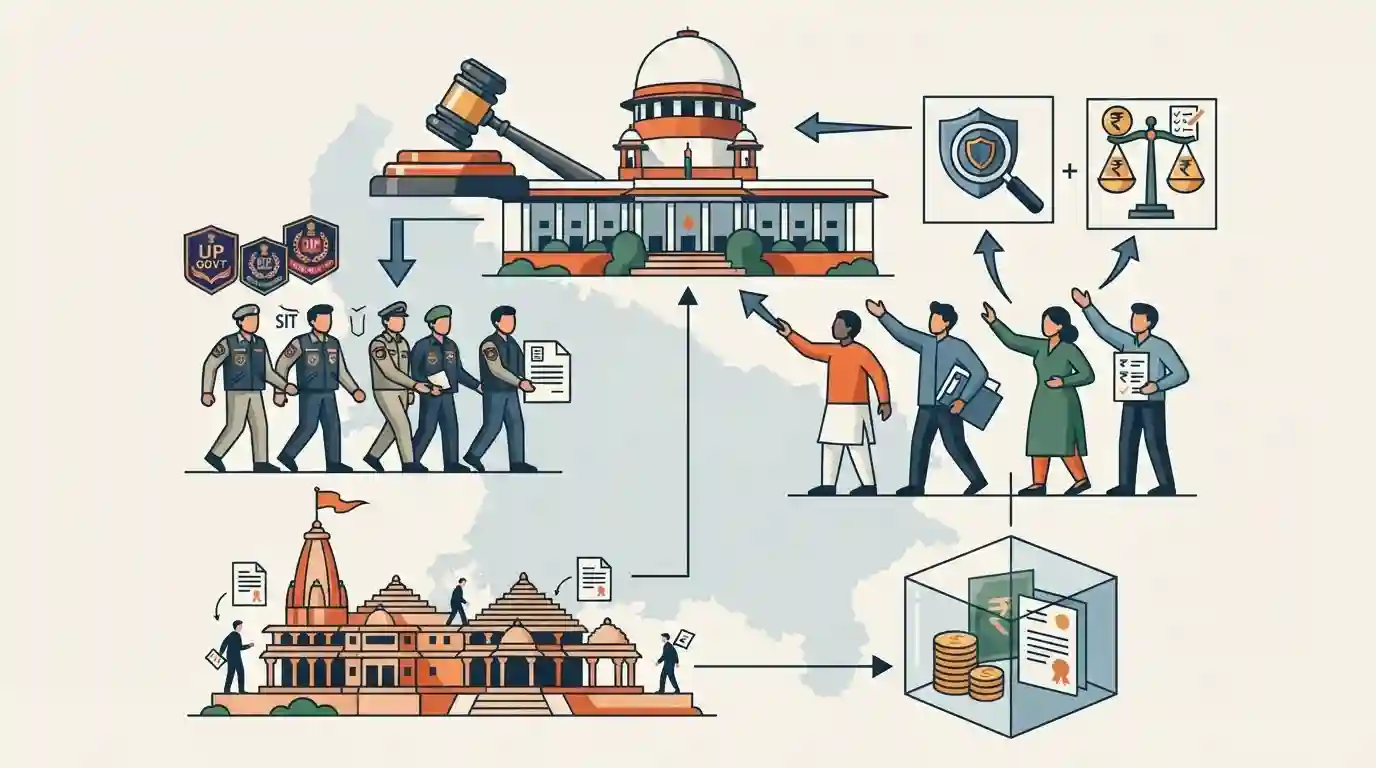
An SIT formed by the Uttar Pradesh government is preparing to present an interim report to the Supreme Court concerning alleged embezzlement in the Shri Ram Janmabhoomi Teerth Kshetra Trust. Amidst the controversy, which has already prompted the resignation of prominent trust officials, petitioners are pressing the Supreme Court for a court-monitored CBI probe and a comprehensive CAG audit to ensure transparency in the management of temple donations.
Key Points
- A Special Investigation Team (SIT) appointed by the UP government is set to submit an interim report to the Supreme Court regarding alleged financial irregularities in Ram temple donations.
- The SIT includes top officials such as the Lucknow Divisional Commissioner, the IG of Police, and the Special Secretary (Finance).
- Petitions filed before the Supreme Court have demanded a court-monitored CBI investigation, along with forensic and CAG audits of the trust's finances.
- The controversy has led to the resignation of key figures like trust general secretary Champat Rai and trustee Anil Mishra, sparking demands for structural reforms in the administration of the temple trust.
Important Terms
Comptroller and Auditor General (CAG)

An independent constitutional authority established under Article 148, acting as the "Guardian of the Public Purse" by auditing all receipts and expenditures of the Central and State governments.
UPSC context
GS Paper II (Polity) and GS III (Economy); tests constitutional bodies, financial accountability, and public finance oversight.
Supreme Court of India
The apex judicial body and final court of appeal in India, established under Article 124 of the Constitution, acting as the ultimate guarantor of fundamental rights.
UPSC context
GS Paper II (Polity/Judiciary); tests judicial review, separation of powers, and landmark constitutional jurisprudence.
Central Bureau of Investigation (CBI)
India's premier central investigating agency, deriving its powers from the Delhi Special Police Establishment Act, 1946, responsible for probing corruption, economic offenses, and inter-state crimes.
UPSC context
GS Paper II (Governance/Statutory & Non-Statutory Bodies); tests administrative transparency, reform of federal police structures, and anti-corruption frameworks.
Special Investigation Team (SIT)
An ad-hoc, specialized body of law enforcement officers temporarily constituted by the executive or judiciary to conduct targeted, impartial investigations into complex or high-profile cases.
UPSC context
GS Paper II (Polity/Governance); tests police reforms, investigative accountability, and judicial monitoring of high-profile cases.
Shri Ram Janmabhoomi Teerth Kshetra Trust
An autonomous public religious trust established in 2020 by the Central Government following the 2019 Supreme Court Ayodhya verdict, mandated to manage and construct the Ram Mandir.
UPSC context
GS Paper II (Governance/Institutions); tests management of religious endowments, transparency, and executive action fulfilling judicial mandates.
Prelims Trap
The Ram Janmabhoomi Trust is a public authority under RTI and is mandatorily audited by the CAG.
Despite being established by the Centre following a Supreme Court verdict, it is not an RTI public authority and not automatically audited by CAG as it lacks substantial government funding.
Static Concepts Connected
Under what conditions can the CAG audit a private or autonomous trust?
- Substantial Funding: Under Section 14 of the CAG (DPC) Act, 1971, bodies 'substantially financed' by government grants or loans are subject to CAG audit.
- Special Request: Under Section 20 of the Act, the President or Governor can formally request the CAG to audit a body not otherwise under its automatic purview.
How does the Constitution govern religious endowments and charities?
- Concurrent List: Charities, charitable institutions, and religious endowments fall under Entry 28 of the Concurrent List (List III), allowing both the Centre and States to legislate.
- Article 26: Grants religious denominations the fundamental right to establish institutions for religious/charitable purposes and administer their property in accordance with law.
- Secular Regulation: Under Article 25(2)(a), the State retains the power to regulate or restrict economic, financial, or other secular activities associated with religious practices.
Cross-Topic Patterns
RTI & 'Public Authority' debate
The classification of temple trusts and entities like PM CARES as non-public authorities tests candidates' understanding of the 'substantially financed' criteria under Section 2(h) of the RTI Act.
FCRA & Religious Endowments
With the Trust securing FCRA registration, the intersection of foreign funding regulations and religious body compliance remains a critical governance theme for GS-2.

Expect a Prelims question on religious trusts linking Concurrent List Entry 28, Article 26 rights, and CAG/RTI applicability.
Linked PYQs · 1
Linked PYQs · 1
- 2015UPPSC_PRELIMSGS1
In which of the following cases the Supreme Court observed that Central Bureau of Investigation is a 'Caged Parrot'?
