UP Constitutes SIT to Investigate Ayodhya Ram Temple Donations
Source:times-of-india ↗
Why It Matters
This article highlights the administrative mechanism of Uttar Pradesh in establishing accountability and checking embezzlement in nationally significant, high-profile public/religious trusts (such as the Shri Ram Janmabhoomi Teerth Kshetra). It demonstrates the coordination between division-level civil administration, police ranges, and special committees to maintain law and order and financial transparency.
Summary
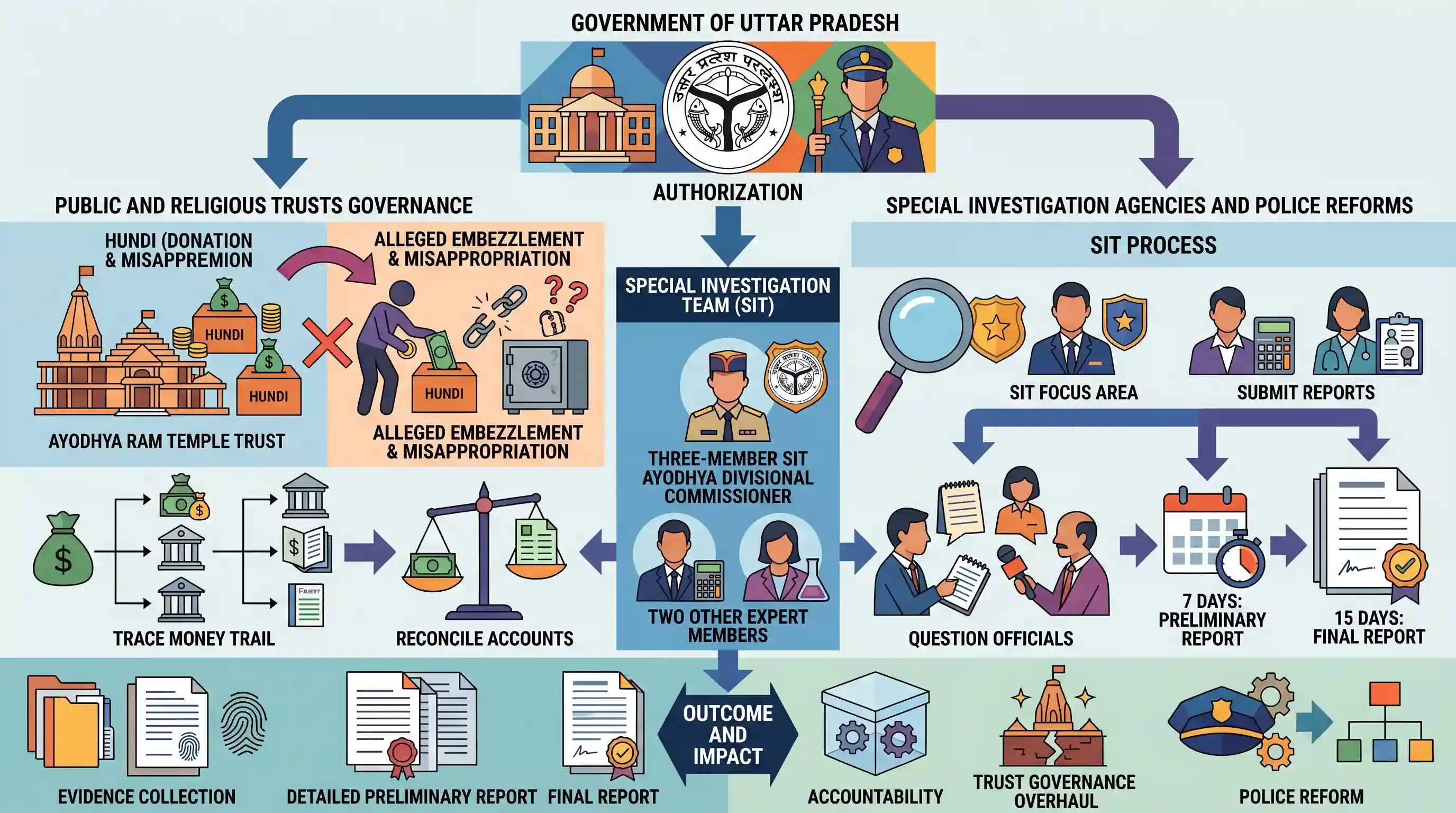
The Uttar Pradesh government has established a three-member Special Investigation Team (SIT) led by the Ayodhya Divisional Commissioner to probe the alleged embezzlement and misappropriation of Ram Temple donations. The SIT will focus on tracing the money trail, reconciling financial accounts, questioning temple trust officials, and submitting a detailed preliminary report within 7 days and a final report within 15 days.
Key Points
- The Uttar Pradesh government has constituted a three-member Special Investigation Team (SIT) to investigate the alleged misappropriation of donations made to the Ram Temple in Ayodhya.
- The SIT comprises three senior officials: Ayodhya Divisional Commissioner Vijay Vishwas Pant, Inspector General of Police (Lucknow Range) Kiran S, and Special Secretary Neel Ratan Kumar.
- The SIT is tasked with launching a field investigation to establish a complete money trail, analyze transaction records, question trust functionaries, and verify financial disclosures of five arrested suspects.
- A dedicated technical and field-support team consisting of inspector-rank officers and financial/digital specialists has been set up to assist the SIT in reconciling cash and digital records.
- The state government mandated a strict timeline: a preliminary report must be submitted within seven days, and the final report must be delivered within fifteen days.
Important Terms
Indian Trusts Act, 1882

A central legislation governing the creation, administration, rights, and duties of private trusts in India. It regulates how property is managed by trustees for specific beneficiaries, excluding public or charitable trusts.
UPSC context
GS Paper II (Polity & Governance); tests legal classification of trusts, differences between private and public entities, and property management regulations.
Charitable and Religious Trusts Act, 1920
A pre-independence central law enacted to provide judicial control, information access, and auditing mechanisms for public trusts created for charitable or religious purposes, enhancing transparency and accountability.
UPSC context
GS Paper II (Governance & Public Trusts); tests mechanisms for supervising public religious funds, administrative transparency, and legislative oversight.
Bharatiya Nyaya Sanhita (BNS)
India's primary substantive criminal code that replaced the colonial-era Indian Penal Code (IPC) in 2024, modernizing criminal classifications, punishments, and gender neutrality across the nation.
UPSC context
GS Paper II (Criminal Justice Reforms); tests comprehension of modern penal code updates, replacing colonial-era laws, and administrative law enforcement.
Special Investigation Team (SIT)
An ad hoc, specialized investigative body constituted by the government or judiciary to probe complex, high-profile, or sensitive cases where standard police investigations are deemed inadequate.
UPSC context
GS Paper II (Police Reforms & Governance); tests specialized police mechanisms, institutional accountability, and judicial intervention in investigations.
Shri Ram Janmabhoomi Teerth Kshetra Trust
A 15-member public religious trust established by the Government of India in 2020, following a Supreme Court mandate, to oversee the construction and management of the Ram Mandir.
UPSC context
GS Paper IV (Ethical Governance); tests fiduciary responsibility, transparency in religious donations, and probity in handling public/charitable funds.
Prelims Trap
The Indian Trusts Act, 1882 governs both private and public charitable/religious trusts in India, offering the baseline legal framework for all trusts.
The 1882 Act applies strictly to private trusts. Public religious and charitable endowments are governed by state-specific acts, the 1920 Act, or Section 92 of the Civil Procedure Code.
Static Concepts Connected
How are public religious trusts governed and audited in India?
- Private vs Public: The Indian Trusts Act, 1882 applies solely to private trusts; public and religious trusts are explicitly excluded from its ambit.
- Civil Procedure Code: Section 92 of the CPC provides the primary civil mechanism to address breaches of trust or mismanagement in public charities.
- Central Legislation: The Charitable and Religious Trusts Act, 1920 allows interested persons to petition district courts for financial audits of public trusts.
What is the legal status of Special Investigation Teams (SITs)?
- No Statutory Act: SITs are ad-hoc, temporary investigative bodies without independent statutory charter, established by courts or executive orders for specific cases.
- Procedural Powers: They draw their operational and investigative powers directly from the Code of Criminal Procedure (now BNSS).
Cross-Topic Patterns
Temple governance vs Article 26 limits
State regulation of secular activities (like finances) of religious institutions often tests the boundary of the freedom to manage religious affairs under Article 26.
Federal policing and ad-hoc SITs
The frequent creation of executive SITs highlights structural gaps in local state police capacity to handle complex, high-profile financial investigations.

UPSC may test the statutory limits of the Indian Trusts Act, 1882 versus state-level public trust laws in a multi-statement question.
Linked PYQs · 2
Linked PYQs · 2
- 2021UPPSC_PRELIMSGS1
The functions of the State Public Service Commission of Uttar Pradesh can be extended by
- 2025UPPSC_PRELIMSGS1
Which of the following Department prepares the National Indicator Framework Progress Report related to Sustainable Development Goals in Uttar Pradesh? 1. Department of Finance 2. Department of Education 3. Department of Planning Select the correct answer from the code given below:
