Shri Ram Janmabhoomi Teerth Kshetra Trust invites CEO applications
Source:indianmasterminds ↗
Why It Matters
The professionalization of the Ram Mandir's management highlights the intersection of public administration and religious endowments. Understanding the governance models of large-scale cultural and tourism hubs is crucial for UPPSC aspirants, especially regarding state infrastructure and administrative appointments.
Summary
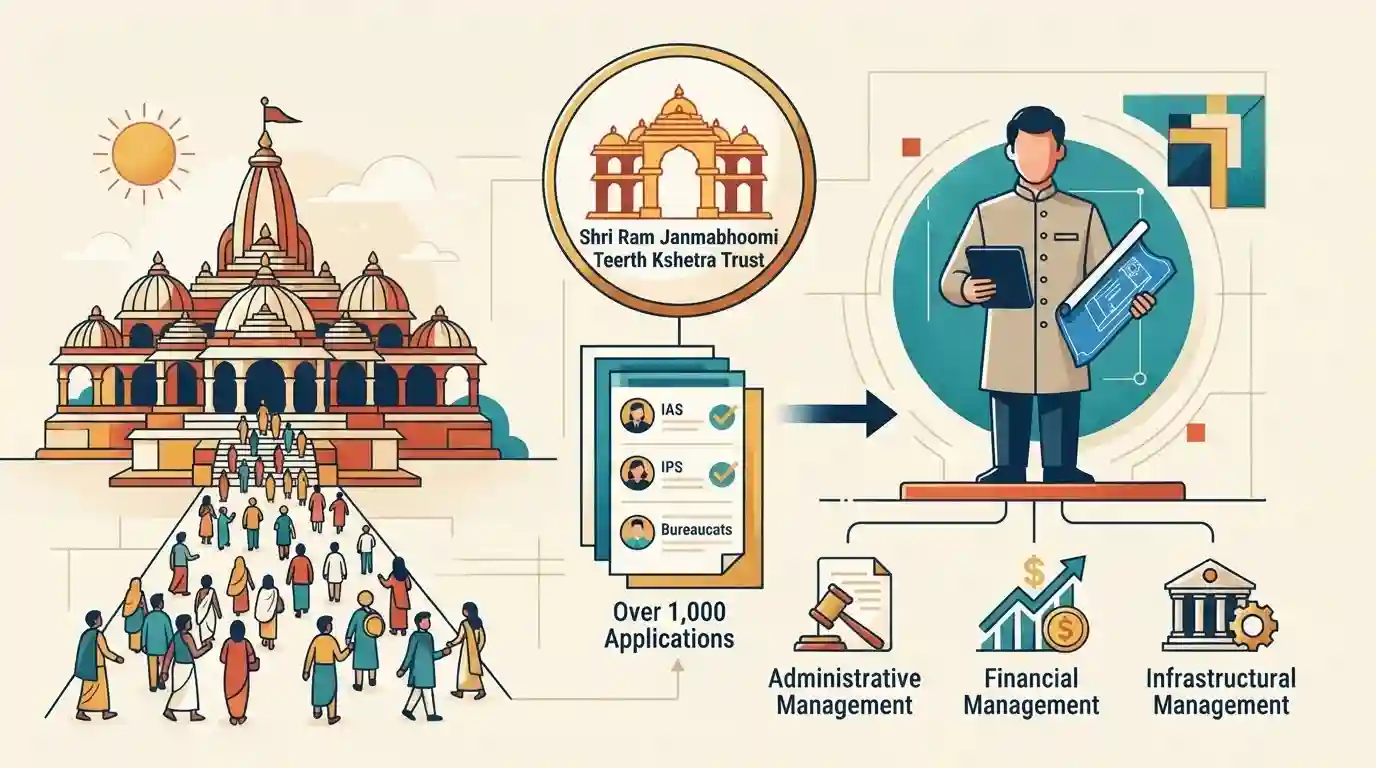
The Shri Ram Janmabhoomi Teerth Kshetra Trust is set to appoint its first-ever Chief Executive Officer (CEO) to manage the sprawling Ram Mandir complex in Ayodhya. Over 1,000 applications have been received, with retired IAS, IPS, and other senior bureaucrats dominating the race. The CEO will be responsible for the temple's administrative, financial, and infrastructural management, signaling a shift towards professional governance to accommodate massive pilgrim influxes.
Key Points
- The Shri Ram Janmabhoomi Teerth Kshetra Trust has received over 1,000 applications for the newly created position of Chief Executive Officer (CEO).
- The applicant pool is heavily dominated by retired senior government officials, including former IAS, IPS, and IFS officers.
- The appointment of a CEO aims to professionalize the administrative and financial management of the Ram Mandir to handle increasing pilgrim footfalls and infrastructural expansion.
- The move reflects a governance model similar to other major religious shrines in India, emphasizing efficient large-scale operations and crowd management in Ayodhya.
Important Terms
Shri Ram Janmabhoomi Teerth Kshetra Trust

A 15-member trust constituted by the Central Government in 2020, following the Supreme Court's 2019 Ayodhya verdict, to oversee the construction, management, and administration of the Ram Temple.
UPSC context
GS Paper 2 (Institutions). Tests the unique legal foundation of religious trusts established via judicial and executive mandates.
Religious Endowments
Properties, funds, or trusts dedicated to religious purposes. In India, Hindu endowments are typically regulated by state governments under the Concurrent List, sparking continuous debates over institutional autonomy versus state control.
UPSC context
GS Paper 2 (Governance). Links to Article 26 (freedom to manage religious affairs) and government intervention in temple administration.
Post-Retirement Appointments
The employment of retired civil servants (IAS/IPS) in statutory bodies, tribunals, or administrative trusts. It often prompts calls for mandatory regulatory rules to preserve pre-retirement bureaucratic neutrality and avoid political patronage.
UPSC context
GS Paper 2 (Role of Civil Services) and Paper 4 (Probity). Evaluates conflicts of interest, political patronage, and bureaucratic ethics.
Cooling-off Period
A mandatory waiting period required before a retired civil servant can take up commercial or certain governmental post-retirement assignments, designed to prevent conflicts of interest and ensure unbiased decision-making during active service.
UPSC context
GS Paper 2 (Civil Services) & Paper 4 (Ethics). Important for structural reforms to safeguard administrative neutrality and probity.
Prelims Trap
The Shri Ram Janmabhoomi Teerth Kshetra Trust is a statutory body and a public authority under the RTI Act, 2005.
Aspirants often assume that since the trust was established following a Supreme Court directive and executive notification, it is a statutory body or a public authority under the RTI Act. In reality, it is a public religious trust and the CIC ruled it is not a 'public authority'.
Static Concepts Connected
What is the constitutional framework governing State control over religious endowments in India?
- Concurrent List Entry: Entry 28 of the Concurrent List (Seventh Schedule) empowers both Parliament and State Legislatures to legislate on charities, charitable institutions, and religious endowments.
- Article 26 Rights: Article 26 guarantees religious denominations the right to manage their own affairs in religion (26b) and to administer property in accordance with law (26d).
- Shirur Mutt Case (1954): The SC held that while the State cannot interfere in core religious practices, it has the constitutional validity to regulate the secular, financial, and administrative aspects of temples.
What defines a 'public authority' under Section 2(h) of the RTI Act, 2005?
- Constitutional/Statutory Origin: Any authority, body, or institution of self-government established by or under the Constitution, or by laws made by Parliament or State Legislatures.
- Executive Notification: Institutions established by a notification issued or order made by the appropriate government.
- Control and Funding: Includes bodies owned, controlled, or substantially financed directly or indirectly by government funds, including non-governmental organizations similarly financed.
Cross-Topic Patterns
Secularism & Temple Management
The tension between state-led control of temple boards and religious freedom under Article 26 remains a central debate in Indian secularism.
Post-retirement Bureaucratic Roles
The recruitment of retired IAS/IPS officers to lead major public trusts highlights the ongoing debate over post-retirement appointments and institutional autonomy.

Constitutional limits of state control over religious trusts (Art 26 vs Entry 28) likely to be tested via statement-based questions.
Linked PYQs · 2
Linked PYQs · 2
- 2021UPPSC_PRELIMSGS1
The functions of the State Public Service Commission of Uttar Pradesh can be extended by
- 2018UPPSC_PRELIMSGS1
In which of the following hills the world famous temple of Lord Venkateswara (Tirupati) is located?
