SIT preliminary report on Ram Mandir donation row to CM Yogi
Source:republic-world ↗
Why It Matters
The article highlights essential administrative, investigative, and judicial processes in Uttar Pradesh. For UPPSC Prelims, understanding the evolution and purpose of PILs (introduced under Chief Justice P.N. Bhagwati), the powers and articles of the CAG (such as Article 148), and the writ jurisdiction of the Allahabad High Court are core political and constitutional areas that are regularly tested.
Summary
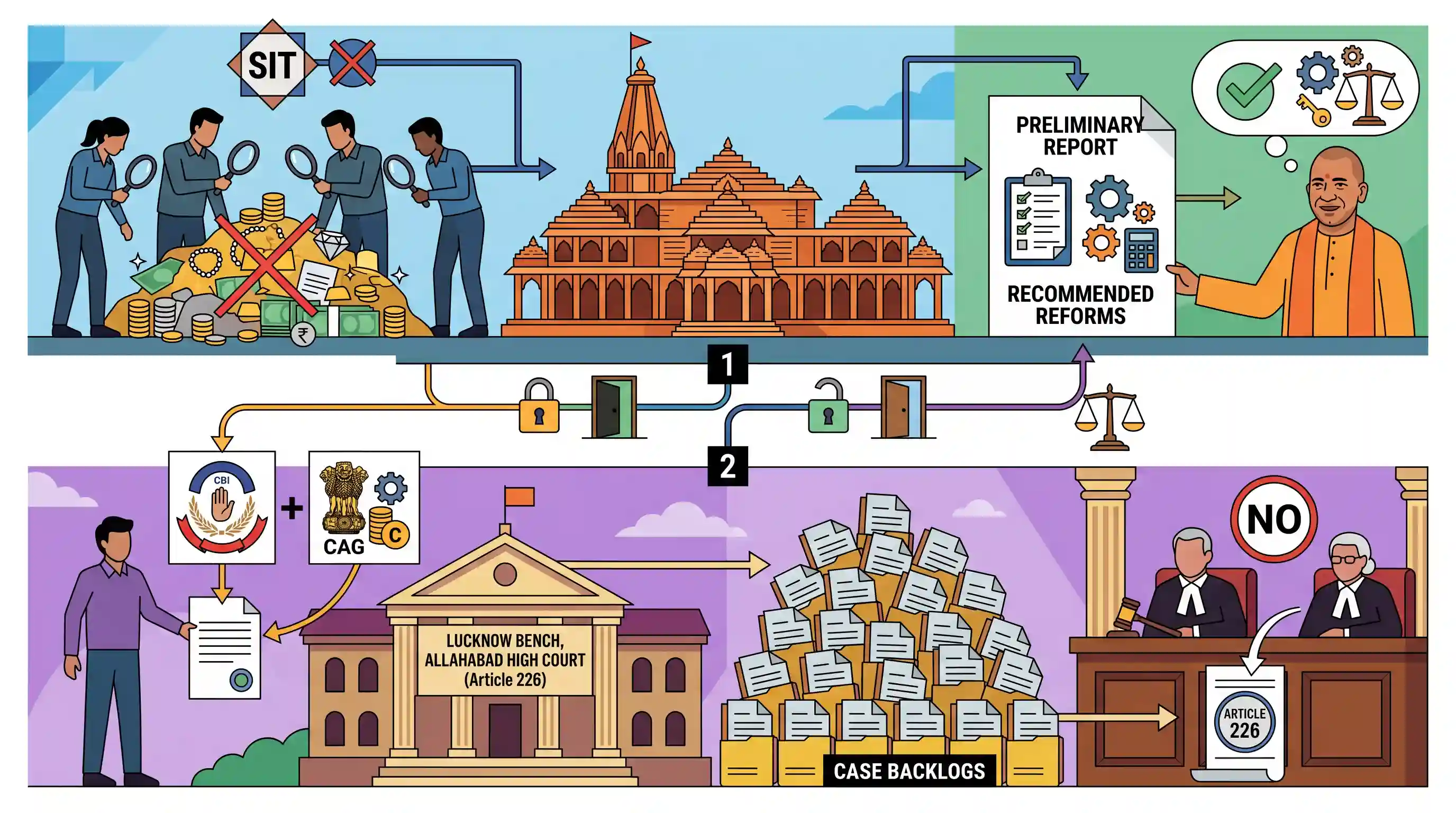
An SIT investigating the alleged Ram Mandir donation scam is set to submit its preliminary report to UP CM Yogi Adityanath, recommending significant auditing and administrative reforms. Meanwhile, the Lucknow Bench of the Allahabad High Court declined an urgent hearing on a PIL seeking a CBI probe or CAG audit of the temple donations, citing case backlogs.
Key Points
- A Special Investigation Team (SIT) led by Ayodhya SSP Raj Karan Nayyar is probing financial irregularities/embezzlement of temple donation funds worth Rs 7 to 7.5 crore at the Ram Mandir.
- The SIT is submitting its preliminary report to Uttar Pradesh Chief Minister Yogi Adityanath, recommending structural changes including weekly professional audits, digital logging, 180-day CCTV storage, and appointing a professional CEO for the trust.
- The Shri Ram Janmabhoomi Teerth Kshetra Trust suspended 40 employees on the basis of preliminary findings.
- A Public Interest Litigation (PIL) was filed by activist Sanjeev Singh in the Lucknow Bench of the Allahabad High Court, seeking a CBI probe or a CAG audit of the donations.
- A division bench of Justice Pankaj Bhatia and Justice Amitabh Kumar Rai declined an urgent out-of-turn hearing for the PIL, citing a severe backlog of cases and pointing out that the matter did not involve immediate life-and-death stakes.
Important Terms
Comptroller and Auditor General of India (CAG)

An independent constitutional authority under Article 148 that audits the receipts and expenditures of the Union and State governments, acting as the guardian of the public purse.
UPSC context
GS Paper II: Constitutional Bodies. Tests understanding of public financial accountability, legislative oversight, and executive control.
Central Bureau of Investigation (CBI)
India's premier central investigating agency, established in 1963. It derives its powers from the Delhi Special Police Establishment Act, 1946, to probe corruption, economic offenses, and serious crimes.
UPSC context
GS Paper II: Statutory, Regulatory and Quasi-judicial Bodies. Tests knowledge of investigative autonomy, federal police relations, and institutional integrity.
Special Investigation Team (SIT)
An ad hoc, specialized investigative body formed by the government or judiciary to probe complex, high-profile, or sensitive crimes when standard police investigations are deemed inadequate.
UPSC context
GS Paper II: Criminal Justice and Judiciary. Tests understanding of judicial oversight, police reforms, and mechanisms for impartial law enforcement.
Shri Ram Janmabhoomi Teerth Kshetra Trust
A 15-member trust set up by the Government of India in February 2020 to oversee the construction and management of the Ram Mandir in Ayodhya following the Supreme Court's landmark verdict.
UPSC context
GS Paper II: Judicial Decisions and Statutory Trusts. Tests knowledge of landmark judgments, temple administration laws, and state-religion relations.
Allahabad High Court (Lucknow Bench)
A permanent bench of India’s largest High Court, established in 1948, exercising writ jurisdiction under Article 226 for the enforcement of fundamental and legal rights within designated districts of Uttar Pradesh.
UPSC context
GS Paper II: Structure and Jurisdiction of Judiciary. Tests understanding of High Court benches, writ powers, and access to justice.
Prelims Trap
The CAG has no legal jurisdiction to audit public trusts or non-governmental organizations that do not receive government grants.
Under Section 20 of the CAG Act 1971, the CAG can audit non-funded private/public trusts upon a formal request from the President or Governor.
Static Concepts Connected
Under what conditions can the CAG audit non-governmental bodies or public trusts?
- Section 20 Request: The President or Governor can formally request the CAG to audit a non-mandated body if it is in the public interest.
- Audi Alteram Partem: The targeted non-governmental body must be given a reasonable opportunity to make representations before the audit commences.
- Substantial Funding Rule: Section 14 mandates audits if a body receives ₹25+ lakh grants, comprising at least 75 percent of its annual expenditure.
How does PIL modify the traditional rule of locus standi?
- Relaxed Locus Standi: Any public-spirited citizen or group can file a petition on behalf of marginalized sections who cannot access courts.
- Constitutional Basis: PILs are filed under Article 32 (Supreme Court) or Article 226 (High Courts) to protect public interest, not private disputes.
- Judicial Innovation: Pioneered by Justices P.N. Bhagwati and V.R. Krishna Iyer; it is a judge-led tool for social action litigation.
Cross-Topic Patterns
Religious freedom vs Financial regulation
Analyzes state capacity to regulate public donations to religious trusts under Article 25(2)(a) without infringing on Article 26 rights.
Judicial efficiency vs PIL priorities
Examines court backlog management and guidelines to prevent frivolous PILs from consuming valuable judicial time, reinforcing administrative efficiency.

CAG's statutory powers to audit non-governmental public trusts (Section 20 of CAG Act) likely to be tested in Prelims 2026.
Linked PYQs · 3
Linked PYQs · 3
- 2018UPPSC_PRELIMSGS1
Who was the Chief Justice of India when Public Interest litigation was introduced in the Indian Judicial system?
- 2025UPPSC_PRELIMSGS1
Given below are two statements, one is labelled as Assertion (A) and the other as Reason (R). Assertion (A): Public Interest Litigation in India is essential for the rule of law. Reason (R): Public Interest Litigation provides effective access of Justice to socially and economically weaker sections. Select the correct answer from the code given below:
- 2016UPPSC_PRELIMSGS1
Match List-I with List-II and select the correct answer using the codes given below the lists: List-I (Articles): (A) Comptroller (B) Finance (C) Administrative 3. Article 148 Tribunal (D) Union Public Service Commission List-II (Institution): 1. Article 315 and Auditor General of India 2. Article 280 Commission 4. Article 323
