Ideological convergence between Gandhi and Ambedkar
Source:Indian Express ↗
Why It Matters
The comparative analysis of the philosophies of Mahatma Gandhi and B.R. Ambedkar is a recurring theme in UPSC Mains (GS1 and Essay). Understanding their shared objectives helps candidates write nuanced answers regarding India's historical social reforms and the evolution of affirmative action, avoiding extreme polarization.
Summary
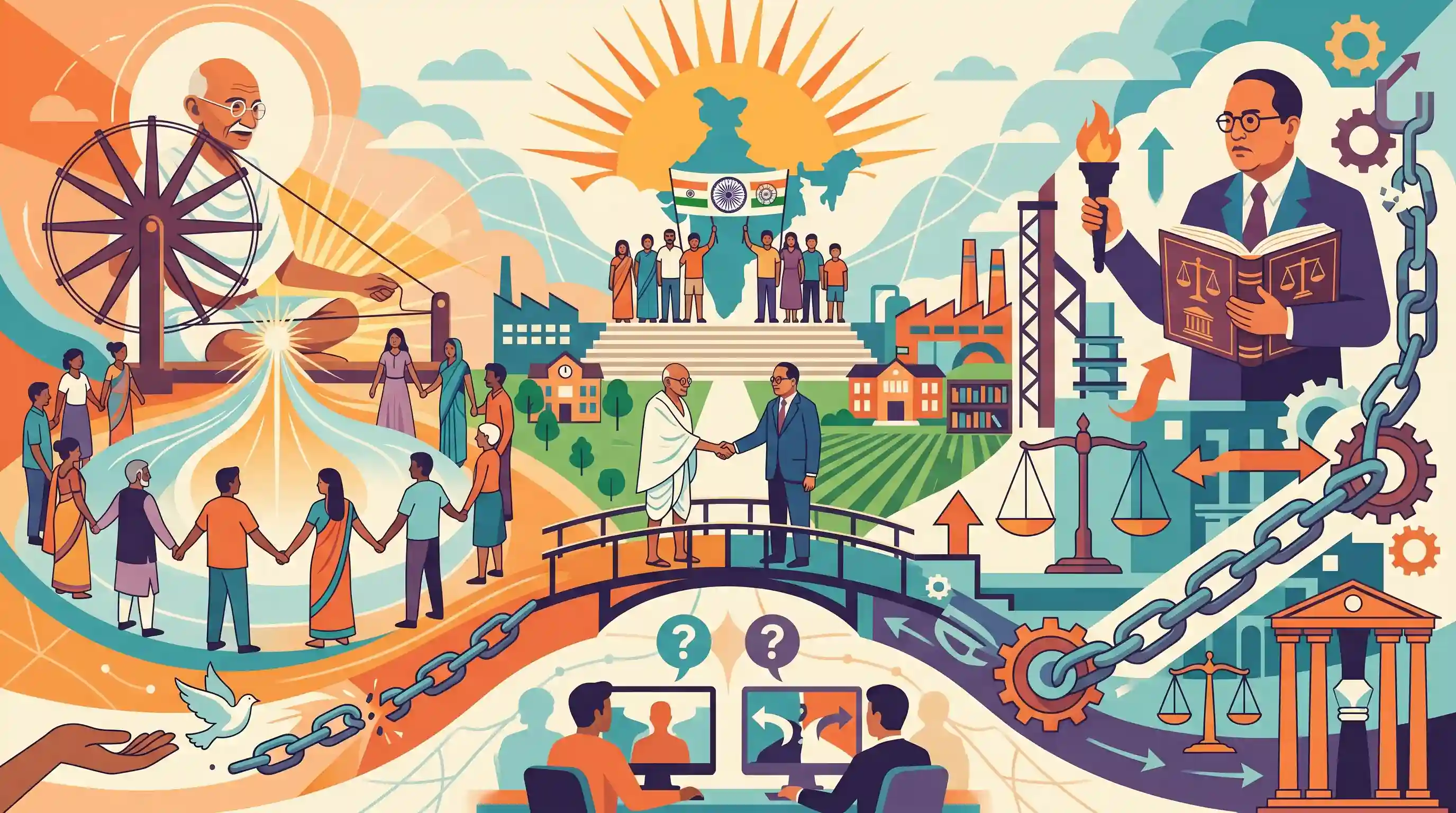
The article explores the ideological convergence between Mahatma Gandhi and Dr. B.R. Ambedkar, arguing that despite their divergent tactical approaches, both leaders shared a fundamental commitment to eradicating untouchability and uplifting the marginalized. While Ambedkar championed legal, constitutional, and structural reforms to annihilate caste, Gandhi focused on moral persuasion and social integration. The piece emphasizes that contemporary narratives often exaggerate their differences, overlooking their mutual respect and complementary roles in shaping modern democratic India.
Key Points
- Both Gandhi and Ambedkar held the emancipation of depressed classes and the eradication of untouchability as central to India's progress, despite their differing methods.
- Ambedkar focused on structural rights, political representation, and legal frameworks to formally annihilate the caste system.
- Gandhi emphasized moral reform, appealing to the conscience of the upper castes, and integrating marginalized communities into the mainstream through constructive programs.
- Historic events, such as the Poona Pact of 1932, demonstrate their tactical disagreements (separate electorates vs. reserved seats) but a shared ultimate objective of political empowerment for Dalits.
- The article cautions against modern political narratives that artificially polarize the two leaders, instead highlighting their collaborative legacy in nation-building and social justice.
Important Terms
Poona Pact (1932)

A 1932 agreement between Gandhi and Ambedkar providing reserved seats for 'Depressed Classes' within a joint electorate, instead of separate electorates. It was signed in Yerwada Jail to end Gandhi's fast.
UPSC context
GS Paper I (Modern History). Tests knowledge of Dalit political representation and the historic ideological compromise between Gandhi and Ambedkar.
Communal Award
A British policy by PM Ramsay MacDonald granting separate electorates to various minorities, including Depressed Classes. It prompted Gandhi's fast-unto-death, as he viewed the measure as divisive for Hindu society.
UPSC context
GS Paper I (Modern History). Crucial for understanding the 'Divide and Rule' policy and constitutional deadlocks during the Round Table Conferences.
Harijan Sevak Sangh
Founded by Gandhi in 1932 after the Poona Pact to eradicate untouchability. It focused on the social, educational, and moral upliftment of Dalits, whom Gandhi termed 'Harijans' (Children of God).
UPSC context
GS Paper I (Modern History/Social Empowerment). Tests understanding of Gandhi's constructive program and his socio-moral approach to caste reform.
Independent Labour Party
A political party founded by Dr. B.R. Ambedkar in 1936 to represent the interests of the working class and Dalits against both Brahmanical social structures and capitalist economic exploitation.
UPSC context
GS Paper I (Modern History). Important for studying Ambedkar’s early political strategy and the party's success in the 1937 provincial elections.
All India Scheduled Castes Federation
A national-level political party founded by Dr. Ambedkar in 1942 as a successor to the ILP. It focused specifically on securing constitutional rights and political representation for Scheduled Castes.
UPSC context
GS Paper I (Modern History). Covers the transition of the Dalit movement into a structured, national political identity during the 1940s.
Prelims Trap
"Both Mahatma Gandhi and B.R. Ambedkar advocated for the complete destruction of the Varna system to eradicate untouchability."
Ambedkar demanded the total annihilation of the caste system, but Gandhi defended an idealized, non-hierarchical Varna system based on division of labor, focusing strictly on eradicating the practice of untouchability.
Static Concepts Connected
What were the core provisions of the Poona Pact of 1932?
- Joint Electorate Retained: Ambedkar abandoned the demand for separate electorates for the Depressed Classes in favor of a joint Hindu electorate with a two-tier primary voting system.
- Reserved Seats Increased: Seats reserved for the Depressed Classes in provincial legislatures were significantly increased from 71 (under Ramsay MacDonald's Communal Award) to 147.
- Central Representation Secured: The Pact guaranteed fair representation for the Depressed Classes in the central legislature and in local bodies/public services through educational grants.
What key organizations did Dr. B.R. Ambedkar establish to secure political and social rights?
- Bahishkrit Hitakarini Sabha: Founded in 1924 to promote education, socio-economic upliftment, and political awareness among the depressed classes with the motto "Educate, Agitate, Organize".
- Independent Labour Party: Established in 1936 as a political organization to counter both Brahmanism and capitalism, actively advocating for workers' and marginalized communities' rights.
- Scheduled Castes Federation: Founded in 1942 to campaign for the political rights and representation of Dalits, eventually evolving into the Republican Party of India.
Cross-Topic Patterns
Fundamental Rights vs. Gandhian DPSPs
Ambedkar’s emphasis on structural, enforceable legal rights heavily shaped Part III (Fundamental Rights), whereas Gandhi’s focus on constructive social work and village integration manifests in the Gandhian DPSPs (e.g., Articles 40 and 46).
Ideological comparisons in Modern History
Comparing prominent personalities is a UPSC Mains staple. The Gandhi-Ambedkar tactical clash over caste deeply mirrors the Gandhi-Bose divergence on political tactics or the Gandhi-Tagore debate on nationalism and modern civilization.

Expect a multi-statement Prelims 2026 question contrasting Gandhi's defense of idealized Varna with Ambedkar's Annihilation of Caste.
Linked PYQs · 4
Linked PYQs · 4
- 2015MainsGS1
Mahatma Gandhi and Dr. B.R. Ambedkar, despite having divergent approaches and strategies, had a common goal of amelioration of the downtrodden. Elucidate.
- 2025PrelimsGS1
Subsequent to which one of the following events, Gandhiji, who consistently opposed untouchability and appealed for its eradication from all spheres, decided to include the upliftment of 'Harijans' in his political and social programme?
- 2019PrelimsGS1
Consider the following pairs: Movement/Organization Leader 1. All India Anti-Untouchability League : Mahatma Gandhi 2. All India Kisan Sabha : Swami Sahajanand Saraswati 3. Self-Respect Movement : E. V. Ramaswami Naicker Which of the pairs given above is/are correctly matched?
- 2012PrelimsGS1
Which of the following parties were established by Dr. B. R. Ambedkar? 1. The Peasants and Workers Party of India 2. All India Scheduled Castes Federation 3. The Independent Labour Party Select the correct answer using the codes given below:
