Dalai Lama India Ties and Geopolitical Impact
Source:Indian Express ↗
Why It Matters
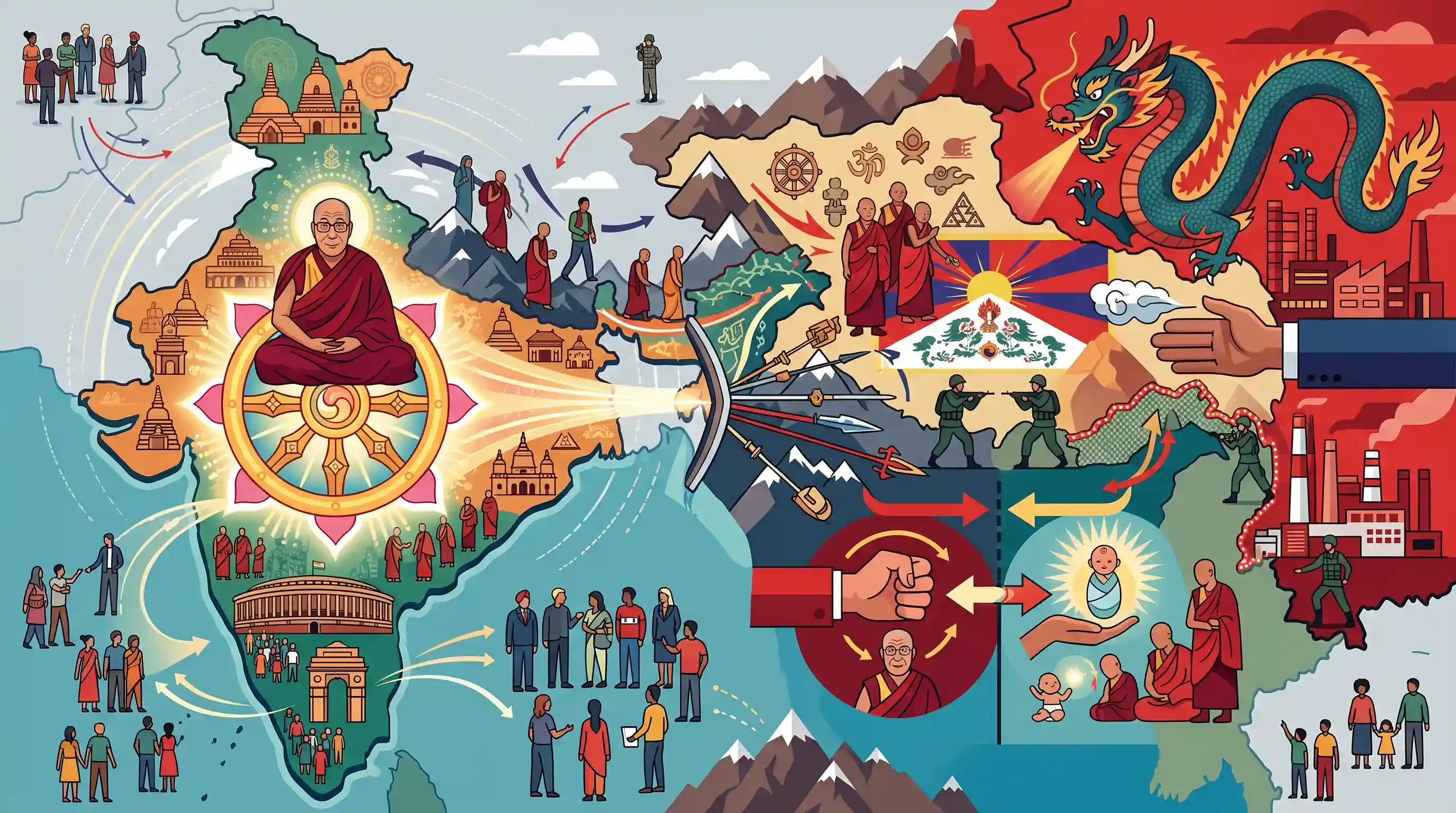
The status of Tibet and the institution of the Dalai Lama form the historical bedrock of the Sino-Indian strategic rivalry and border disputes. The looming succession crisis of the 14th Dalai Lama is a major upcoming geopolitical flashpoint. Understanding the interplay between cultural diplomacy (Buddhist soft power) and hard security issues is critical for answering questions in GS2 (International Relations) and GS1 (Indian Culture/History).
Summary
In this column, Ram Madhav explores the profound spiritual and cultural bond between India and the Dalai Lama, portraying India as his true 'spiritual home.' Tracing the Tibetan spiritual leader's six-decade exile, the article underscores the civilizational links forged by Buddhism and highlights the geopolitical weight of the Tibet issue in Sino-Indian relations. As the Dalai Lama ages, the impending succession process threatens to become a major flashpoint, pitting Beijing's political ambitions against Tibetan religious autonomy. India's continued role as a sanctuary for the Tibetan leadership reinforces its democratic ethos and soft power, while simultaneously presenting a strategic lever in countering China's maneuvers across the Himalayas.
Key Points
- Emphasizes the deep-rooted cultural and spiritual ties between India and Tibet, encapsulated by the Dalai Lama's sentiment that India is his spiritual home and its 'dal-chawal' runs in his veins.
- Highlights India's strategic leverage and enduring use of 'Buddhist soft power' by hosting the Dalai Lama and the Tibetan Government-in-Exile since 1959.
- Points to the unresolved Tibet issue as a historical and ongoing catalyst for geopolitical friction and border disputes in Sino-Indian relations.
- Warns of the impending geopolitical conflict over the 14th Dalai Lama's succession, as Beijing attempts to hijack the reincarnation process to cement its control over Tibet.
- Argues that supporting Tibetan religious and cultural autonomy aligns with India's democratic values while countering China's hegemonic ambitions in the region.
Important Terms
Panchsheel Agreement

A 1954 treaty between India and China outlining five principles of peaceful coexistence, including mutual non-interference. It formally recognized Tibet as a "region of China," marking a major shift in India’s northern policy.
UPSC context
GS Paper II (IR). Tests foundational bilateral treaties and the history of India-China boundary disputes.
Central Tibetan Administration (CTA)
The Tibetan government-in-exile based in Dharamshala, India. Formed in 1959, it manages the Tibetan diaspora and advocates for autonomy, though India does not officially recognize it as a sovereign entity.
UPSC context
GS Paper II (IR/Diaspora). Relevant for humanitarian commitments and the "Tibet issue" in bilateral diplomacy.
Chinese Communist Party (CCP)
The ruling party of China that asserts total state authority over religious affairs, including the selection of reincarnated lamas, viewing the Dalai Lama as a separatist "splittist" threat to national sovereignty.
UPSC context
GS Paper II. Essential for understanding the political drivers of China’s internal and external policies.
Tulku System
The Tibetan Buddhist system where high lamas are believed to reincarnate. The current succession is a flashpoint, as China claims legal authority over the process while the Dalai Lama emphasizes religious autonomy.
UPSC context
GS Paper I/II. Tests cultural heritage and geopolitical conflicts regarding religious freedom versus state control.
Soft Power
Diplomatic influence achieved through cultural and ideological attraction. India leverages its status as the birthplace of Buddhism to foster civilizational ties and counterbalance China’s regional influence.
UPSC context
GS Paper II (IR). Key for analyzing non-military tools and cultural diplomacy in foreign policy.
Buffer State
A neutral territory situated between two larger, potentially hostile powers to prevent direct conflict. Historically, an autonomous Tibet performed this role between India and China until its 1950 annexation.
UPSC context
GS Paper II (IR). Explains the strategic impact of Tibet's loss and the resulting border militarization.
Prelims Trap
India officially recognizes the Central Tibetan Administration (CTA) as the sovereign Government-in-Exile of Tibet.
India does not officially recognize the CTA as a sovereign government. Since 2003, India officially recognizes the Tibet Autonomous Region as part of China, while hosting the Dalai Lama strictly as an honored spiritual leader.
Static Concepts Connected
What was the 1954 Panchsheel Agreement regarding Tibet?
- Formal Name: Agreement on Trade and Intercourse between the Tibet Region of China and India.
- Key Concession: India formally recognized Tibet as a "region of China," relinquishing extraterritorial rights inherited from the British era.
- Five Principles: Established mutual respect for territorial integrity, non-aggression, non-interference, equality, and peaceful co-existence.
Who is Avalokiteshvara in Mahayana Buddhism?
- Bodhisattva of Compassion: The most revered Bodhisattva, also known as Padmapani (holding a lotus), who embodies the compassion of all Buddhas.
- Dalai Lama Link: The Dalai Lama is considered the earthly manifestation or reincarnation of Avalokiteshvara by the Gelug school of Tibetan Buddhism.
- Cave Depiction: A world-famous mural depicting Padmapani Avalokiteshvara is found in Ajanta Cave 1.
Cross-Topic Patterns
Buddhist Diplomacy & Act East Policy
India leverages platforms like the Global Buddhist Summit and Nalanda's revival as cultural soft power to balance China's assertiveness and deepen ties with ASEAN and East Asian nations.
One China Policy vs. Border Disputes
Since 2010, India has stopped explicitly reiterating the "One China" policy in joint statements, subtly linking its stance on Tibet to China's reciprocity regarding Arunachal Pradesh and Jammu & Kashmir.

Expect a multi-statement Prelims question linking Mahayana Bodhisattvas (Avalokiteshvara) to the Gelug school and Tibetan succession.
Linked PYQs · 5
Linked PYQs · 5
- 2014MainsGS2
With respect to the South China sea, maritime territorial disputes and rising tension affirm the need for safeguarding maritime security to ensure freedom of navigation and over flight throughout the region. In this context, discuss the bilateral issues between India and China.
- 2012MainsGS2
Do you think that China's emergence as one of the largest trading partners of India has adversely affected the settlement of the outstanding border problem?
- 2016MainsGS1
Early Buddhist Stupa-art, while depicting folk motifs and narratives successfully expounds Buddhist ideals. Elucidate.
- 2019PrelimsGS1
Consider the following: 1. Deification of the Buddha 2. Treading the path of Bodhisattvas 3. Image worship and rituals Which of the above is/are the feature/features of Mahayana Buddhism?
- 2018PrelimsGS1
With reference to Indian history, who among the following is a future Buddha, yet to come to save the world?
