Strategic Response Frameworks for State Sponsored Cross Border Terror
Source:Indian Express ↗
Why It Matters
The dynamic between India and Pakistan forms a critical component of India's foreign policy and internal security architecture. Understanding this strategic shift helps analyze the broader implications for regional stability in South Asia.
Summary
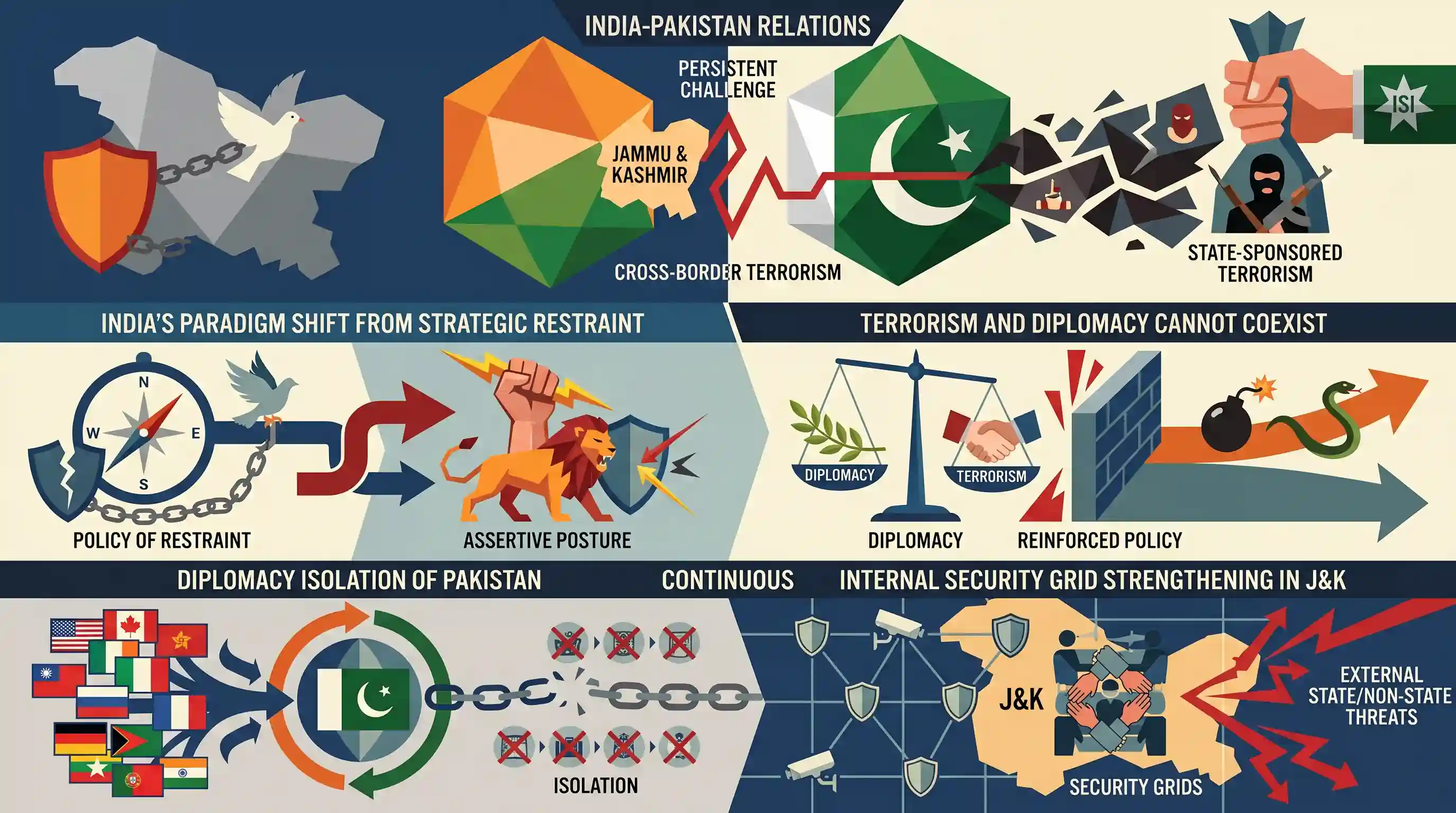
In this column, Ram Madhav analyzes India's strategic approach toward an aggressive Pakistan, focusing on the persistent challenge of cross-border terrorism. The article highlights India's paradigm shift from strategic restraint to an assertive posture, reinforcing the policy that terrorism and diplomacy cannot coexist. It emphasizes the need for continuous diplomatic isolation of Pakistan, alongside strengthening internal security grids in Jammu and Kashmir to neutralize threats posed by external state and non-state actors.
Key Points
- Persistent cross-border terrorism orchestrated by Pakistan remains the primary roadblock to bilateral dialogue and normalization of relations.
- India has adopted an assertive posture, maintaining that terror and talks cannot go together, which has led to Pakistan's regional and global diplomatic isolation.
- Effectively managing aggressive posturing requires robust deterrence mechanisms against both state and non-state actors operating from Pakistani soil.
- Internal security strategies in Jammu and Kashmir must blend kinetic counter-terrorism operations with efforts to win the 'hearts and minds' of the local populace.
Important Terms
SAARC

An eight-member regional intergovernmental organization established in 1985. It is currently largely dysfunctional due to India-Pakistan tensions, leading India to prioritize other groupings like BIMSTEC.
UPSC context
GS Paper 2: International Relations. Tests understanding of regional cooperation challenges and India's 'Neighborhood First' policy.
FATF
An intergovernmental organization that sets global standards for combating money laundering and terrorist financing. It uses 'Grey' and 'Black' lists to monitor jurisdictions with strategic deficiencies.
UPSC context
GS Paper 2 & 3: Global groupings and money laundering. Crucial for questions on terror financing.
Cross-border Terrorism
Terrorism originating from one country (Pakistan) targeting another (India), often involving infiltration across borders. It is a core pillar of Pakistan's proxy war against India.
UPSC context
GS Paper 3: Internal Security. Evaluates India's border management and counter-terror strategies.
Strategic Restraint
A policy of avoiding immediate military escalation in response to provocations, focusing instead on diplomatic and economic pressure. India shifted away from this after the 2016 and 2019 attacks.
UPSC context
GS Paper 2: Foreign Policy. Tests India's doctrinal evolution in response to security threats.
State-sponsored Terrorism
Government support of violent non-state actors as proxies to achieve foreign policy goals. Pakistan is frequently accused of using this to destabilize the Kashmir region.
UPSC context
GS Paper 2 & 3: International Relations and Security. Focuses on the role of external state actors.
Grey List
The formal name for FATF’s list of 'jurisdictions under increased monitoring.' Countries here must actively work with FATF to address systemic terror financing and money laundering flaws.
UPSC context
GS Paper 2: International Relations. Examines the impact of global pressure on state behavior.
Prelims Trap
India officially withdrew from SAARC following the 2016 Uri terror attack.
India boycotted the 2016 Islamabad summit, effectively paralyzing the bloc, but has never formally withdrawn from SAARC. Membership remains legally active.
Static Concepts Connected
What constitutes the WHAM (Winning Hearts and Minds) strategy in J&K?
- Civic Action Programmes: Military-run welfare initiatives like Operation Sadbhavana focus on education, healthcare, and infrastructure to build local trust.
- Kinetic + Non-Kinetic: Combining hard military operations against armed insurgents with soft-power socio-economic interventions for the civilian population.
- Counter-Radicalization: Efforts to prevent youth alienation through counseling, sports, and employment generation schemes (e.g., Himayat and UDAAN).
How does the SAARC Charter address bilateral disputes?
- Unanimity Clause: Decisions at all levels in SAARC require unanimous agreement, essentially giving any single member veto power over joint initiatives.
- Bilateral Exclusion: Article X of the SAARC Charter strictly excludes "bilateral and contentious issues" from the organization's official deliberations.
Cross-Topic Patterns
SAARC stagnation to BIMSTEC pivot
Pakistan's state-sponsored terrorism paralyzed SAARC, forcing India to re-route its 'Neighbourhood First' policy through BIMSTEC to maintain regional economic integration.
FATF as a diplomatic weapon
India's strategy to isolate Pakistan heavily leverages multilateral financial watchdogs like FATF, bridging GS-3 (Money Laundering/Terror Financing) with GS-2 (Foreign Policy).

Expect a 2026 Mains question linking India's 'assertive deterrence' security doctrine to its strategic pivot from SAARC to BIMSTEC.
Linked PYQs · 4
Linked PYQs · 4
- 2015MainsGS2
Terrorist activities and mutual distrust have clouded India-Pakistan relations. To what extent the use of soft power like sports and cultural exchanges could help generate goodwill between the two countries? Discuss with suitable examples.
- 2016MainsGS2
Increasing cross-border terrorist attacks in India and growing interference in the internal affairs of several member-states by Pakistan are not conducive for the future of SAARC (South Asian Association for Regional Cooperation)." Explain with suitable examples.
- 2021MainsGS3
Analyse the multidimensional challenges posed by external state and non-state actors, to the internal security of India. Also discuss measures required to be taken to combat these threats.
- 2023MainsGS3
Winning of 'Hearts and Minds' in terrorism-affected areas is an essential step in restoring the trust of the population. Discuss the measures adopted by the Government in this respect as part of the conflict resolution in Jammu and Kashmir.
