India Needs Regional Leadership Amid Declining Globalism
Source:Indian Express ↗
Why It Matters
The transition from globalization to sovereign nationalism is a core theme in contemporary International Relations. This article underscores the critical importance of India's 'Neighborhood First' policy and regional consolidation, offering a vital strategic perspective for GS2 questions on India's foreign policy shifts, neighborhood challenges, and the emerging multipolar world order.
Summary
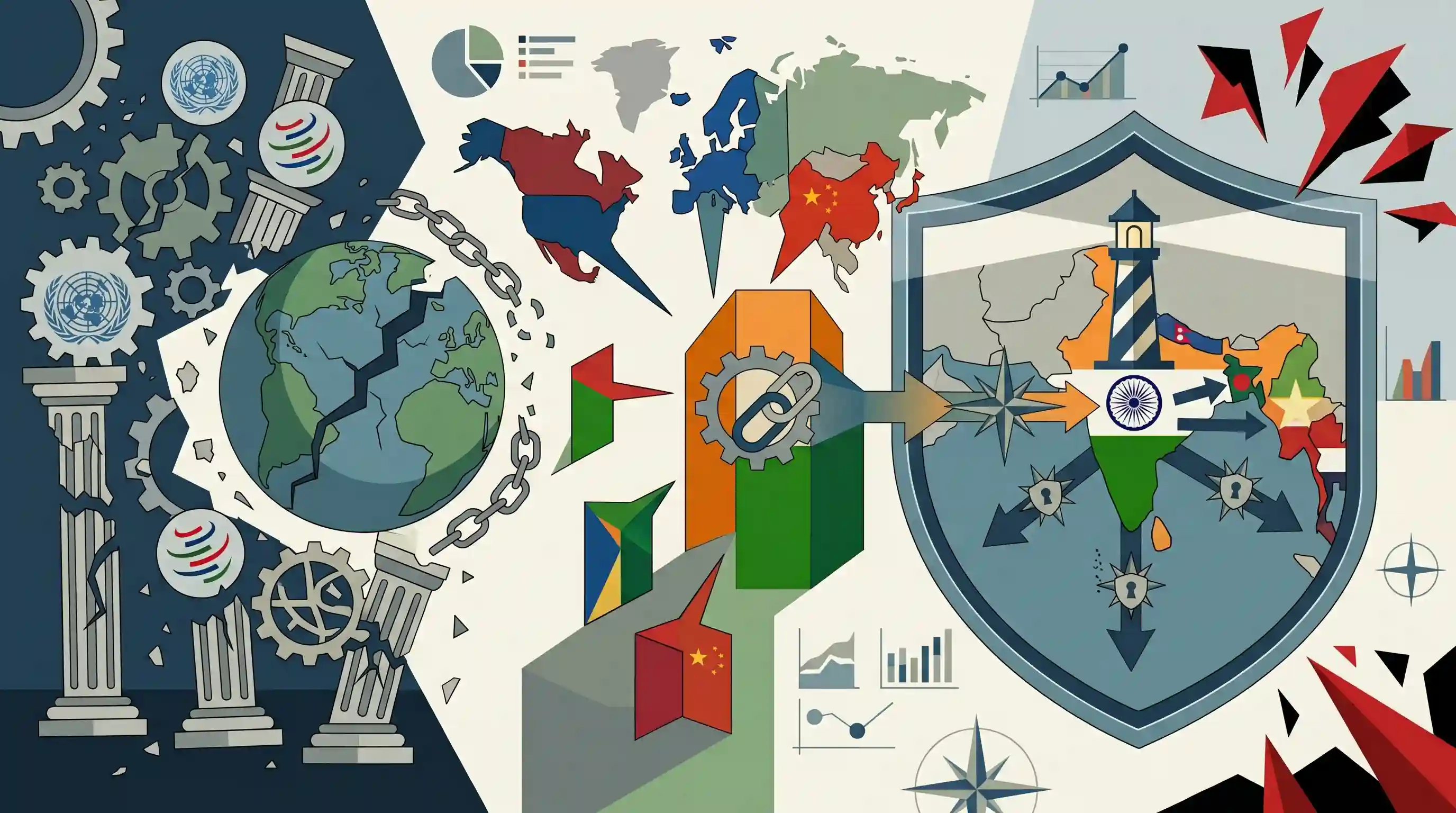
The author argues that the era of universal 'globalism' is concluding, making way for a multipolar world driven by sovereign nationalism and regionalism. As global governance structures falter amidst geopolitical conflicts and protectionism, India is advised to recalibrate its foreign policy priorities. Rather than overextending to champion a declining globalist order or solely seeking a seat at the global high table, India must focus on consolidating its immediate strategic backyard. By reinvigorating its 'Neighborhood First' policy and asserting undisputed regional leadership in South Asia and the Indian Ocean Region, India can build the necessary strategic depth to navigate a fragmented world and effectively counter external adversaries.
Key Points
- The era of hyper-globalization is giving way to sovereign nationalism, protectionism, and fragmented regional architectures as global institutions like the UN and WTO lose their effectiveness.
- Instead of solely pursuing global high-table aspirations, India's strategic imperative is to cement its position as the undisputed regional leader in South Asia and the Indian Ocean Region.
- Consolidating ties in the immediate neighborhood is essential to counterbalance the expanding strategic footprint of external powers (such as China) and ensure regional security.
- India's foreign policy should emphasize pragmatic multi-alignment, minilateralism, and championing the Global South, anchoring its global influence on a strong regional foundation.
Important Terms
Neighborhood First Policy

India's strategic priority to engage its immediate neighbors (South Asia and littoral states) to foster regional stability, physical/digital connectivity, and economic interdependence through a non-reciprocal, consultative approach.
UPSC context
GS Paper II: International Relations — crucial for 'India and its Neighborhood' and 'Bilateral, regional and global groupings'.
SAGAR (Security and Growth for All in the Region)
India's maritime vision for the Indian Ocean Region (IOR) aimed at deepening economic and security cooperation with littoral neighbors while positioning India as a 'net security provider.'
UPSC context
GS Paper II: International Relations — tests maritime diplomacy and strategic interests in the Indo-Pacific.
BIMSTEC
A regional grouping of seven nations around the Bay of Bengal, serving as a bridge between South and Southeast Asia and an alternative to the stalled SAARC.
UPSC context
GS Paper II: Regional Groupings — significant for 'Act East' and regional economic integration.
WTO (World Trade Organization)
The global body regulating international trade, currently facing 'institutional paralysis' due to the collapse of its Appellate Body and a rise in protectionist 'sovereign nationalism.'
UPSC context
GS Paper II/III: International Institutions and Economy — tests awareness of global trade governance and protectionism.
Multipolarity
A distribution of power in which more than two nation-states have nearly equal amounts of military, cultural, and economic influence, replacing the post-Cold War unipolar order.
UPSC context
GS Paper II: Global Politics — fundamental concept for analyzing the 'Effect of policies of developed/developing countries.'
BRICS
An intergovernmental organization comprising Brazil, Russia, India, China, and South Africa (plus recent invitees) that advocates for a multipolar world and greater representation for the Global South.
UPSC context
GS Paper II: Global Groupings — tests India's role in shifting world orders and Global South leadership.
Prelims Trap
India is pivoting exclusively to minilateral frameworks like Quad and abandoning multilateral forums like the UN.
India uses minilaterals to bypass UN paralysis, but it has not abandoned multilateralism. It still actively champions the Global South and seeks UNSC reform.
Static Concepts Connected
What distinguishes 'Minilateralism' from traditional Multilateralism in International Relations?
- Scope and Size: Multilateralism involves broad, universal participation (UN, WTO); minilateralism is limited to a small group of nations with shared strategic interests.
- Decision-Making: Minilaterals are agile, informal, and consensus-driven on specific issues, bypassing the bureaucratic paralysis of larger organizations.
- Legal Framework: Traditional multilaterals rely on binding treaties and charters, whereas minilaterals rely on voluntary cooperation and flexible alignment.
What are the core tenets of India's Gujral Doctrine for neighborhood relations?
- Non-Reciprocity: With immediate neighbors like Bangladesh, Bhutan, and Nepal, India gives what it can in good faith without demanding reciprocal actions.
- Non-Interference: No South Asian country should interfere in internal affairs, nor allow its territory to be used against regional interests.
- Bilateral Resolution: All disputes should be resolved peacefully through bilateral negotiations, explicitly excluding third-party intervention.
Cross-Topic Patterns
Minilaterals and supply chain resilience
Groupings like Quad increasingly focus on non-traditional security, directly overlapping with GS1/GS3 Economic Geography topics like critical mineral mapping and semiconductor supply chains.
Global South and Climate Finance
India's assertion as the regional leader of the Global South anchors its negotiating stance at UNFCCC COP summits, demanding equitable climate finance and tech transfers.
IOR Regionalism and Maritime Security
The strategic pivot to the Indian Ocean Region ties foreign policy to GS3 internal security, focusing on coastal defense, counter-piracy, and the SAGAR framework.

Expect a 15-marker in GS2 Mains 2026 evaluating India's shift to agile minilaterals (Quad/I2U2) to counterbalance UN/WTO paralysis.
Linked PYQs · 3
Linked PYQs · 3
- 2025MainsGS2
"With the waning of globalization, post-Cold War world is becoming a site of sovereign nationalism.” Elucidate.
- 2022MainsGS2
India is an age-old friend of Sri Lanka.’ Discuss India's role in the recent crisis in Sri Lanka in the light of the preceding statement.
- 2022MainsGS2
How will I2U2 (India, Israel, UAE and USA) grouping transform India's position in global politics?
