Ideological Divergence During Indian National Movement and Partition
Source:Indian Express ↗
Why It Matters
The ideological differences between key leaders like Gandhi and Nehru are central to understanding the complex dynamics of the Indian freedom struggle and the tragic reality of partition. It helps aspirants critically analyze the nuances of historical decision-making that shaped modern India.
Summary
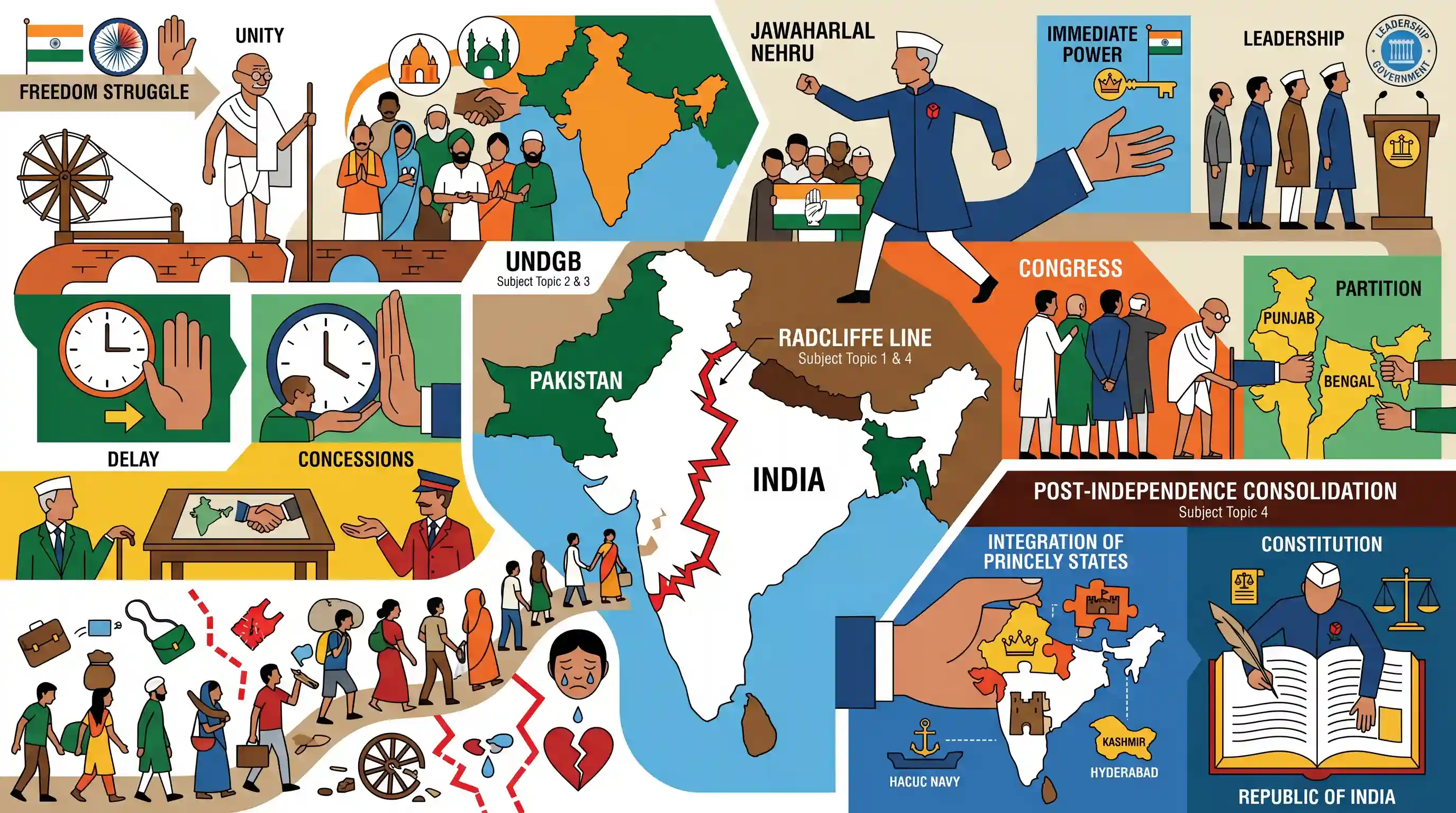
In this opinion piece, Ram Madhav critically examines the ideological and political divergence between Mahatma Gandhi and Jawaharlal Nehru leading up to the partition of India. The article argues that Gandhi's primary objective was to maintain the unity of the Indian subcontinent, and he was prepared to delay independence or make significant concessions to avoid its division. Conversely, the author contends that Nehru and other Congress leaders prioritized the immediate transfer of power and assumption of leadership, ultimately sidelining Gandhi's objections and accepting the territorial and human costs of partition.
Key Points
- The article critically contrasts the political motivations of Mahatma Gandhi and Jawaharlal Nehru during the tumultuous period of India's partition.
- It argues that Gandhi was driven by a deep desire to keep the subcontinent united, often willing to make substantial compromises to prevent partition.
- In contrast, the author asserts that Nehru was primarily motivated by the immediate acquisition of power, accepting the division of India to expedite independence.
- The piece highlights how Gandhi's staunch anti-partition stance was eventually sidelined by the broader Congress leadership who agreed to the Mountbatten Plan.
Important Terms
Partition of India

The 1947 division of British India into the independent dominions of India and Pakistan, based on religious majorities, leading to massive migration and communal violence.
UPSC context
GS Paper I (Modern History); tests understanding of the causes, communalism, and long-term socio-political consequences of India's division.
Two-Nation Theory
The ideology asserting that Hindus and Muslims constitute two distinct nations that cannot coexist, serving as the foundational justification for the creation of Pakistan.
UPSC context
GS Paper I (Modern History); tests critical analysis of ideological shifts in the freedom struggle and the origins of communal separatism.
Mountbatten Plan
The final blueprint for independence proposed by Lord Mountbatten on June 3, 1947, outlining the procedure for partition and the rapid transfer of power.
UPSC context
GS Paper I (Modern History); tests knowledge of the constitutional and administrative framework for decolonization and the end of British rule.
Indian National Congress
Founded in 1885, it was the primary vehicle for the freedom struggle; it eventually accepted partition to ensure immediate independence and check escalating communal strife.
UPSC context
GS Paper I (Modern History); tests knowledge of the party's evolution, leadership debates, and role in negotiating independence.
Muslim League
Established in 1906, it initially sought Muslim rights and later, under Jinnah, led the political movement for a separate state based on the Two-Nation Theory.
UPSC context
GS Paper I (Modern History); tests understanding of communal politics and the specific role of political actors in the subcontinent's division.
Direct Action Day
Observed on August 16, 1946, this call for protest by the Muslim League triggered mass communal riots, significantly forcing the political acceptance of partition.
UPSC context
GS Paper I (Modern History); tests comprehension of critical turning points and the impact of communal violence on political decision-making.
Prelims Trap
Gandhi eventually consented to the Mountbatten Plan to halt communal violence.
Gandhi never endorsed partition. He was politically sidelined by the broader Congress leadership (Nehru, Patel) who pragmatically accepted the June 3 Plan to expedite independence.
Static Concepts Connected
How did the Mountbatten Plan differ from the initial 'Dickie Bird' Plan?
- Dickie Bird Plan: Proposed transferring power directly to individual provinces, severely risking balkanization. Nehru vehemently opposed this.
- June 3 Plan: The finalized framework proposing the creation of two separate dominions (India and Pakistan) with boundary commissions.
- Independence Act 1947: Gave legal effect to the Mountbatten Plan, formally ending British suzerainty.
What were the core ideological divergences between Gandhi and Nehru post-1947?
- Role of Congress: Gandhi wanted the Indian National Congress dissolved into a 'Lok Sevak Sangh' for social work; Nehru required it for political nation-building.
- Economic Vision: Gandhi championed decentralized village republics and cottage industries; Nehru prioritized heavy industrialization, top-down planning, and a strong centralized state.
Cross-Topic Patterns
Ideological contrasts: Gandhi vs. Peers
UPSC frequently tests contrasting ideologies. The Gandhi-Nehru divergence on partition and statecraft mirrors the Gandhi-Bose split on means of struggle, and the Gandhi-Tagore debate on nationalism.
Partition's link to Post-Independence Consolidation
The political friction preceding independence directly shaped the Indian Independence Act 1947 and the urgent need for Patel's integration of princely states, linking Freedom Struggle to Post-Independence Consolidation.

Expect Mains questions comparing the pragmatism of Nehru and Patel during the transfer of power with Gandhi's moral absolutism on Partition.
Linked PYQs · 3
Linked PYQs · 3
- 2015MainsGS1
How different would have been the achievement of Indian independence without Mahatma Gandhi? Discuss.
- 2000PrelimsGS1
The Balkan Plan for fragmentation of India was the brain-child of
- 2025MainsGS1
Trace India's consolidation process during early phase of independence in terms of polity, economy, education and international relations.
