Artificial Intelligence Ethics and Moral Governance of Technology
Source:Indian Express ↗
Why It Matters
The debate on AI ethics is a defining challenge of the 21st century. For UPSC aspirants, understanding the intersection of technology and morality is crucial for GS-4 (Ethics in technology, human interface), GS-3 (Awareness in fields of IT/Computers), and tackling philosophical Essay topics on the future of humanity.
Summary
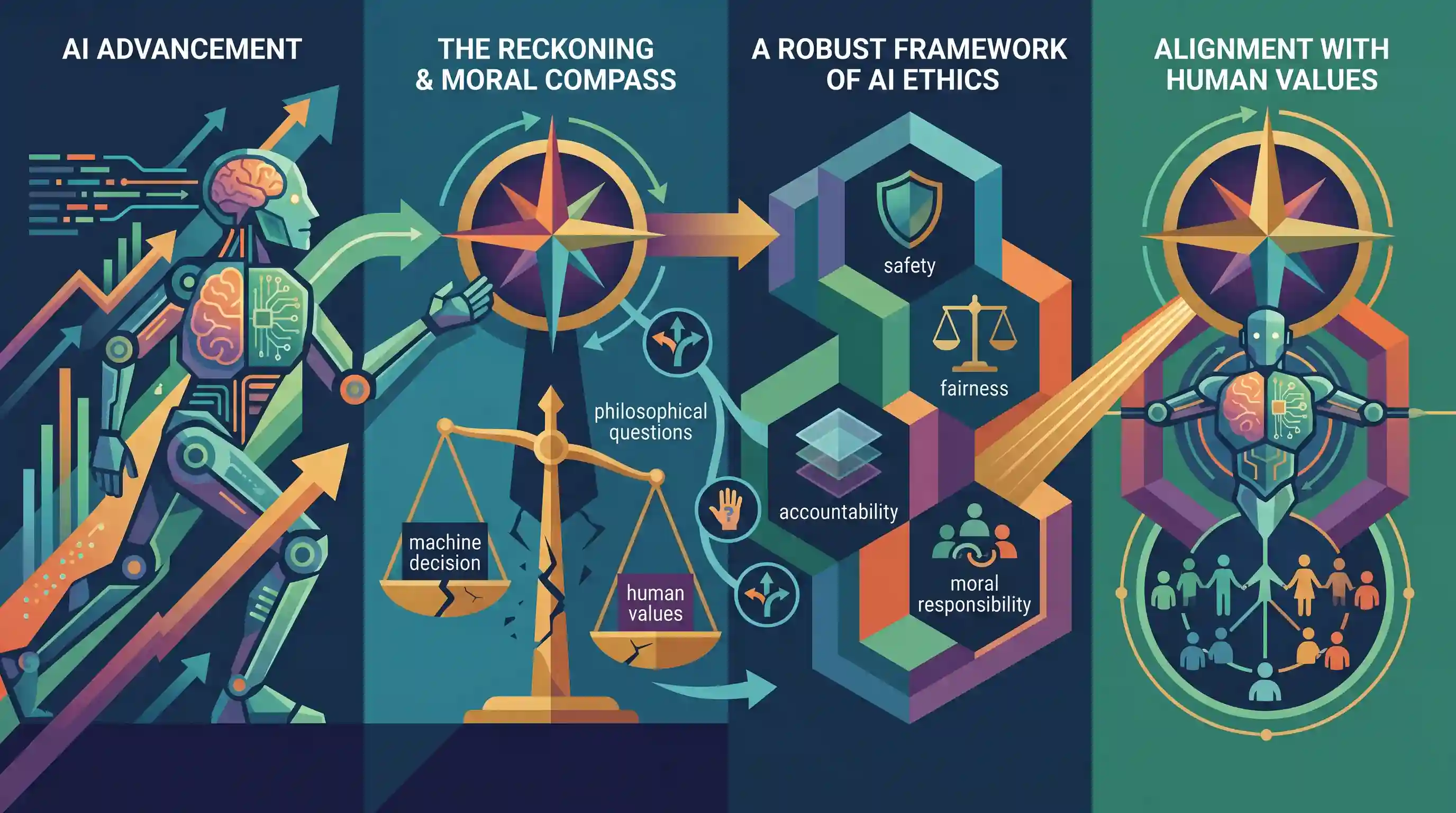
In this opinion piece, Ram Madhav explores the profound ethical challenges posed by the rapid advancement of Artificial Intelligence. As machines progressively develop the capability to 'think' and make autonomous decisions, the central question shifts from technological feasibility to philosophical and moral governance. The article argues that humanity's own moral compass faces a reckoning, emphasizing the urgent need for a robust framework of AI ethics to ensure that emerging technologies align with human values and do not undermine moral responsibility.
Key Points
- The rapid evolution of Artificial Intelligence and machine learning from basic computational tools to systems that emulate human thinking necessitates a profound shift toward ethical governance.
- Humanity's moral compass faces a reckoning, as autonomous AI systems will inevitably reflect or inherit the moral frameworks, biases, and values of their human creators.
- There is an urgent requirement to develop a robust framework of 'AI ethics' to govern autonomous decision-making and mitigate risks to human empathy and societal norms.
- The challenge of AI is as much philosophical as it is technological, demanding consensus on how to align advanced machines with human values and moral responsibility.
Prelims Trap
The Bletchley Declaration is a legally binding UN treaty on Artificial Intelligence governance.
The Bletchley Declaration (2023) is a voluntary global agreement on frontier AI safety signed by 28 nations, not a legally binding UN treaty.
Static Concepts Connected
What are the core principles of Responsible AI and 'Algor-ethics'?
- Human-centric approach: Prioritizes human moral agency, empathy, and societal well-being over pure computational efficiency.
- Algorithmic Transparency: Ensures AI decision-making processes are explainable, mitigating hidden prejudices inherited from training datasets.
- Strict Accountability: Establishes clear legal and moral responsibility frameworks for actions taken by autonomous AI systems.
How is Artificial Intelligence currently governed in India?
- NITI Aayog Strategy: Guided by the 'Responsible AI for All' framework focusing on safety, inclusivity, privacy, and ethics.
- Sectoral Guidelines: Bodies like ICMR (healthcare) and SEBI (markets) have issued domain-specific ethical guidelines for AI deployment.
- No standalone AI law: India currently regulates AI indirectly through the IT Act 2000 and the Digital Personal Data Protection Act 2023.
Cross-Topic Patterns
Algorithmic Bias + Social Justice
AI trained on historical data perpetuates inequalities, linking GS3 AI mechanics directly with GS4 foundational values of justice, fairness, and empathy.
Global AI Governance fragmentation
Diverging frameworks like the EU AI Act (rights-based), US approach (market-driven), and China's rules (state-control) create a fragmented geopolitical tech landscape.

Expect a GS4 case study on algorithmic accountability, or Prelims matching AI declarations (Bletchley, Rome) to their aims.
Linked PYQs · 4
Linked PYQs · 4
- 2024MainsGS4
The application of Artificial Intelligence as a dependable source of input for administrative rational decision-making is a debatable issue. Critically examine the statement from the ethical point of view.
- 2023MainsGS3
Introduce the concept of Artificial Intelligence (AI). How does Al help clinical diagnosis? Do you perceive any threat to privacy of the individual in the use of Al in healthcare?
- 2020PrelimsGS1
With the present state of development, Artificial Intelligence can effectively do which of the following? 1. Bring down electricity consumption in industrial units 2. Create meaningful short stories and songs 3. Disease diagnosis 4. Text-to-Speech Conversion 5. Wireless transmission of electrical energy Select the correct answer using the code given below:
- 2019MainsEssay
Values are not what humanity is, but what humanity ought to be
