Geopolitical Contestation and Maritime Security in the Indian Ocean
Source:Indian Express ↗
Why It Matters
Understanding the geopolitical dynamics of the Indian Ocean is crucial for UPSC aspirants, as it frequently features in GS Paper 2 (International Relations) and GS Paper 3 (Internal Security). Questions on China's 'String of Pearls', the strategic significance of the Maldives, and India's maritime defense strategy are common in Mains.
Summary
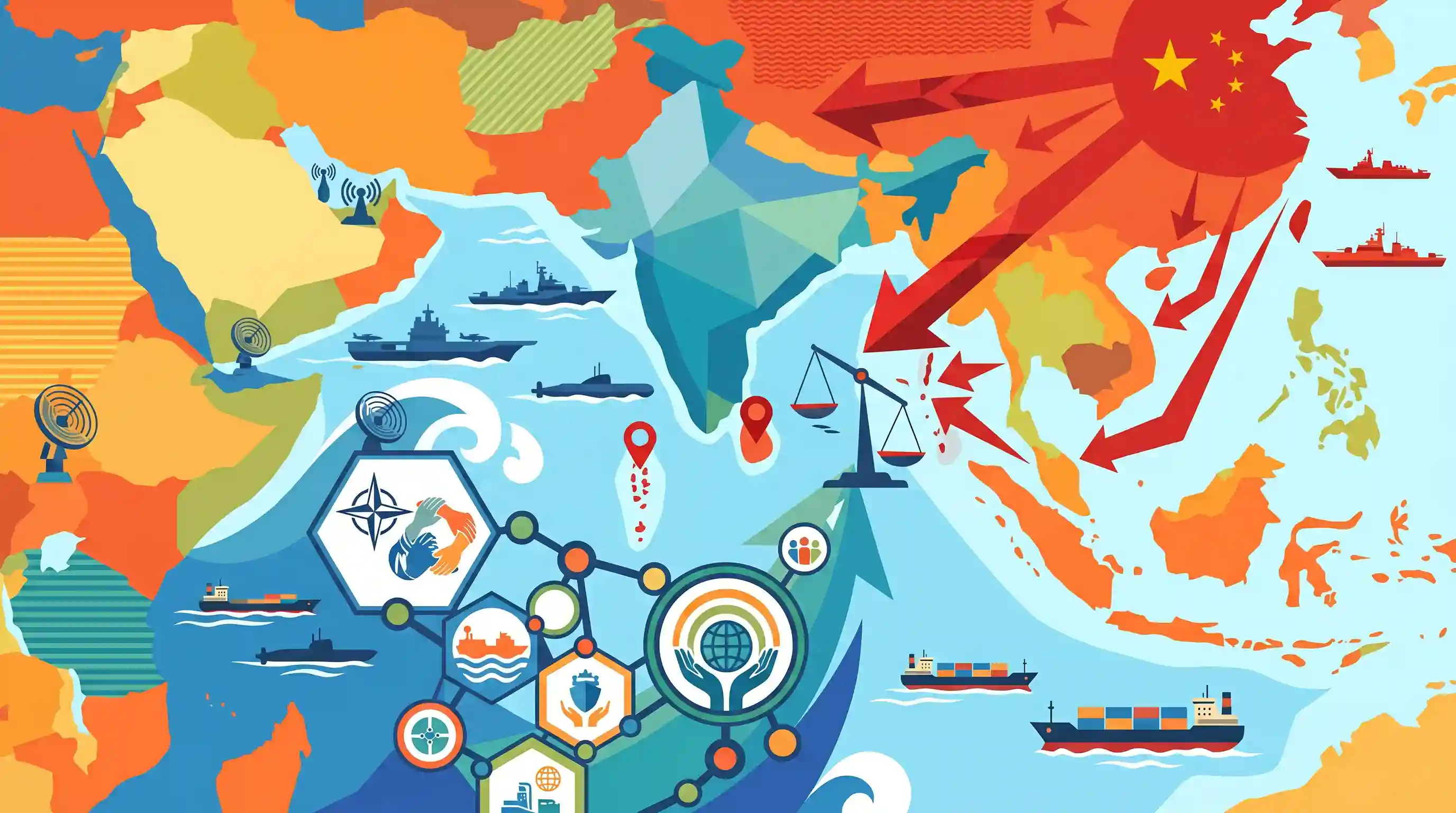
The article analyzes the intensifying geopolitical contestation in the Indian Ocean Region (IOR), driven primarily by China's aggressive maritime expansion and strategic maneuvering in India's immediate neighborhood. It highlights how Beijing's growing influence in critical island nations like the Maldives and Sri Lanka disrupts the regional balance of power. The author emphasizes that India must proactively counter these moves by strengthening its maritime security architecture, upgrading its naval capabilities, and leveraging regional frameworks like SAGAR and the QUAD to ensure freedom of navigation and maintain regional stability.
Key Points
- The Indian Ocean Region (IOR) is emerging as a critical theater for great power competition, shifting the geopolitical center of gravity.
- China's expanding naval presence and strategic investments in IOR island nations (often termed the 'String of Pearls') pose significant challenges to India's traditional maritime dominance.
- Political dynamics in pivotal island nations, such as the Maldives and Sri Lanka, increasingly reflect the geopolitical tug-of-war between New Delhi and Beijing.
- To safeguard its interests, India must enhance its role as a net security provider, bolster naval modernization, and deepen strategic partnerships through platforms like the QUAD and initiatives like SAGAR.
Important Terms
SAGAR (Security and Growth for All in the Region)

India's strategic vision for the Indian Ocean (2015), emphasizing inclusive cooperation, maritime security, and collective growth for all littoral nations in the region.
UPSC context
GS Paper 2 (IR) & Paper 3 (Security). Tests India's regional leadership and maritime diplomacy frameworks.
QUAD (Quadrilateral Security Dialogue)
An informal strategic forum comprising India, Japan, Australia, and the USA, aimed at ensuring a "free, open, and inclusive" Indo-Pacific.
UPSC context
GS Paper 2 (Global Groupings). Essential for questions on Indo-Pacific stability and balancing China’s influence.
People's Liberation Army Navy (PLAN)
The naval branch of China's military, currently the world's largest by ship count, aggressively expanding its footprint in the Indian Ocean Region (IOR).
UPSC context
GS Paper 2 (India & Neighborhood) & Paper 3 (Maritime Security). Concerns India’s strategic encirclement and regional balance of power.
Net Security Provider
India's stated ambition and responsibility to provide safety, security, and stability to neighboring maritime nations in the Indian Ocean through HADR and patrol.
UPSC context
GS Paper 3 (Security). Tests understanding of India’s evolving role from a coastal to a regional power.
Indian Navy
The maritime branch of the Indian Armed Forces; acts as a "resident power" and "first responder" in the Indian Ocean Region.
UPSC context
GS Paper 3 (Security Challenges). Focuses on naval modernization and deterrent capabilities against regional threats.
Indo-Pacific
A geopolitical and strategic construct linking the Indian and Pacific Oceans, serving as the primary theater for modern great-power competition.
UPSC context
GS Paper 2 (International Relations). Central to analyzing shifting global power dynamics and India’s strategic autonomy.
Prelims Trap
SAGAR is a formal multilateral military treaty among Indian Ocean littoral states.
SAGAR is India's overarching strategic vision and doctrine announced in 2015 focusing on cooperative security and growth. It is not a legally binding treaty.
Static Concepts Connected
What are the primary maritime chokepoints in the Indian Ocean Region?
- Malacca Strait: Connects the Indian and Pacific Oceans; crucial for China and East Asia's energy imports.
- Strait of Hormuz: Connects the Persian Gulf to the Arabian Sea; vital for global oil transit.
- Bab el-Mandeb: Connects the Red Sea to the Gulf of Aden; the primary route to the Suez Canal.
What constitutes India's "Net Security Provider" role in the IOR?
- HADR Missions: Conducting prompt Humanitarian Assistance and Disaster Relief operations, such as Operation Vanilla in Madagascar.
- Capacity Building: Providing coastal radar systems, naval assets, and training to smaller Indian Ocean littoral states.
- Maritime Domain Awareness: Sharing real-time white-shipping intelligence via the Information Fusion Centre for Indian Ocean Region (IFC-IOR).
Cross-Topic Patterns
SLOCs + Critical Mineral Supply Chains
Securing Indian Ocean Sea Lines of Communication (SLOCs) links to supply chain resilience, as the QUAD focuses heavily on the safe transit of critical minerals from Africa and Australia.
Domestic Politics + Foreign Policy
Domestic elections in the Maldives ("India Out" campaign) and Sri Lanka frequently test the Gujral Doctrine's non-reciprocity principle and India's neighborhood-first foreign policy.

Expect a multi-statement Prelims question linking IFC-IOR, SAGAR doctrine, and the geography of specific chokepoints in 2026.
Linked PYQs · 5
Linked PYQs · 5
- 2024MainsGS2
Discuss the geopolitical and geostrategic importance of Maldives for India with a focus on global trade and energy flows. Further also discuss how this relationship affects India's maritime security and regional stability amidst international competition ?
- 2011MainsGS2
Critically examine the security and strategic implications of the so-called 'string of pearls' theory for India.
- 2025MainsGS3
Why is maritime security vital to protect India's sea trade? Discuss maritime and coastal security challenges and the way forward.
- 2022MainsGS3
What are the maritime security challenges in India ? Discuss the organisational, technical and procedural initiatives taken to improve the maritime security.
- 2014MainsGS2
With respect to the South China sea, maritime territorial disputes and rising tension affirm the need for safeguarding maritime security to ensure freedom of navigation and over flight throughout the region. In this context, discuss the bilateral issues between India and China.
