Madhya Pradesh High Court Rules Notarized Divorce Invalid for Pension
Source:verdictum ↗
Why It Matters
This case highlights the intersection of central personal laws (Hindu Marriage Act, 1955) and state-specific administrative legislations (MP Civil Service Pension Rules and MP High Court Appeal Adhiniyam), which is a key area of inquiry in state-level public service exams regarding judicial structures and governance.
Summary
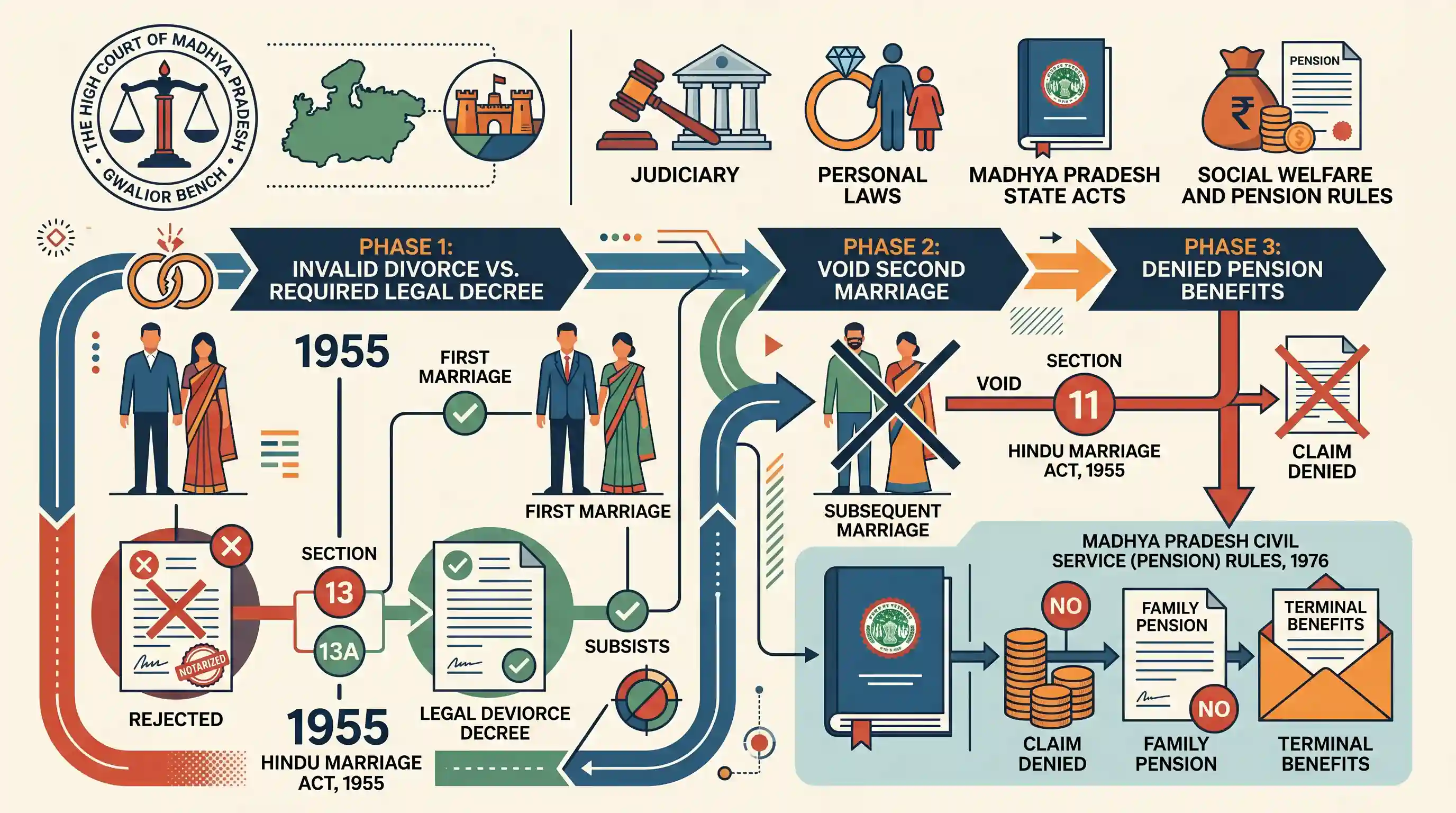
In Ram Kripal Singh v. The State of Madhya Pradesh, a Division Bench of the Madhya Pradesh High Court (Gwalior Bench) ruled that a Hindu marriage cannot be dissolved by a notarized agreement. Without a legal divorce decree under Section 13 or 13A of the Hindu Marriage Act, 1955, the first marriage subsists, making any subsequent marriage void under Section 11. Consequently, a partner in such an invalid relationship cannot claim family pension or terminal benefits under the Madhya Pradesh Civil Service (Pension) Rules, 1976.
Key Points
- The Madhya Pradesh High Court (Gwalior Bench) held that a marriage under Hindu law cannot be legally dissolved merely by executing a notarized agreement of divorce.
- The ruling came during an intra-court appeal under Section 2(1) of the Madhya Pradesh Uchcha Nyayalaya (Khand Nyayapeeth Ko Appeal) Adhiniyam, 2005.
- Under Section 5(i) of the Hindu Marriage Act, 1955, neither party must have a living spouse at the time of marriage; violation of this condition renders any subsequent marriage void under Section 11.
- The Court clarified that even long cohabitation or live-in relationships cannot be presumed as a valid marriage if the prior marriage of either party continues to legally subsist in the absence of a proper court decree under Section 13 or 13A.
- Consequently, a subsequent partner/spouse in such a void marriage has no legal status and cannot claim terminal benefits or family pension under the Madhya Pradesh Civil Service (Pension) Rules, 1976.
Important Terms
Madhya Pradesh Uchcha Nyayalaya (Khand Nyayapeeth Ko Appeal) Adhiniyam, 2005

A Madhya Pradesh state legislation enabling an intra-court appeal against a judgment or order passed by a single judge of the High Court to a Division Bench of the same court.
UPSC context
GS Paper II (Judiciary & Polity); tests understanding of judicial structures, appeals processes, and state laws governing High Courts.
Hindu Marriage Act, 1955
A central Act regulating personal laws on marriage, separation, and divorce among Hindus, setting conditions for a valid marriage and formalizing legal procedures for dissolution.
UPSC context
GS Paper II (Personal Laws & Social Justice); tests knowledge of matrimonial rights, divorce laws, and personal law reforms.
Madhya Pradesh Civil Service (Pension) Rules, 1976
State-specific rules governing the administration, eligibility criteria, and disbursement of regular pensions, family pensions, and terminal benefits to Madhya Pradesh government employees and their dependents.
UPSC context
GS Paper II (Governance & Welfare); tests administrative law, service rules, and state-level social security provisions.
Madhya Pradesh High Court
The highest judicial organ in Madhya Pradesh, established in Jabalpur with permanent benches at Indore and Gwalior, carrying appellate and constitutional supervisory jurisdiction.
UPSC context
GS Paper II (Polity & Judiciary); tests constitutional jurisdiction of High Courts, judicial structure, and administration of justice.
Department of Tribal and Welfare
The state government department in Madhya Pradesh responsible for coordinating, executing, and monitoring educational, economic, and social welfare programs for Scheduled Tribes and Scheduled Castes.
UPSC context
GS Paper II (Welfare Schemes); tests administration of tribal development policies, institutional mechanisms, and social security programs.
Prelims Trap
A void bigamous marriage is automatically validated if the first legal spouse passes away.
A void marriage is null ab initio. The death of the first spouse does not retrospectively legalize the second marriage; a new marriage must be legally solemnized.
Static Concepts Connected
What is the difference between void and voidable marriages under Hindu law?
- Void Marriages: Marriages violating bigamy, prohibited degrees, or sapinda rules are void ab initio under Section 11 and carry no legal status.
- Voidable Marriages: Marriages that can be annulled under Section 12 on grounds like impotency, fraud, or lack of mental consent.
- Legitimacy of Children: Under Section 16, children born from both void and voidable marriages are deemed legally legitimate.
How are permanent and circuit High Court Benches established in India?
- Permanent Benches: Established by the President of India under Section 51(2) of the States Reorganisation Act, 1956, after consultation.
- Circuit Benches: Established by the Chief Justice of the concerned High Court under Section 51(3), with the prior approval of the Governor.
Cross-Topic Patterns
Personal laws vs. public service pension benefits
Demonstrates how administrative law and state pension eligibility are deeply intertwined with, and legally dependent upon, the strict validation of personal laws.
Uniform Civil Code vs. customary exceptions
Connects statutory exceptions for customary divorce under Section 29(2) to Article 44 debates, illustrating the challenges of standardizing diverse personal practices.

Multi-statement questions on the legitimacy of children of void marriages and the status of customary divorce under HMA are highly probable.
Linked PYQs · 1
Linked PYQs · 1
- 2020MPPSC_PRELIMSGS1
Who among the following Chief Justice of Madhya Pradesh High Court has not been the Judge at Supreme Court of India?
