Rakhigarhi skeletons DNA and facial reconstruction study for history
Source:Indian Express ↗
Why It Matters
This development bridges Ancient Indian History and modern Science & Technology. For UPSC, Rakhigarhi is a highly significant Harappan site, and archaeological evidence of social stratification (through grave goods) is a key analytical concept for Mains GS1. The application of DNA studies in archaeology also touches upon the interdisciplinary nature of modern historical research.
Summary
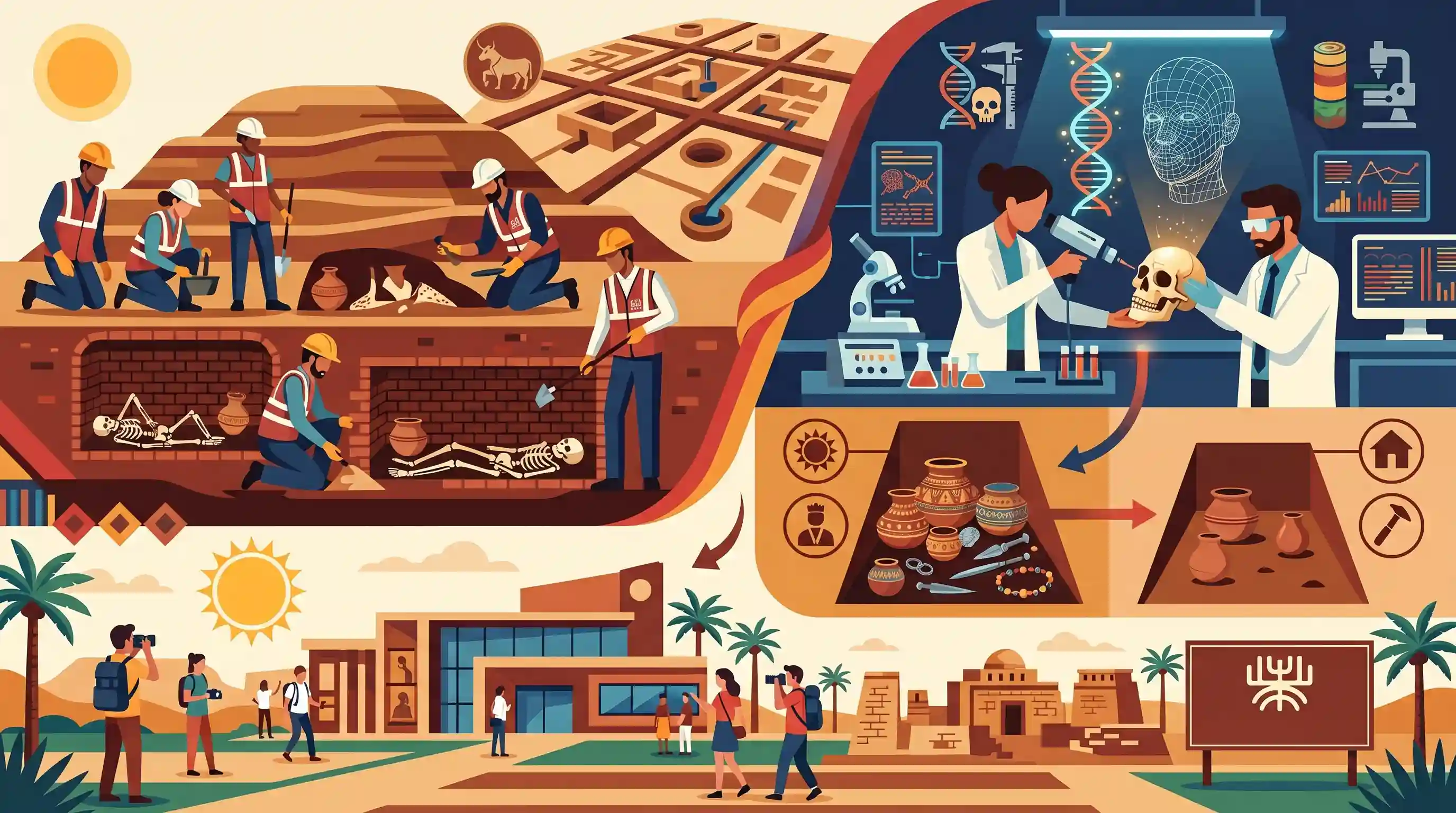
The Archaeological Survey of India (ASI) has initiated advanced DNA and craniofacial reconstruction studies on skeletons unearthed at the Harappan site of Rakhigarhi to uncover details about their ancestry, physical traits, and lifestyle. The findings from Mound No. 7, particularly the variation in pottery offerings found in graves, offer critical insights into social stratification within the Indus Valley Civilization. The involvement of specialized institutes like AnSI and BSIP underscores the growing integration of science and technology in historical research. Rakhigarhi is also being developed as a major cultural heritage destination.
Key Points
- The Archaeological Survey of India (ASI) is conducting DNA testing and craniofacial reconstruction on five 5,000-year-old skeletons excavated from Rakhigarhi, Haryana.
- The scientific analysis, undertaken by the Anthropological Survey of India (AnSI) and the Birbal Sahni Institute of Palaeosciences (BSIP), aims to determine the ancestry, physical features, dietary habits, and health of the Harappan people.
- Excavations at Mound No. 7 (a cemetery area) revealed burials accompanied by 5 to 40 pottery offerings, providing strong evidence of social stratification and varying social status in Harappan society.
- Rakhigarhi, dating back to 4200 BCE, is one of the two largest Indus Valley Civilization sites in India alongside Dholavira, and has been identified in the Union Budget for development as a cultural heritage destination.
Important Terms
Archaeological Survey of India (ASI)

A premier government agency under the Ministry of Culture responsible for archaeological research and the conservation of national monuments. Founded in 1861 by Alexander Cunningham, it administers more than 3,600 historical sites.
UPSC context
GS Paper 1: Indian Culture. Tests knowledge of institutions protecting India's archaeological wealth and heritage.
Rakhigarhi
The largest Indus Valley Civilization site in India, located in Hisar, Haryana. It provides a rare, continuous archaeological record spanning the Early, Mature, and Late Harappan phases (c. 5000–1300 BCE).
UPSC context
GS Paper 1: Ancient History. Critical for understanding IVC urbanism, chronology, and recent genetic findings.
Birbal Sahni Institute of Palaeosciences (BSIP)
An autonomous body under the Department of Science and Technology specializing in palaeobotany and palaeosciences. It reconstructs past climates, ecosystems, and human history using molecular and geological data.
UPSC context
GS Paper 3: Science and Technology. Highlighted for its multidisciplinary approach to historical and environmental research.
Anthropological Survey of India (AnSI)
A Ministry of Culture organization dedicated to the bio-cultural study of India’s populations. It analyzes human skeletal remains and documents the ethnic and biological diversity of ancient and contemporary communities.
UPSC context
GS Paper 1: Social Issues/Culture. Relevant for scientific methods used to study ancient human ancestry and diversity.
Social Stratification (Indus Valley)
The hierarchical division of Indus Valley society evidenced by variations in burial goods (pottery, jewelry) and urban layout (citadel vs. lower town), reflecting differences in status and wealth.
UPSC context
GS Paper 1: Ancient History. Tests the ability to interpret archaeological evidence to reconstruct ancient social structures.
Craniofacial Reconstruction
A forensic and archaeological technique that reconstructs a person's facial features from their skeletal remains using anatomy, 3D modeling, and art to visualize ancient populations.
UPSC context
GS Paper 3: Science and Technology. Demonstrates modern technological applications in history and forensic anthropology.
Prelims Trap
"Harappan society was entirely egalitarian, lacking any archaeological evidence of social stratification in their burial practices."
Burials at Rakhigarhi’s Mound 7 show significant variation in pottery offerings (from 5 to 40 per grave), providing concrete evidence of social stratification and hierarchy.
Static Concepts Connected
How do burial practices vary across major Indus Valley Civilization sites?
- Lothal: Famed for evidence of double burials (male and female buried together) alongside standard extended inhumations.
- Kalibangan: Yielded evidence of distinct brick-chambered graves and circular pit burials occasionally lacking skeletal remains (symbolic burials).
- Surkotada: Known for rare instances of pot burials where bones were found interred in large urns.
What are the distinguishing static features of the Rakhigarhi site?
- Largest IVC Site: Spanning over 350 hectares in the Ghaggar-Hakra basin, it is the largest Harappan site in the Indian subcontinent, surpassing Mohenjo-Daro.
- Continuous Sequence: Exhibits a continuous evolutionary cultural sequence from the Early Harappan (~5000 BCE) right through to the Mature Harappan phases.
- Indigenous Origins: Past ancient DNA (aDNA) analysis from Rakhigarhi strongly suggests an indigenous origin for the Harappan people, refuting Steppe pastoralist ancestry.
Cross-Topic Patterns
Biotechnology S&T integration in Archaeology
The use of Ancient DNA (aDNA) and craniofacial reconstruction by BSIP bridges Ancient History and modern Biotechnology, a trend UPSC favors heavily in recent S&T questions.
Union Budget's "Iconic Sites" Scheme
Rakhigarhi connects to current governance as one of five sites (alongside Hastinapur, Shivsagar, Dholavira, Adichanallur) slated for on-site museum development under the Union Budget's Iconic Sites scheme.

Expect a multi-statement Prelims 2026 question combining Rakhigarhi's aDNA findings (indigenous origins) and evidence of social hierarchy.
Linked PYQs · 4
Linked PYQs · 4
- 2021PrelimsGS1
Which one of the following ancient towns is well-known for its elaborate system of water harvesting and management by building a series of dams and channelizing water into connected reservoirs?
- 2019PrelimsGS1
Which one of the following is not a Harappan site?
- 2025MainsGS1
Discuss the salient features of the Harappan architecture.
- 2014MainsGS1
To what extent has the urban planning and culture of the Indus Valley Civilization provided inputs to the present day urbanization? Discuss.
