Biennial Rajya Sabha Elections Scheduled for March
Source:The Hindu ↗
Why It Matters
The composition of the Rajya Sabha directly influences the legislative capacity of the ruling government. Understanding how state assembly elections indirectly alter the balance of power in the Upper House is crucial for questions regarding parliamentary dynamics and federalism.
Summary
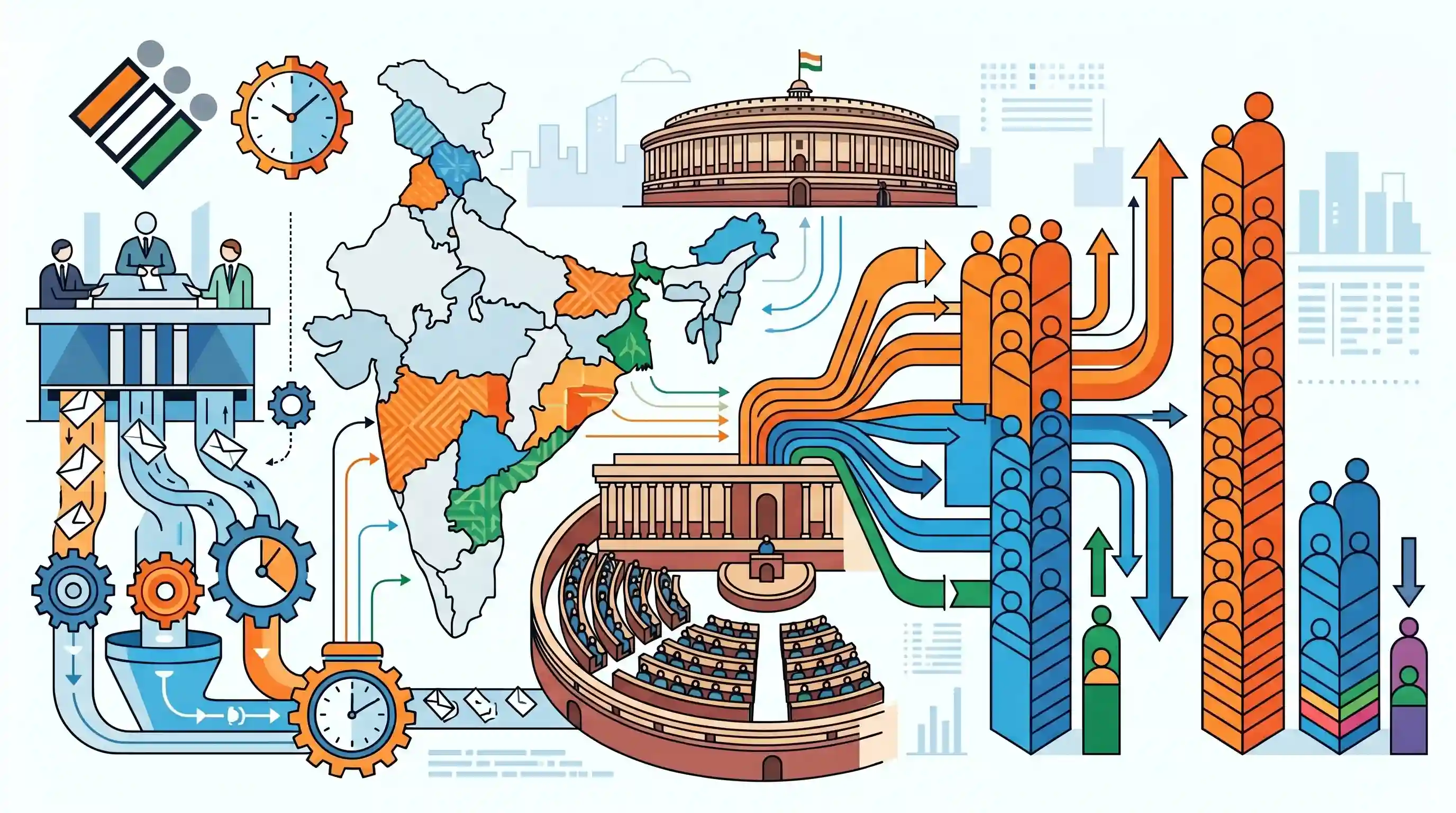
The Election Commission of India has scheduled biennial elections for 37 Rajya Sabha seats across 10 states on March 16. The political calculus indicates that the ruling National Democratic Alliance (NDA) is poised to increase its presence in the Upper House, potentially securing 25 of the 37 seats, up from the 15 it currently holds among the retiring cohort. This shift stems from the NDA's electoral dominance in states like Maharashtra, Bihar, and Odisha. In contrast, the opposition INDIA bloc is expected to lose ground, with its tally in this group likely reducing from 19 to 10 seats.
Key Points
- The Election Commission of India has announced biennial elections for 37 Rajya Sabha seats across 10 states, scheduled to be held on March 16.
- The ruling National Democratic Alliance (NDA) is projected to increase its Rajya Sabha tally from 15 to 25 in these seats, leveraging its power in six of the ten states.
- The opposition INDIA bloc is expected to see a reduction in its strength in this cohort, potentially dropping from 19 to 10 seats.
- Prominent retiring members include Sharad Pawar, Abhishek Singhvi, Saket Gokhale, and Ramdas Athawale.
Important Terms
Election Commission of India (ECI)

An autonomous constitutional authority (Article 324) responsible for administering elections to the Parliament, State Legislatures, and the offices of the President and Vice-President of India.
UPSC context
GS II (Constitutional Bodies); essential for questions on electoral integrity, the Model Code of Conduct, and federalism.
National Democratic Alliance (NDA)
A center-right political coalition led by the Bharatiya Janata Party (BJP), formed in 1998 to offer a national alternative to the Congress and maintain executive stability.
UPSC context
GS II (Political Parties); key for studying coalition politics and the shift from one-party dominance to multi-party alliances.
INDIA bloc
The Indian National Developmental Inclusive Alliance; a multi-party opposition coalition led by the Congress, established in 2023 to consolidate opposition votes against the ruling NDA.
UPSC context
GS II (Functioning of Political Parties); tests knowledge of opposition unity and contemporary electoral strategies in India.
Biju Janata Dal (BJD)
A dominant regional party in Odisha, founded by Naveen Patnaik in 1997, focusing on regional identity and often maintaining "equidistance" from major national alliances.
UPSC context
GS II (Regional Parties & Federalism); important for understanding the role of regional players in Rajya Sabha voting patterns.
Bharat Rashtra Samithi (BRS)
Formerly Telangana Rashtra Samithi (TRS), this party spearheaded the Telangana statehood movement and remains a significant regional player affecting the balance of power in the Upper House.
UPSC context
GS II (Federalism); relevant for the study of regional movements and their transition into established political forces.
Indian National Congress (INC)
India's oldest political party, currently the principal component of the INDIA bloc and a key negotiator in Rajya Sabha seat-sharing arrangements among opposition members.
UPSC context
GS II (Political Parties); central to understanding the historical and modern landscape of the Indian party system.
Prelims Trap
Defying a party whip in Rajya Sabha elections leads to automatic disqualification under the Anti-Defection Law.
The Supreme Court clarified that cross-voting in Rajya Sabha polls does not attract Tenth Schedule disqualification, though it invites party disciplinary action.
Static Concepts Connected
How are state representatives elected to the Rajya Sabha?
- Electorate: Elected exclusively by the elected members of State Legislative Assemblies. Nominated members do not participate.
- Voting method: Through proportional representation by means of the single transferable vote (PR-STV).
- Open ballot: Since 2003, an 'open ballot' system is used where MLAs must show their marked ballot to the party's authorized agent.
Why is the NOTA option invalid in Rajya Sabha elections?
- SC Ruling: The Supreme Court (2018) ruled that NOTA applies only to direct elections based on universal adult suffrage.
- System conflict: Introducing NOTA undermines the proportional representation system and complicates the vote-transfer mathematics required for RS seats.
Cross-Topic Patterns
Federalism and Article 312
A changing RS composition directly impacts the creation of new All-India Services, which requires an exclusive Rajya Sabha resolution under Article 312.
Electoral Reforms and Open Ballots
The 2003 shift to open ballots to curb corruption contrasts with the non-applicability of the Tenth Schedule, a frequent GS2 Mains debate theme.

Expect a multi-statement Prelims question combining RS open ballot rules, NOTA inapplicability, and Tenth Schedule exemptions in 2026.
Linked PYQs · 3
Linked PYQs · 3
- 2012PrelimsGS1
Consider the following statements: 1. Union Territories are not represented in the Rajya Sabha. 2. It is within the purview of the Chief Election Commissioner to adjudicate the election disputes. 3. According to the Constitution of India, the Parliament consists of the Lok Sabha and the Rajya Sabha only. Which of the statements given above is/are correct?
- 2017PrelimsGS1
Consider the following statements: 1. The Election Commission of India is a five-member body. 2. Union Ministry of Home Affairs decides the election schedule for the conduct of both general elections and bye-elections. 3. Election Commission resolves the disputes relating to splits/mergers of recognised political parties. Which of the statements given above is/are correct?
- 2020PrelimsGS1
Rajya Sabha has equal powers with Lok Sabha in
