Madhya Pradesh Rajya Sabha Polls Spur Cross-Voting Concerns
Source:The Hindu ↗
Why It Matters
Understanding the Rajya Sabha election process, proportional representation via single transferable vote (STV), seat calculation, and rules surrounding the disqualification and voting eligibility of MLAs (under RPA 1951 and Tenth Schedule) is critical for MPPSC State Service Prelims under the Indian Polity and MP Polity sections. Previous exams have specifically asked about MP Rajya Sabha by-elections and MLAs.
Summary
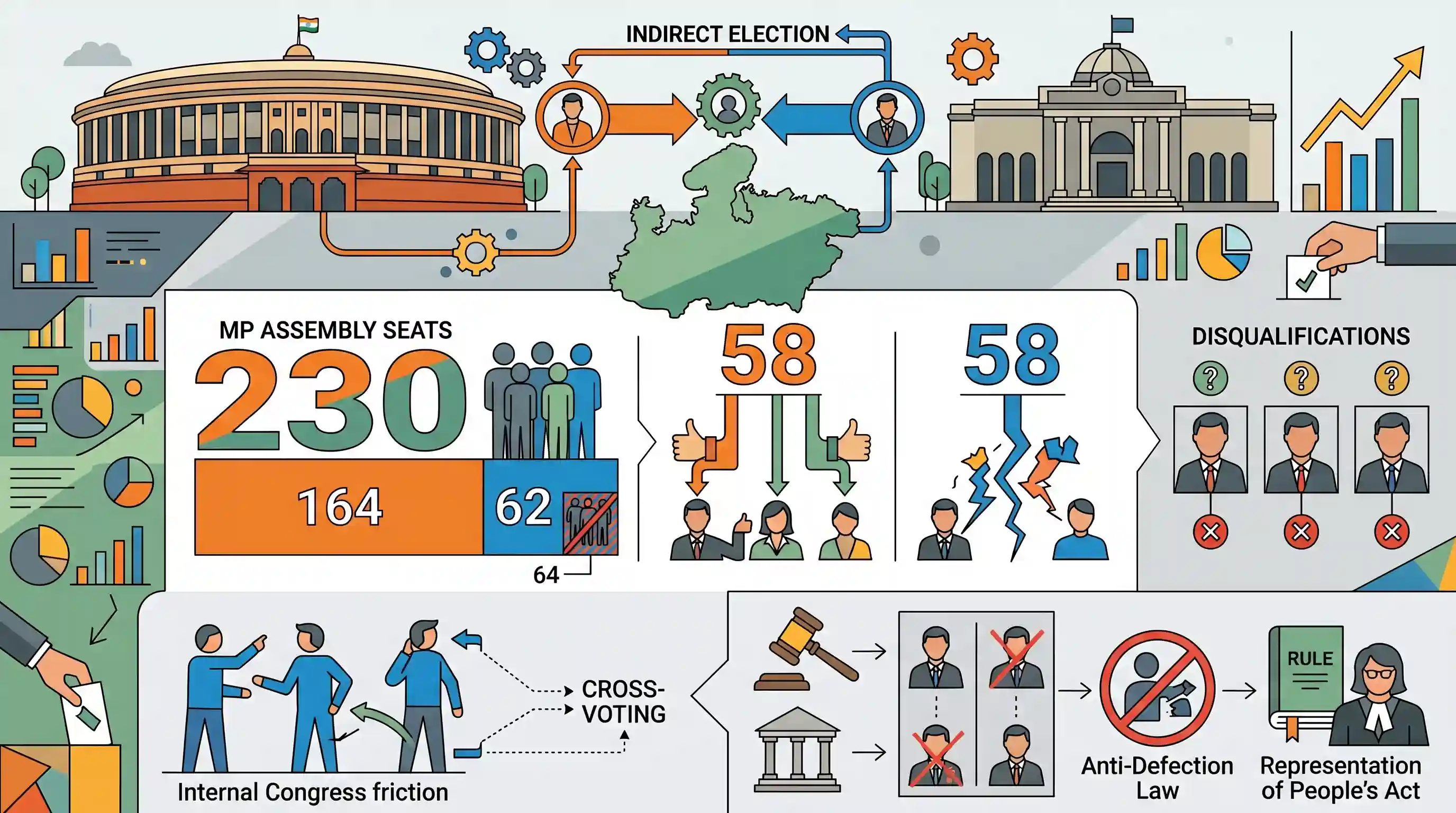
This article outlines the political dynamics and voting calculations for the upcoming Rajya Sabha elections (June 2026) for three seats from Madhya Pradesh. With 230 seats in the MP Assembly, candidates require 58 first-preference votes to win. The BJP (164 MLAs) is set to easily win two seats, while the Congress (with 62 active eligible votes out of 64 due to court-ordered disqualifications/voting bars) is positioned to win one. However, the Congress faces internal friction over the choice of Meenakshi Natarajan, leading to concerns of cross-voting. The article highlights the legal disqualifications of MLAs Rajendra Bharti, Mukesh Malhotra, and Nirmala Sapre, illustrating the intersection of court verdicts, parliamentary elections, and the anti-defection law.
Key Points
- Madhya Pradesh has 11 seats in the Rajya Sabha and 230 seats in its Legislative Assembly (Vidhan Sabha).
- Three Rajya Sabha seats from MP are falling vacant, previously held by Union Minister George Kurien (BJP), Sumer Singh Solanki (BJP), and senior Congress leader Digvijaya Singh.
- Candidates nominated: BJP fielded Tarun Chug (national general secretary) and Rajneesh Agrawal (state secretary). Congress fielded former MP Meenakshi Natarajan.
- The Voting Mathematics: To secure a Rajya Sabha seat from MP in this 3-vacancy scenario, a candidate requires 58 first-preference votes. BJP (164 MLAs) can comfortably win 2 seats (using 116 votes) with 48 spare, needing 10 more to grab the third. Congress has 62 legal/eligible votes, which is enough to secure 1 seat, but fears of cross-voting and internal dissent exist.
- MLA Disqualification & Voting Restrictions: (1) Rajendra Bharti (Congress, Datia) was disqualified after a fraud conviction; (2) Mukesh Malhotra (Congress, Vijaypur) was convicted in an election affidavit case, and while his disqualification was stayed by the Supreme Court, he was barred from voting in these RS polls; (3) Nirmala Sapre (Congress, Bina) crossed over to the BJP and faces active disqualification proceedings under the Tenth Schedule.
Important Terms
Tenth Schedule of the Constitution of India

Added by the 52nd Amendment Act of 1985, it contains the anti-defection law, specifying the grounds (such as defying a party whip) under which legislators can be disqualified.
UPSC context
GS Paper II (Polity) — crucial for questions on government stability, role of the Speaker, and party discipline/floor crossings.
Representation of the People Act, 1951
A parliamentary statute detailing the conduct of elections in India, including qualifications/disqualifications of candidates (e.g., Section 8 conviction rules), corrupt practices, and electoral dispute resolution.
UPSC context
GS Paper II (Elections) — explicitly mentioned in the syllabus; vital for understanding disqualification, political party registrations, and electoral reforms.
Article 80 of the Indian Constitution
Establishes the composition of the Rajya Sabha, limiting total membership to 250, including 12 nominated by the President and 238 representatives of States and Union Territories.
UPSC context
GS Paper II (Parliament) — tests structural knowledge of legislative composition, proportional representation, and federal mechanics.
Rajya Sabha
The 'Council of States' and permanent upper house of India's bicameral Parliament, representing states and Union Territories through indirect elections using proportional representation.
UPSC context
GS Paper II (Legislatures) — fundamental for debates on federalism, legislative checks-and-balances, and special powers over the state list.
Prelims Trap
An MLA voting against their party's nominee in Rajya Sabha elections is disqualified under the Tenth Schedule (Anti-Defection Law).
The Supreme Court held that the Tenth Schedule does not apply to Rajya Sabha voting; parties can take disciplinary action, but the MLA is not disqualified.
Static Concepts Connected
What is the Open Ballot System in Rajya Sabha elections?
- Legal origin: Introduced via a 2003 amendment to Section 59 of the Representation of the People Act, 1951, to check corruption and horse-trading.
- Showing ballot: MLAs belonging to political parties must show their marked ballot paper to their authorized party agent before casting it.
- Independent MLAs: Independent MLAs must not show their marked ballot to any party agent; doing so invalidates their vote.
- No binding whip: Parties cannot issue a legally binding whip, meaning cross-voting does not attract disqualification under the Tenth Schedule.
How is the winning quota calculated in Rajya Sabha elections?
- Mathematical formula: Calculated as [Total Valid Votes / (Vacant Seats + 1)] + 1 to find the minimum first-preference votes required.
- Proportional representation: Utilizes proportional representation by means of a single transferable vote (PR-STV) system as per Article 80 of the Constitution.
Cross-Topic Patterns
Domicile removal and federal character
The 2003 RPA amendment removed state residency requirements for candidates, altering the Rajya Sabha's constitutional role from representing local state interests to acting as a chamber of national party nominees.
Judicial intervention in legislative voting
Supreme Court orders staying a conviction but barring an MLA from voting in Rajya Sabha polls highlight the delicate balance between judicial oversight and legislative privileges.

Expect a multi-statement question on Rajya Sabha poll mechanics: testing the Tenth Schedule exception, open ballot system, and Kuldip Nayar.
Linked PYQs · 1
Linked PYQs · 1
- 2018MPPSC_PRELIMSGS1
Who among the following women won the by-edition in 2017 for the one Rajya Sabha seat from Madhya Pradesh?
