Rajya Sabha Passage of Tribunals Reforms Bill and Commission
Source:The Hindu ↗
কেন এটি গুরুত্বপূর্ণ
The establishment of a centralized 'National Tribunals Commission' (NTC) directly addresses a decade-long demand by the Supreme Court of India (e.g., in L. Chandra Kumar and Roger Mathew cases) to rescue tribunals from executive department controls and secure their administrative and judicial independence. This is a critical development for GS Paper 2 (Polity, Governance, and Judiciary).
সারসংক্ষেপ
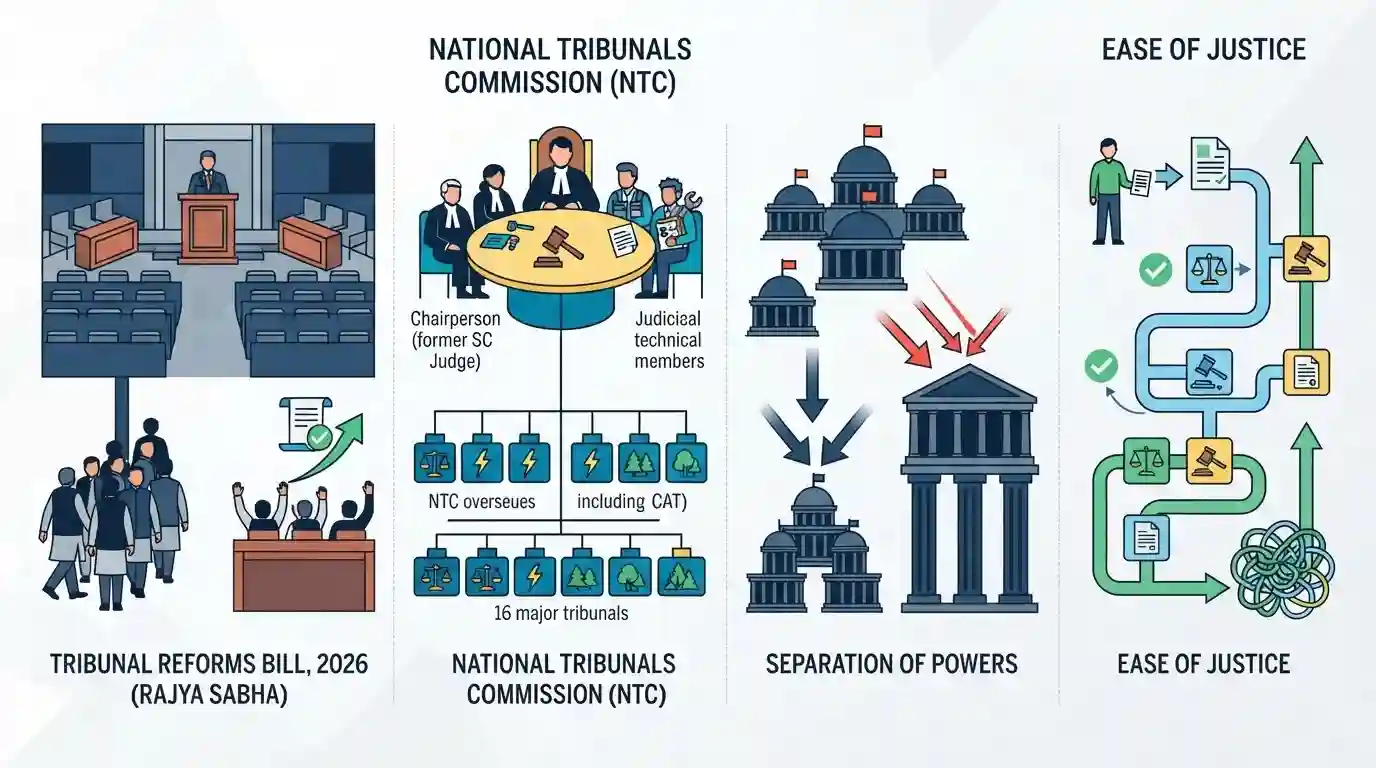
The Rajya Sabha has passed the landmark Tribunals Reforms Bill, 2026, which aims to overhaul India's quasi-judicial architecture by establishing the National Tribunals Commission (NTC). Chaired by a former Supreme Court Judge or High Court Chief Justice, with two judicial and two technical members, the NTC will uniformly manage appointments, terms, and service conditions of members across 16 major tribunals (including CAT and NGT). The reform seeks to insulate these tribunals from executive influence, bring structural uniformity, and enhance the 'ease of justice' in accordance with long-standing judicial guidance, though it was passed in the Upper House amid an Opposition walkout.
মূল বিষয়
- The Rajya Sabha passed the Tribunals Reforms Bill, 2026, which provides for the establishment of the National Tribunals Commission (NTC).
- The NTC will act as an independent, centralized supervisory body to streamline qualifications, selection, appointments, salaries, and other service conditions for 16 major tribunals, including the Central Administrative Tribunal (CAT) and the National Green Tribunal (NGT).
- The NTC will be chaired by a former Supreme Court judge or a former Chief Justice of a High Court, and will include two judicial members and two technical members to ensure transparency and merit-based appointments.
- According to Law Minister Arjun Ram Meghwal, the Bill aims to promote a modern, uniform, and independent tribunal system without altering the core jurisdiction of these tribunals.
- The reforms are designed to bolster the institutional architecture, aligning with global best practices, and enhancing both the 'ease of justice' and 'ease of doing business' in India.
- The Bill was passed amidst a walkout by Opposition (INDIA bloc) members, who protested over separate political demands, including police action on students.
গুরুত্বপূর্ণ শব্দ
Tribunals Reforms Bill, 2026

A landmark bill passed by Parliament that repeals the 2021 Act to establish the National Tribunals Commission, standardizing appointments, tenures, and service conditions across 16 major tribunals.
UPSC context
GS Paper II: Quasi-judicial bodies. Tests awareness of statutory changes to administrative justice and executive-judicial balance.
National Tribunals Commission
An independent central oversight body proposed to manage appointments, conduct performance reviews, and supervise the administrative operations of 16 major Indian tribunals free from executive interference.
UPSC context
GS Paper II: Separation of Powers & Quasi-judicial bodies. Tests structural solutions to protect judicial independence in tribunals.
Central Administrative Tribunal
A specialized quasi-judicial body established under Article 323A of the Constitution to resolve recruitment and service disputes of central government public servants.
UPSC context
GS Paper II: Administrative Law & Constitutional/Statutory Bodies. Tests understanding of service dispute adjudication and judicial review mechanisms.
National Green Tribunal
A dedicated statutory body established under the NGT Act, 2010, for the fast-track and expert adjudication of cases concerning environmental protection, conservation, and legal rights.
UPSC context
GS Paper III: Environmental Governance. Tests institutional knowledge of specialized dispute resolution and environmental justice mechanisms.
Separation of Powers
A constitutional principle separating the executive, legislative, and judicial branches to prevent concentration of power, recognized as part of the Basic Structure of the Indian Constitution.
UPSC context
GS Paper II: Constitutional Principles & Basic Structure. Tests conceptual clarity on constitutional checks and balances and judicial independence.
প্রিলিমস ফাঁদ
The National Tribunals Commission (NTC) is a constitutional body created under Part XIV-A of the Constitution.
The NTC is a statutory body created by the 2026 Bill. While tribunals get constitutional backing via Part XIV-A, the centralized oversight commission (NTC) itself is purely statutory.
সংযুক্ত স্থির ধারণা
How do Articles 323A and 323B of the Constitution differ?
- Subject scope: Article 323A covers only public service/administrative matters. Article 323B covers a wider range of subjects like taxation, industrial/labour disputes, land reforms, and environment.
- Legislative authority: Only Parliament can establish administrative tribunals under 323A. Under 323B, both Parliament and State Legislatures can establish tribunals based on their legislative competence.
- Hierarchy: Article 323A allows one tribunal at the Center and one per state (or joint). Article 323B permits a multi-tiered hierarchy of tribunals.
Why has the tribunal system historically conflicted with the Separation of Powers?
- Executive dominance: Parent ministries (e.g., Environment Ministry for NGT) controlled tribunal appointments, salaries, and infrastructure, giving the executive undue influence over bodies meant to judge the executive.
- Judicial mandate: The Supreme Court (e.g., Madras Bar Association case) repeatedly mandated an independent body like the NTC to sever the executive's umbilical cord, aligning with Article 50 (Separation of Powers).
আন্তঃবিষয় প্যাটার্ন
NGT adjudicatory vs CPCB regulatory roles
UPSC often contrasts the adjudicatory/quasi-judicial nature of tribunals like the NGT (now under NTC oversight) with the standard-setting, regulatory functions of statutory bodies like the CPCB.
Economic reforms via judicial infrastructure
The NTC's push for structural uniformity and faster tribunal appointments links directly to Economic Survey themes emphasizing contract enforcement and faster dispute resolution to boost India's 'Ease of Doing Business'.

Expect a 2026 Prelims multi-statement question mixing Art 323A/323B distinctions with the NTC's statutory (not constitutional) status.
সংযুক্ত PYQ · 3
সংযুক্ত PYQ · 3
- 2025MainsGS2
Comment on the need of administrative tribunals as compared to the court system. Assess the impact of the recent tribunal reforms through rationalization of tribunals made in 2021.
- 2019MainsGS2
“The Central Administrative Tribunal which was established for redressal of grievances and complaints by or against central government employees, nowadays is exercising its powers as an independent judicial authority.” Explain.
- 2018PrelimsGS1
How is the National Green Tribunal (NGT) different from the Central Pollution Control Board (CPCB)? 1. The NGT has been established by an Act whereas the CPCB has been created by an executive order of the Government. 2. The NGT provides environmental justice and helps reduce the burden of litigation in the higher courts whereas the CPCB promotes cleanliness of streams and wells, and aims to improve the quality of air in the country. Which of the statements given above is/are correct?
