End-of-life care and passive euthanasia legal framework in India
Source:Indian Express ↗
Why It Matters
The debate over passive euthanasia and end-of-life care intersects multiple UPSC themes: the interpretation of Fundamental Rights (Article 21), the dynamics between the Judiciary and the Legislature (judicial activism vs legislative vacuum), and the socioeconomic realities of India's healthcare system (high out-of-pocket expenditure).
Summary
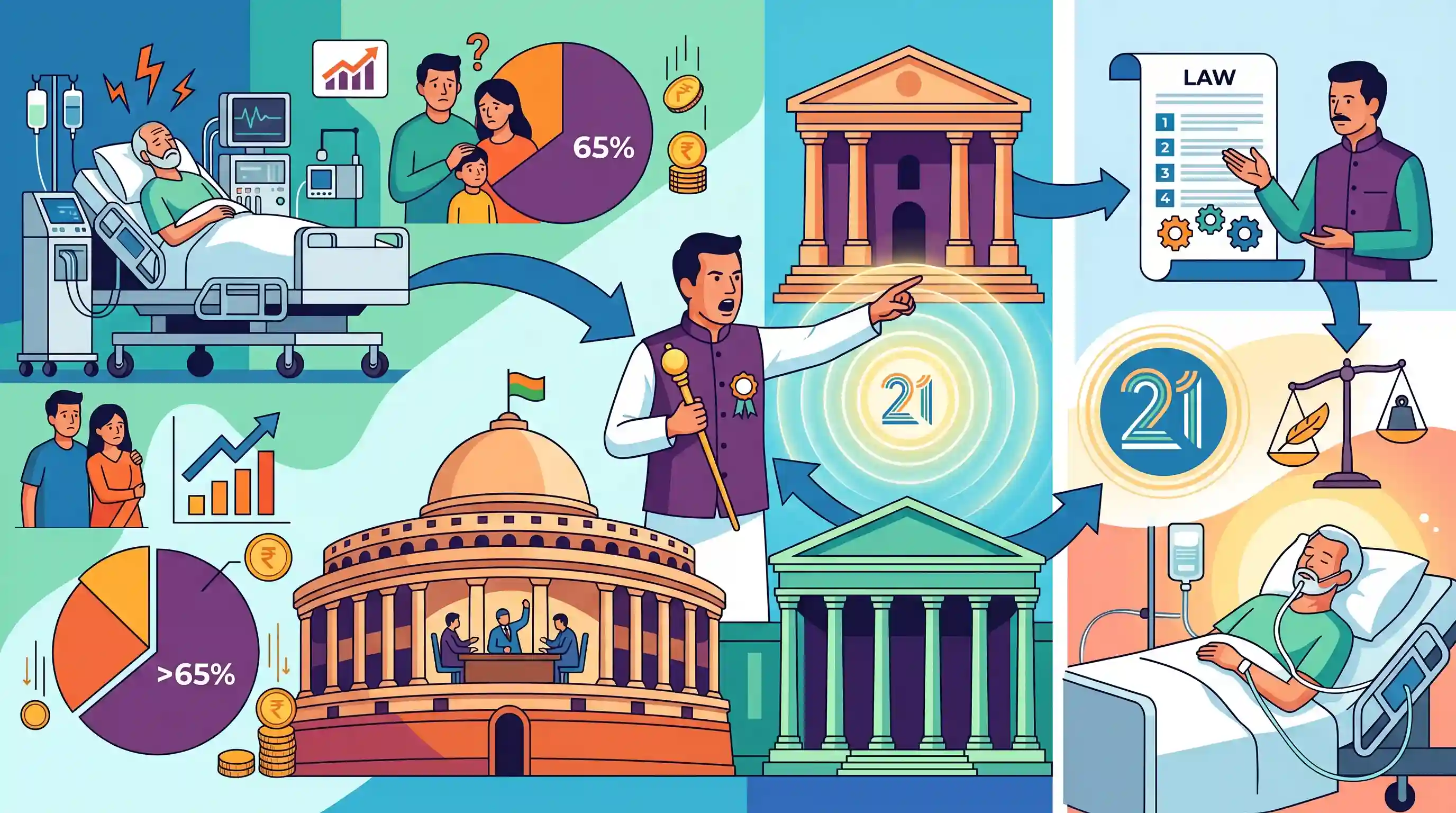
A Rajya Sabha MP has called for the urgent enactment of a law concerning end-of-life care for terminally ill patients, citing the model bill proposed in the 196th Law Commission Report. Highlighting the severe emotional and financial distress caused by prolonged life support—where out-of-pocket healthcare expenses exceed 65% in India—the MP stressed the need for clear legislative guidelines on passive euthanasia. Pointing to the Supreme Court's continuous expansion of Article 21 to cover the right to die with dignity, the MP warned against over-reliance on the judiciary and urged Parliament to fulfill its legislative duty.
Key Points
- A Rajya Sabha MP has urged the Central government to enact a dedicated law regulating end-of-life care and passive euthanasia for terminally ill patients.
- The MP highlighted that the Law Commission's 196th Report in 2006 had already drafted a model bill on the subject which remains unpassed.
- The lack of clear legislation forces families to bear immense emotional and financial burdens, with over 65% of India's healthcare expenditure paid out-of-pocket.
- While the Supreme Court has permitted passive euthanasia under Article 21 in specific cases (like the recent Harish Rana case), the MP argued that Parliament must step in to prevent judicial overreach.
Important Terms
Medical Treatment of Terminally Ill Patients Bill

A proposed legislative framework aimed at protecting terminally ill patients' rights to refuse treatment and shielding medical practitioners from liability when withdrawing life-sustaining measures.
UPSC context
GS Paper II: Government Policies and Interventions. Important for understanding legislative gaps in end-of-life care and healthcare ethics.
Article 21 (Right to Die with Dignity)
Constitutional provision for Right to Life, interpreted by the Supreme Court to include the 'Right to Die with Dignity' and the right to refuse futile medical treatment.
UPSC context
GS Paper II: Constitution and Fundamental Rights. Tests knowledge of judicial activism and the expansion of the Right to Life.
Passive Euthanasia
The intentional withholding or withdrawal of life-prolonging medical treatment (like ventilators or feeding tubes) to allow a terminally ill patient to die naturally.
UPSC context
GS Paper II & IV: Social Justice and Ethics. Concerns the legal status of end-of-life care and ethical dilemmas in medicine.
Living Will (Advance Medical Directive)
A legal document in which an individual specifies their medical treatment preferences in advance, should they become mentally or physically incapacitated in the future.
UPSC context
GS Paper II: Governance and Judiciary. Tests understanding of the 'Common Cause' judgment (2018) and patient autonomy.
Out-of-Pocket Expenditure (OOPE)
Direct healthcare payments made by households at the time of service, which in India remains high (around 61-65%), often causing catastrophic financial distress.
UPSC context
GS Paper III: Indian Economy and Public Health. Tests awareness of healthcare financing and socio-economic barriers to universal health.
196th Law Commission Report
A landmark 2006 document that recommended legalizing the withholding of life support for terminally ill patients, forming the basis for subsequent legislative drafts.
UPSC context
GS Paper II: Statutory Bodies. Tests knowledge of the Law Commission's role in recommending legal reforms on sensitive social issues.
Prelims Trap
Both active and passive euthanasia are legally permitted in India under Article 21 through a Parliamentary Act.
Active euthanasia remains completely illegal in India. The Supreme Court only permitted passive euthanasia (withdrawing life support) and Advance Directives under Article 21, and Parliament has yet to pass a statutory law.
Static Concepts Connected
How has the Supreme Court interpreted the Right to Die under Article 21?
- Gian Kaur Case (1996): The SC held that the 'Right to Life' does not include the 'Right to Die', upholding the constitutional validity of IPC Section 309 (attempt to suicide).
- Common Cause Case (2018): The SC recognized the 'Right to Die with Dignity' as a fundamental right, legalizing passive euthanasia and Advance Medical Directives (living wills) under strict guidelines.
- Active vs. Passive: Active euthanasia (lethal injection) is illegal. Passive euthanasia (withdrawing/withholding life-sustaining treatment) is legally permissible.
What is Judicial Legislation in the context of Separation of Powers?
- Constitutional Bridge: When Parliament fails to enact laws on crucial rights, the Judiciary issues binding guidelines (e.g., Vishaka guidelines, Euthanasia rules) to fill the vacuum.
- Separation of Powers: Prolonged reliance on court-mandated rules without legislative backing raises concerns of judicial overreach, blurring the lines of the Doctrine of Separation of Powers.
Cross-Topic Patterns
Article 21 meets Out-of-Pocket Health Expenditure
The passive euthanasia debate is deeply linked to India's Out-of-Pocket Expenditure (OOPE). Prolonged life support forces families into catastrophic health expenditures, making the 'Right to Die with Dignity' a critical health-economics issue.
Law Commission reports & Legislative Inertia
Like the 196th report on terminally ill patients, numerous Law Commission drafts remain unpassed. UPSC often tests these in Mains to highlight legislative inertia and the resulting reliance on judicial guidelines.

Expect a 2026 Prelims statement on Advance Medical Directives, or a Mains Q on judicial guidelines filling legislative vacuums.
Linked PYQs · 3
Linked PYQs · 3
- 2023MainsGS2
“The Constitution of India is a living instrument with capabilities of enormous dynamism. It is a constitution made for a progressive society.” Illustrate with special reference to the expanding horizons of the right to life and personal liberty.
- 2024MainsGS2
In a crucial domain like the public healthcare system the Indian State should play a vital role to contain the adverse impact of marketisation of the system. Suggest some measures through which the State can enhance the reach of public healthcare at the grassroots level.
- 2020MainsGS2
Judicial Legislation is antithetical to the doctrine of separation of powers as envisaged in the Indian Constitution. In this context justify the filing of large number of public interest petitions praying for issuing guidelines to executive authorities.
